An Introduction to
Design Thinking
Design Thinking
Business Value Creation with IT (BVC)
Neu-Ulm University of Applied Sciences
April 6, 2026
What is design?
aesthetics
event
product
experience
Design is
a process …
… based on these mindsets.
Human-centered
Understand people in context — focus on how they do things and why, their physical and emotional needs, how they think about the world and what matters to them.
Collaborative
Focus on diversity — bring people with different backgrounds and experiences together to really understand a problem and evolve a solution.
Experimential
Embrace experimentation — prototyping helps you learn and think — taking action on an idea to understand it better, validating it or gaining evidence of the right solution.
Iterative
Refine relentlessly — circle back, reassess assumptions, and evolve your solution through continuous feedback and learning.
Action-oriented
Make it real - transform ideas into tangible prototypes that can be tested, experienced, and refined in the physical world.
Design Thinking process
Design thinking is the way designers think: the mental processes they use to design objects, services or systems, as distinct from the end result of elegant and useful products.
Design thinking results from the nature of design work: an interdisciplinary and projectbased work flow around “wicked” problems.
- Solving complex problems
- Holistic perspective
- Consideration of the interests of as many stakeholders as possible
The process
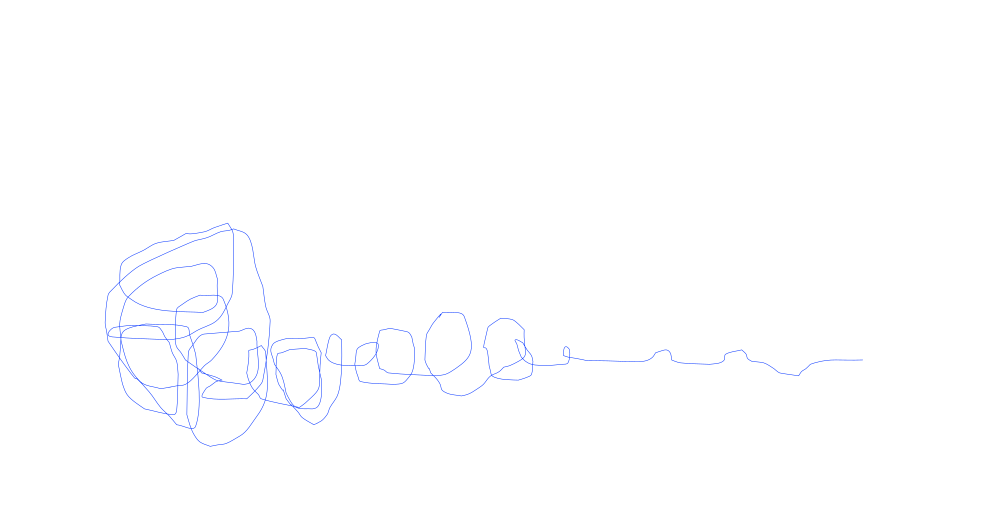
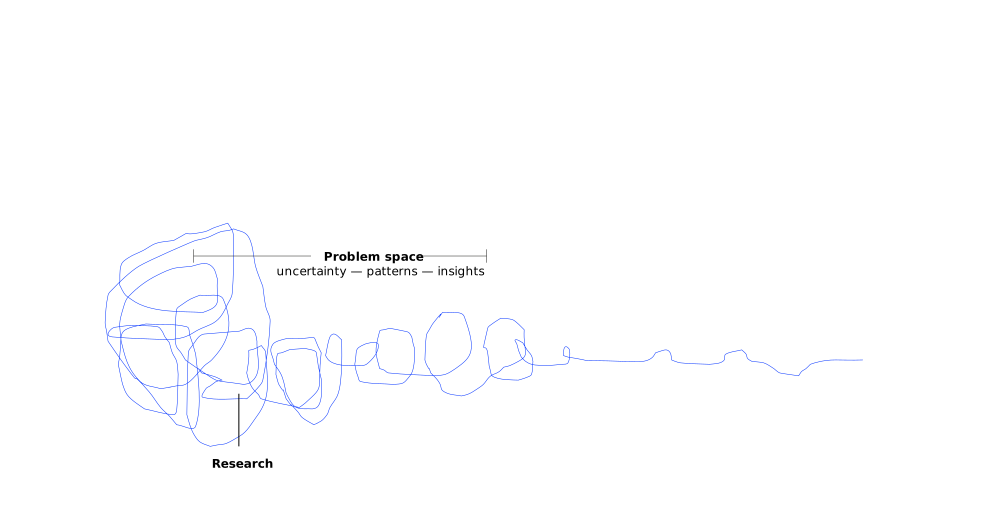
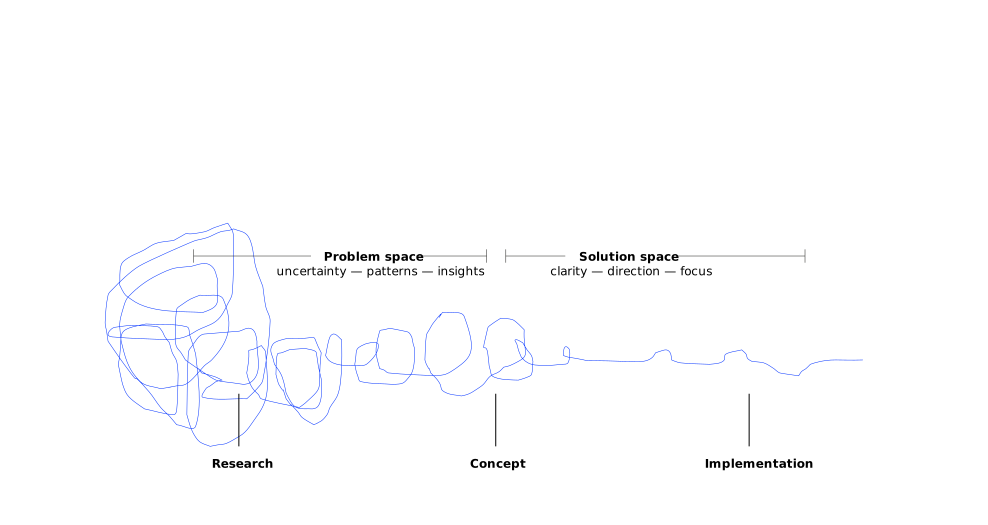
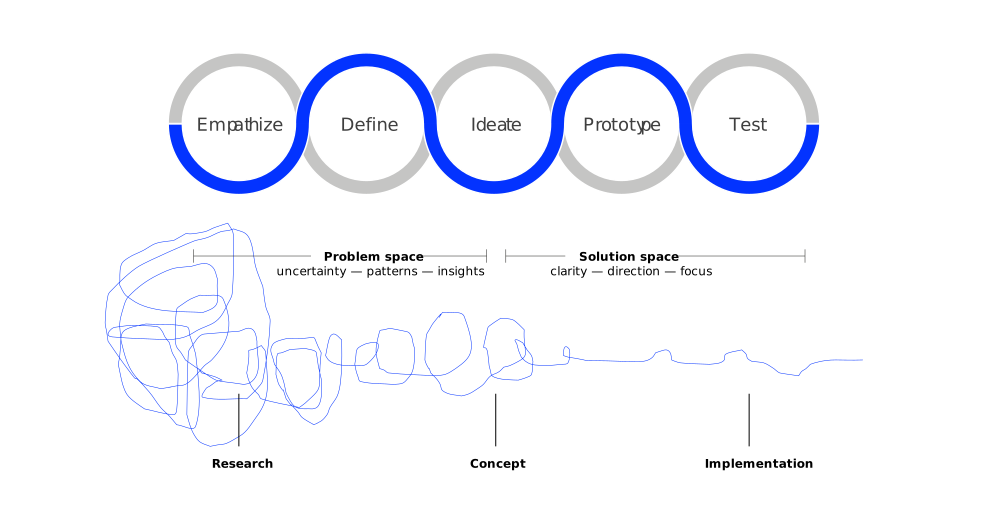
Designers can imagine the world from multiple perspectives – those of colleagues, clients, end users, and customers (current and prospective).
Emphasize
We want to guide innovation efforts, find out everything about our customer or user and understand their problem as well as uncover even latent needs and desires.
We can use Stakeholder Mapping, Why-How Laddering, and Jobs to be Done.
Emphasize — Stakeholder Mapping
Stakeholder mapping is the process of identifying a system of parties involved and interested in a particular outcome or product and their relations to one another.
Stakeholder maps create a solid foundation for user-centered design as they
- visualize and communicates the different parties involved and
- show hierarchies, key relationships, interests, problems, perspectives, etc.
Start with a simple brainstorming and organize your results in a comprehensive map.
Emphasize — Why-How Laddering
Why-How Laddering is a powerful technique used to explore both the deeper purpose (the “why”) and practical implementation (the “how”) of concepts or problems.
- Moving up the ladder (why questions):
When you ask “Why?” you move up to more abstract, purpose-driven thinking. - Moving down the ladder (how questions):
When you ask “How?” you move down to more concrete, implementation-focused thinking.
For each need, ladder up by asking why until you reach an abstract need. Climb back down the ladder asking how to address the need.
This helps you to connect tactical actions to strategic purpose, identify whether you’re solving the right problem, reveal assumptions that might need challenging and provide multiple entry points for solution development.
Emphasize — Why-How Laddering (Example)
We need to increase electric vehicle adoption.
Why?
Up the ladder:
- … to reduce transport emissions
- … to mitigate climate change
- … to ensure a sustainable future for people and ecosystems
How?
Down the ladder:
- … by making EVs more affordable
- … by reducing battery production costs
- … by scaling battery R&D and manufacturing
Emphasize — Jobs to be Done
People don’t buy products or services — they “hire” them to make progress on a job in a specific situation.
- Functional dimension: the practical task to accomplish
- Emotional dimension: how the user wants to feel while doing it
- Social dimension: how they want to be perceived by others
The job is the unit of analysis — not the user segment, not the product feature.
This applies equally to external customers and internal stakeholders, making it directly useful for IT and process innovation challenges.
Emphasize — Job Statement
When [SITUATION], I want to [MOTIVATION / PROGRESS], so I can [OUTCOME].
Today I “hire” [CURRENT WORKAROUND] to do this job, but it falls short because [FRICTION].
Workarounds are the key signal: shadow Excel sheets, side Slack channels, and informal “ask Klaus” chains reveal exactly where progress is blocked.
A well-written job statement is essentially a pre-formed POV — feed it directly into the Define phase.
Emphasize — Jobs to be Done (Example)
Weak / generic
A production engineer needs better data access because data is fragmented.
Sharp / JTBD-style
When scrap rates spike on line 3 mid-shift, I want to correlate machine telemetry with the last quality check and the current alloy batch, so I can decide within one shift whether to stop the line or adjust parameters. Today I ‘hire’ a colleague in IT plus three Excel exports to do this job, but by the time I have an answer the shift is over.
The second framing makes the solution question answerable on the basis of which option gets the job done fastest — better SAP reporting, a departmental data mart, or an LLM-over-existing-sources approach — rather than which has the most features.
If I had one hour to solve a problem, I would spend the first fifty-five minutes thinking about the problem and five minutes thinking of the solutions. Albert Einstein
Define
We want to synthesize findings from the previous step, identify a specific and meaningful challenge to tackle, and create an actionable problem statement.
We can use a Point of View (POV) Madlib to synthesize our findings into a problem statement that defines the challenge, and then transform this into How Might We (HMW) questions that open up opportunity spaces for ideation throughout the design process.
For further tools see bootcamp bootleg (Plattner, 2010)
Define — POV Madlib
[USER] needs to [USER’S NEED] because [SURPRISING INSIGHT].
Use a whiteboard or scratch paper to try out a number of options, playing with each variable and the combinations of them.
The need and insight should flow from your unpacking and synthesis work.
For example, instead of “A teenage girl needs more nutritious food because vitamins are vital to good health” try “A teenage girl with a bleak outlook needs to feel more socially accepted when eating healthy food, because in her hood a social risks is more dangerous than a health risk.” (Plattner, 2010)
Define — How Might We (HMW)
How might me [ACTIONABLE PIECE] for [USER] in order to [NEED]?
The POV statement keeps you anchored to the core problem, while HMW questions open up thinking about potential solutions without losing sight of that problem.
- Begin with your POV or problem statement (user and need)
- Generate as many potential HMWs as you can
- Group and theme HMWs
- Vote and/or select the top HMW question to anchor your project
The ideate phase represents a process of “going wide” in terms of concepts and outcomes — it is a mode of “flaring” rather than “focus.”
The goal of ideation is to explore a wide solution space both a large quantity of ideas and a diversity among those ideas (Plattner, 2010).
Ideate
We want to progress from defining problems to exploring solutions, spark creativity and innovation, move beyond the expected, and exploit the multiplicity of perspectives in your team.
We can use different brainstorming and brainwriting methods to create and evaluate ideas.
Ideate — Visual Brainstorming
Visual brainstorming uses visualization as a tool to organize information, capturing ideas by using something like a mindmap.
- Write your problem statement in the middle.
- Write all your ideas around it can connect it to the statement like in a mind map.
- Continue ideation phase — go back through all of your ideas and write down every thought you have in connection to them, how they maybe relate to each other, support them with visuals, expand upon them etc.
- Go through each of your ideas again and try to determine elements that are sticking out and color them.
- Organize your ideas. E.g., create a summary in form of a text document, a more organized mind map etc.
Prototype
We want to learn and eliminate ambiguity, fail quickly and cheaply by testing a number of ideas, refine solutions with users, and inspire others by showing your vision.
We can use multiple methods such as paper prototyping, physical prototyping, click-dummies or even tools like LCDP.
Test
We put our ideas into the appropriate context to improve and understand the variables, evaluate and refine the idea, and receive constructive feedback
Methods such as pitch, lean startup, surveys (quantitative and qualitative), 4-quadrant test and many more are suitable for testing our ideas and prototypes.
Aim of todays workshop
Narrow down the problem space of your challenge
- Iterate through the emphasize, define, and ideate phases.
- Get in touch with the challenge givers and get answers to your questions (1.00 pm).
- Use the tools and templates presented or find others online.
- Upload the results of today’s workshop (at leat your POVs and HMW questions).
- Optional: ask for feedback (I will walk around)
We spend a lot of time designing the bridge, but not enough time thinking about the people who are crossing it. Dr. Prabhjot Singh, Director of Systems Design at the Earth Institute
If you can dream it,
you can do it. Walt Disney