Pitch
How to sell your solution convincingly?
Neu-Ulm University of Applied Sciences
May 18, 2026
Learning objectives
After this session, you should be able to:
- Explain why a convincing pitch starts with the problem, not the solution.
- Recognise the two failure modes of a pitch and how to avoid them.
- Translate your in-depth research into a problem statement decision-makers recognise as their own.
- Apply the modes of persuasion, the four truths of a story, and the narrative map to structure your pitch.
- Anticipate decision-makers’ questions and rehearse your answers.
Agenda
- Warm-up 10 min
- Setting the scene 10 min
- Ways to lose the audience 10 min
- Problem first 30 min
- Break
- Persuasion & narrative map 30 min
- Delivery & evaluation 10 min
- Wrap-up 5 min
- Q&A 15 min
Warm-up
A pitch that stuck
Think of a pitch you remember.
In pairs, share one pitch (a product, a project, an idea) that genuinely convinced you, or one that visibly failed to convince its audience.
What made it stick, or fall flat?
05:00
Introduction
Relevance
Great ideas are a dime a dozen. What separates the dreamers from the doers is the ability to convince others to get behind the idea. This could mean securing funding, getting buy-in from colleagues, or attracting customers.
Without that ability to sell,
your ideas are likely to stay just that: ideas.
Setting
This is your unique opportunity to present your idea to the board.
You have 12 minutes to raise the funds for the market-ready development of your solution.
Decision-makers will judge your solution along three dimensions:
- desirable (it sufficiently addresses relevant parts of the challenge),
- viable (it creates business value for the company), and
- feasible (it can be implemented within a reasonable timeframe).
One instance of a wider skill
The board is your audience for this exam.
It is not the only audience this skill serves.
The same logic applies whenever you pitch to people who decide:
- investors deciding whether to fund a venture,
- executives deciding whether to back an initiative,
- clients deciding whether to engage you, and
- hiring committees deciding whether to bring you on.
Throughout this unit, decision-makers refers to the general role; the board refers to your specific audience on pitch day.
Two ways to lose the audience
The asymmetry
You have (hopefully) spent weeks on the problem.
Your audience will spend minutes on it.
Your group has investigated the challenge, talked to stakeholders, and tested ideas. Decision-makers have not, or have done so under very different conditions.
That gap is your central communication problem.
Two failure modes
Problem understanding fails
Even the best solution lands in a vacuum. Decision-makers never feel the pain your solution would solve.
Solution falls short
A sharp problem framing raises expectations. A weak solution then disappoints decision-makers twice: once for the problem, once for itself.
Implication
You have to earn the right to talk about your solution.
The price of admission is a problem framing decision-makers recognise as their own.
This is also why the first minutes of the pitch are disproportionately important. You earn (or fail to earn) the right to spend the remaining ten minutes on your solution within the first two.
Practically, this changes how you draft the deck. Most student groups start with the solution slides because that is where they have invested the most effort. Draft the problem slides first, get them right, and only then build the solution slides to match.
Problem first
Make the problem stick
Make your
problem statement
stick.
Demonstrate understanding of the stakeholders, their values, and their interests before you offer a solution.
A workable template
Based on the tools and templates discussed so far, you could use the following template to formulate your problem statement:
For [stakeholder], who [situation/pain],
the challenge is [problem].
If unresolved, [consequence].
[Decision-makers] care because [their priority].
On point; no jargon; no solutioning yet.
Whose problem?
- Whose pain is sharpest?
- Whose authority releases the budget?
- Whose support do you need after the pitch?
These are often three different people.
Lead with the first; address the second; do not forget the third.
Decision-makers see a slice
Your map of the problem and the one decision-makers carry into the room rarely overlap.
Side by side, the gap looks like this:
What you know:
- Full problem space
- Multiple stakeholder views
- Trade-offs explored
- Dead ends ruled out
What decision-makers care about:
- A few prioritised dimensions
- Strategic fit
- Speed and cost
- Risk
Connect their slice back to your depth, not the other way around.
Exercise: problem-statement sprint
Sharpen the problem your audience will hear first.
In your project group, run three rounds:
- Draft (4 min): each member writes the problem statement using the template, individually.
- Compare (3 min): read all drafts aloud. Mark the clauses that disagree.
- Refine (3 min): agree on the version your team will lead with on pitch day.
Be ready to send me your statement to the plenary at the end.
10:00
Persuasion
Modes of persuasion
Aristotle suggested that any spoken or written communication intended to persuade contains three key rhetorical elements:
Logos
Appeals to the audience’s reason, building up logical arguments.
Ethos
Appeals to status or authority so that listeners trust the speaker.
Pathos
Appeals to the emotions, e.g., making the audience feel concerned or hopeful.
Four truths of a story
Guber (2007) argues that a story persuades when it carries four truths:
- Truth to the teller: you must believe your own problem framing.
- Truth to the audience: speak to decision-makers’ priorities, not yours.
- Truth to the moment: the time you have, the room you are in, the decision pending.
- Truth to the mission: anchor your idea in business value creation, not in the elegance of the technology.
Story elements
Behind every good story is a well-thought-out structure that forms its backbone. The essential elements are:
Characters
Setup or conflict
Sequence of events (plot)
Resolution
Narrative map
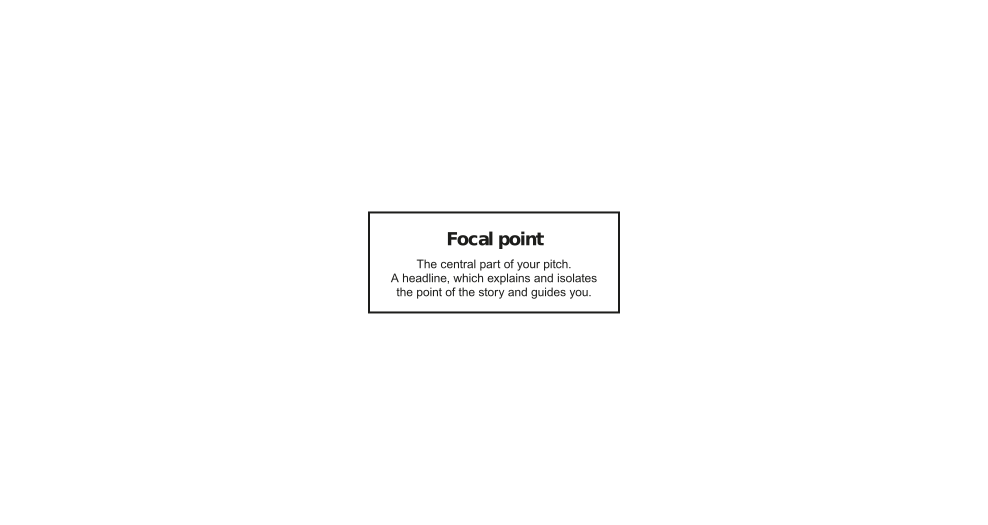
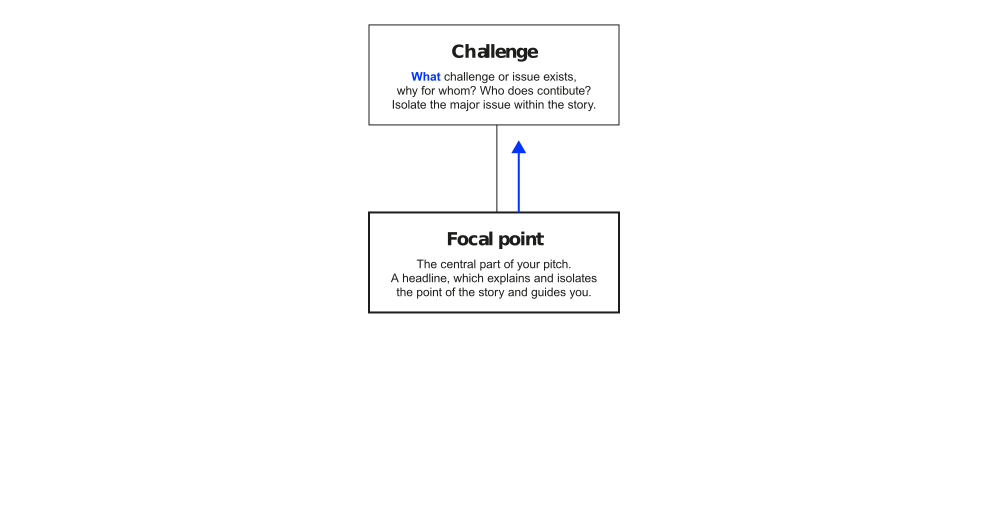
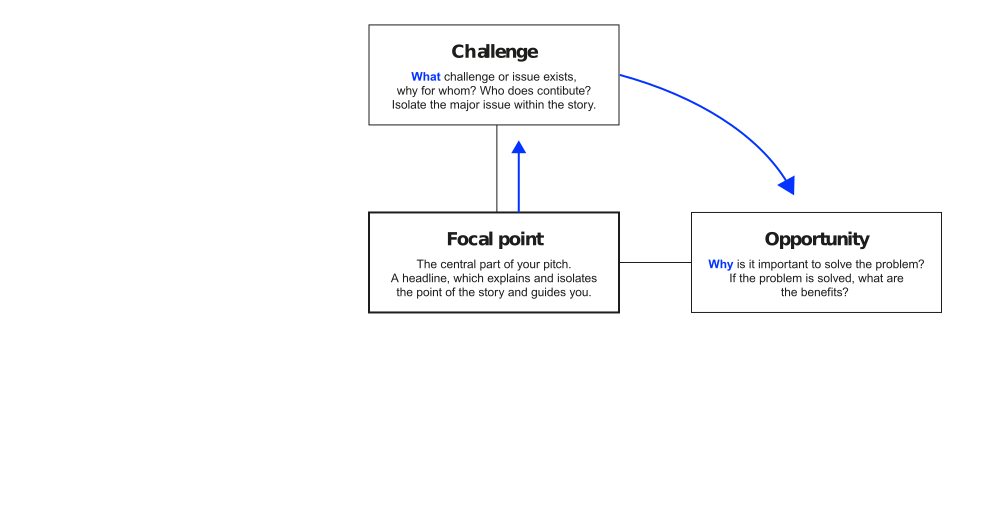
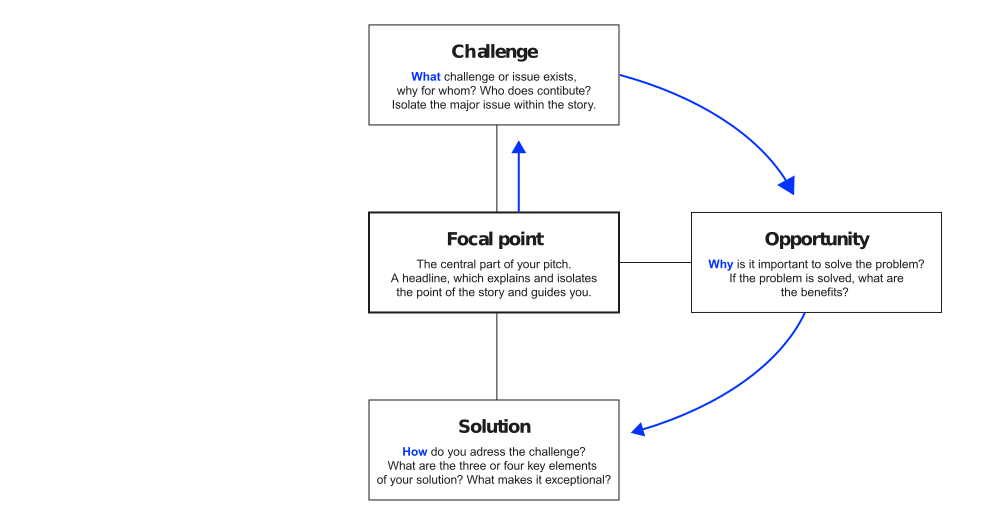
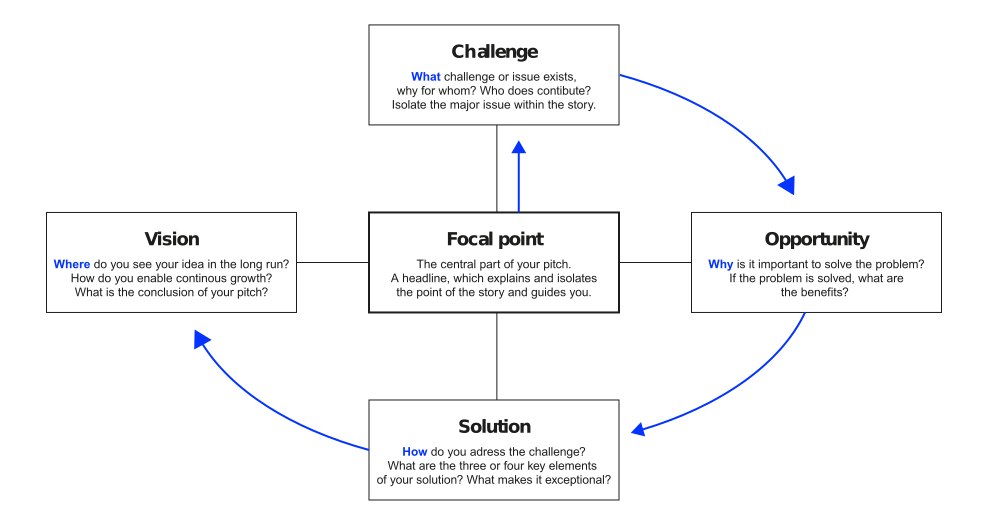
Exercise: narrative-map sprint
Build the backbone of your pitch.
In your project group, fill in the narrative map for your own pitch. Work on a single sheet or shared canvas; keep each element to one or two sentences.
- Focus: what is your pitch fundamentally about? Not the technology; the value at stake.
- Conflict / challenge: the problem and why it persists.
- Opportunity: what changes once decision-makers act.
- Approach: how you get there in practice.
- Resolution: what success looks like, and for whom.
Your map stays inside the group; nothing is shared with the plenary.
15:00
Delivery
Show, don’t tell
Show, don’t tell.
- Use valid facts and figures.
- Demonstrate your prototype rather than describe it.
- Make the value proposition tangible: a number, a workflow, a screen.
Sell yourself
When you are selling your idea,
the audience must first buy you.
Make sure the audience trusts that you have recognised the problem correctly and can lead the solution to success.
Look ahead
Everything starts with an idea,
but this is only the beginning.
Present a roadmap: a plan for translating the idea into actions and results.
Time budget
A defensible default split for a 12-minute pitch:
| Section | Time |
|---|---|
| Hook and problem | 3 min |
| Approach and solution | 3 min |
| Prototype demo | 3 min |
| Value, roadmap, ask | 2 min |
| Buffer | 1 min |
Evaluation criteria
The main criterion is how convincing your pitch and solution are.
In addition, we look at:
- The problem is clearly and comprehensively defined, with a strong understanding of the stakeholder(s) and their needs.
- The proposed approach to value creation is logical, complete, and well aligned with the problem and stakeholder needs.
- The solution is well developed, addresses the problem effectively, and reflects the characteristics of a viable MVP.
- The team communicates clearly, confidently, and professionally, telling a convincing story and using effective visuals.
- The presentation is well structured with clear flow, transitions, and effective use of time.
- The presentation is free from language, spelling, or formatting errors and demonstrates high attention to quality.
Key takeaways
- Problem first: You earn the right to talk about your solution by framing the problem in a way decision-makers recognise.
- Mind the asymmetry: You see the full problem; decision-makers see the slice that matches their priorities, or hold a different framing of their own. Lead with their view; back it with your depth.
- Two failure modes: A weak problem kills any solution; a strong problem framing raises the bar your solution must meet.
- Story moves money: Modes of persuasion, four truths, and the narrative map are deliberate tools, not decoration.
- Rehearse the questions: The pitch is often decided in Q&A, not in the prepared minutes.