Mobility and Ubiquity
Emergent Technologies & Media (ETM)
Neu-Ulm University of Applied Sciences
September 23, 2025
Revision
Characteristics of emerging technologies
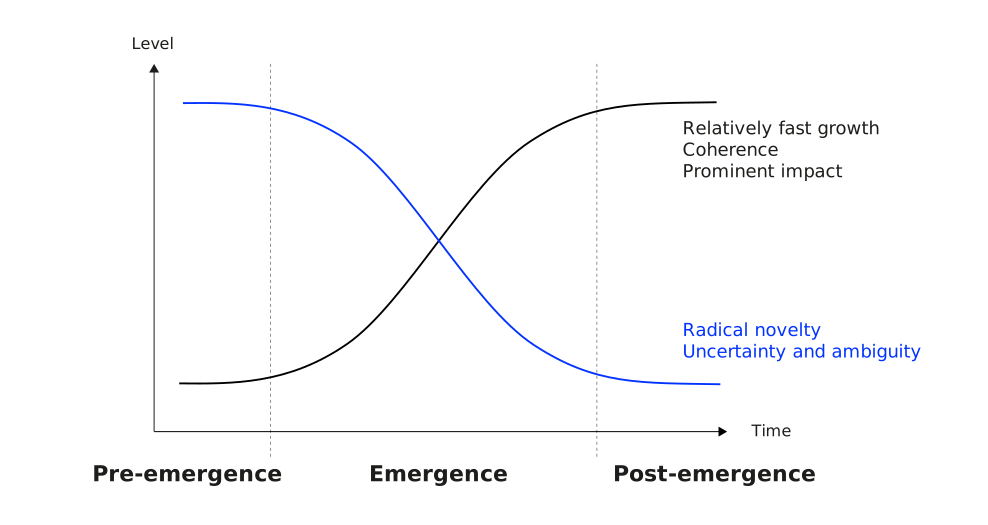
Rotolo et al. (2015) outlines five attributes that classify emerging technologies and differentiate them from other technologies:
- Radical novelty
- Relatively fast growth
- Coherence
- Prominent impact
- Uncertainty and ambiguity
Stages of emergence
Interconnectedness
Interconnectedness refers to a formal linkage between two different systems.
Computer networks reflect a collection of computers and devices connected so that they can share information and services. They, thus, are the clue of (interconnected) information systems.
Effects
Emergent digital technologies facilitate more strongly interconnected systems, as they enhance
networking infrastructure, connectivity capabilities, and interoperability (e.g. through standardization).
Examples of emergent technologies driving interconnected systems are
5G and IoT ecosystems (e.g., Matter smart homes) and cloud-native microservices architectures (e.g., containers and orchestration platforms)
Distributed systems
A distributed system is a collection of independent computers that appear to its users as a single coherent system.
The independent computers, also known as nodes, communicate and coordinate their actions by passing messages as they do not share a common memory.
Effects
Emergent digital technologies drive and are driven by distributed systems as they they provide the necessary infrastructure for e.g.,
scalability and efficiency, fault tolerance and reliability, real-time processing, data privacy and security, and cost-effectiveness.
Examples: Edge computing, distributed AI/ML, distributed ledger technologies and consensus algorithms, and serverless computing
As digital technologies continue to evolve, the role of distributed systems will only become more critical in enabling innovative applications and services across various industries.
Hypothesis 4
Emerging information technologies enable mobile and ubiquitous systems.
Mobility
Discussion
How would your life look like without a mobile phone?
For which tasks and activities do you heavily rely on mobile computing?
Imagine what you would do if you would not have access to a smartphone.
10:00
Definition
Mobile computing
Using portable devices in wireless-enabled networks to perform computational tasks and access network services on the move (e.g., anyplace, and anytime)
Discussion
What marks the breakthrough of mobile computing?
Key components
Mobile computing is not simply a miniaturisation of conventional computer technology. It is a complex ecosystem with several key components as enablers:
Mobile devices, wireless networks, mobile first operating systems, mobile applications, and the related ecosystems (e.g., app stores, edge computing).
Exercise
Select on of the sectors listed below and work on following tasks:
- Identify three ways mobile computing has already transformed their assigned sector.
- Predict two significant changes that will likely occur in their sector in the next years based on emerging mobile technologies.
- Propose one innovative mobile solution to an existing challenge in their sector.
Be prepared to present your findings.
Sectors: healthcare, education, retail, transportation, finance/banking, entertainment, agriculture, manufacturing, and tourism
20:00
Effects
As an emerging technology, mobile computing has had a significant impact on multiple levels and undoubtedly transformed our lives.
Increased productivity, improved communication and collaboration, enhanced access to information and entertainment, and new business models and social interactions.
Challenges
However, mobile computing also comes with some challenges:
Digital divide, security vulnerabilities, health concerns, and impact on social interactions.
AI x XR x Mobile Computing
Reflection
Will AR glasses become the next primary computing platform?
- What technological hurdles still need to be overcome before AR glasses could replace smartphones as our primary computing device?
- Which tasks that would be fundamentally transformed if AR glasses became our primary computing interface?
- How might widespread adoption of AR glasses affect social interactions, privacy, and the challenges we’ve discussed?
Discuss the questions in small groups and be prepared to present and discuss your findings.
20:00
Summary
Mobile computing established the behavioral and infrastructural foundations for pervasive digital environments:
Portability, always-on connectivity, context introduction, ecosystem model, and user adaptation.
Ubiquity
Definition
Ubiquitous computing integrates computation into the environment, rather than having computers which are distinct objects.
The most profound technologies are those that disappear. They weave themselves into the fabric of everyday life until they are indistinguishable from it. Mark Weiser, American computer scientist and chief technology officer (CTO) at Xerox PARC
Characteristics
Ubiquitous computing (UC), also known as ubicomp, is characterized by several key features that differentiate it from traditional computing:
Invisibility, context-awareness, connectivity, and situated and proactive interaction.
Evolution
From mainframe
to personal computer
to ubiquitous computing.
Mainframe: one computer shared by many people
Personal computer (PC): one computer, one person
Ubiquitous computing (UC): lots of computers, used by individual users, partly shared
UC systems
Ubiquitous computing systems rely on tiny computing devices which vanish into the environment1 and adapt dynamically to it.
These tiny computers need to be…
- networked, distributed, and transparently accessible,
- context-aware to optimize their operation in the respective environment,
- capable of acting autonomously, without human intervention, and
- able to manage a variety of dynamic activities through intelligent decision-making.
UC vs. virtual reality
Ubiquitous computing is roughly the opposite of virtual reality.
Example
Exercise
What are other examples of ubiquitous computing?
Reflect the characteristics and name the main technological enablers.
15:00
Context
Context is any information that can be used to characterize the situation of an entity.
An entity is a person, place, or object that is considered relevant to the interaction between a user and an application, including the user and applications themselves.
Context-aware computing
A system is context-aware if it uses context to provide relevant information and/or services to the user, where relevancy depends on the user’s task.
Following contexts need to be considered:
user context, environmental context, social context, and service context.
Discussion
How is context-awareness implemented in your example(s)?
Summary
As computing devices fade into the environment, the underlying infrastructure remains—and scales.
Miniaturization, connectivity, software orchestration, sensing, and cloud and analytics.
Synthesis
Two paradigms, one trajectory
Mobile computing and ubiquitous computing represent two evolutionary stages in the relationship between humans and technology.
Mobile Computing
- Focus: Device portability
- User attention: Explicit interaction
- Model: Anywhere, anytime
- Visibility: Device-centric
- Context: User carries context
Ubiquitous Computing
- Focus: Environmental integration
- User attention: Implicit, ambient interaction
- Model: Everywhere, all the time
- Visibility: Invisible
- Context: Environment provides context
From mobility to ubiquity
Mobile computing laid the groundwork for ubiquitous computing by normalizing three critical shifts:
- Always-connected expectations
- Mobile computing trained users to expect continuous network access, creating the behavioral foundation for ubicomp environments.
- Context as a design primitive
- Location-aware services on smartphones introduced users to context-sensitive computing, paving the way for richer environmental awareness.
- Distributed ecosystems
- Cloud backends and over-the-air software deployment (e.g., app stores) established the infrastructure patterns that ubiquitous systems now scale across physical environments.
The smartphone as transitional artifact
The smartphone represents a transitional artifact—too visible to be truly ubiquitous, yet too connected to be merely mobile.
- Mobile computing asks: How do we bring computing with us?
- Ubiquitous computing asks: How do we weave computing around us?
The answer is the same infrastructure, different visibility.
As computing disperses into wearables, ambient displays, smart environments, and AI agents, the explicit device fades while the computational layer persists.
Synopsis
Mobile computing established the behavioral and infrastructural foundations—portable devices, wireless networks, app ecosystems, and always-on connectivity. Ubiquitous computing extends this foundation by dissolving the device boundary, weaving computation into the environment through context-awareness, invisibility, and proactive interaction.
Together, they enable and are enabled by information systems characterized by:
Multimodality and immersion, intelligence and affection, as well as interconnectedness and distributivity.
Q&A
Literature
Footnotes
They vanish into the environment due to miniaturization and new materials, for example