Administrivia
Introduction to AI (I2AI)
Neu-Ulm University of Applied Sciences
February 9, 2026
General remarks
Motivation and goals
Artificial Intelligence (AI) is becoming a basic innovation that is developing into a driver of digitalisation and autonomous systems in all areas of life.
- AI will change life, work, the economy and communication in a similar way to the internet.
- The release of openAI’s chatGPT at the end of 2022 was a milestone in the history of AI.
- Since then, most people have realised that AI will soon change the way we learn, work and live.
- But large language models are only one type of AI. There are many other AI types, each with their own applications.
This lecture will give you a clear understanding of different types of AI, what they do, and how they work.
Format of the lecture
This course will use a flipped classroom approach for most lectures: you will prepare the content at home and we will do exercises on site.
The focus of the classes is to briefly introduce major concepts that underpin intelligent systems.
The greatest amount of work is in preparing for and following up lectures in order to become sufficiently familiar with and understand the concepts.
Please prepare your schedule accordingly.
Discussion
What to you expect to learn in this lecture?
Contents
AI is defined here as the study of agents that receive percepts from the environment and perform actions.
In this course, we will
- cover different types of agents (i.e., goal-based and utility-based agents)
- illuminate some concepts and major functions they implement,
- discuss, how to convert these agents into learning agents,
- identify and discuss real life use cases for these agents, and
- have a look at philosophical stances and ethical implications of AI.
Learning objectives
During this course, you should advance your skills in the following areas:
- Understanding of the origins, strengths and limitations of AI
- Basic knowledge of concepts, functions, and use cases of AI
- Basic knowledge of problem-solving algorithms, knowledge representation, probabilistic reasoning, machine learning, and natural language processing
- Capability to apply your knowledge and understanding of AI to different managerial and organizational contexts
- Ability to assess the potential of AI and use it in digital innovations
- Ability to evaluate new information and to question existing assumptions
- Capacity to assess social and ethical implications of AI applications
Supporting literature
Besides the literature cited in the lecture notes, Russel & Norvig (2022) is the recommended accompanying reading for rereading and deepening the concepts
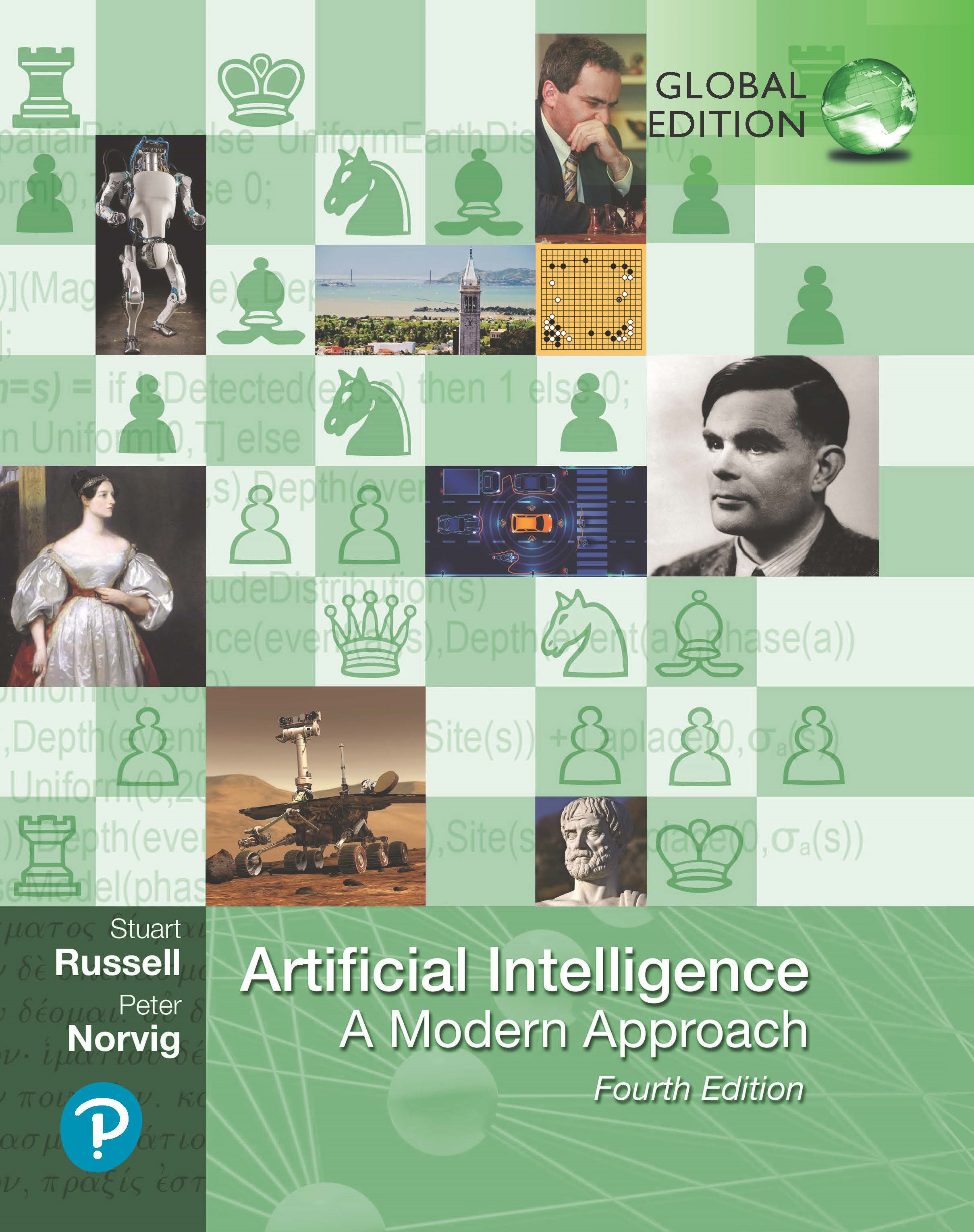
Artificial Intelligence: A Modern Approach, Global Edition, 4/E Russell / Norvig
ISBN-10: 1292401133 • ISBN-13: 9781292401133
The 3rd edition is available in the library
OneTutor
To assess your learning progress and prepare for the exam, you can use OneTutor.
OneTutor is your personal AI tutor that the lecture content and is available 24/7.
- Chat with the lecture notes: ask questions, get explanations, explore concepts
- Test yourself with quizzes: check your understanding and identify gaps
Get started at onetutor.ai.
Exam
There will be a written exam at the end of the semester.
The exam will
- take place during the examination weeks,
- will last 90 minutes,
- cover all contents discussed in lecture,
- focus on the application of the knowledge gained in the course.
Schedule
| Date | Topic | Lecturer | Preparation |
|---|---|---|---|
| 25.03.2026 | Administrivia & Introduction | awe | — |
| 02.04.2026 | Environments & Agents | dj | Lecture notes |
| 09.04.2026 | Search & Planning | awe | Lecture notes |
| 16.04.2026 | Knowledge & Inference | dj | Lecture notes |
| 23.04.2026 | Modelling of Uncertainty I: Probability Theory | awe | Lecture notes |
| 30.04.2026 | Modelling of Uncertainty II: Bayes Net | dj | Lecture notes |
| 07.05.2026 | Machine Learning I: Basic Concepts | awe | — |
| 14.05.2026 | Public Holiday | — | Review contents |
| 21.05.2026 | Machine Learning II: Decision Trees | dj | Lecture notes |
| 28.05.2026 | Witsun Holidays | — | — |
| 04.06.2026 | Witsun Holidays | — | — |
| 11.06.2026 | Machine Learning III: Neural Networks | awe | Article1 |
| 18.06.2026 | Generative Artificial Intelligence | awe | — |
| 25.06.2026 | Governance & Management of AI | dj | — |
| 02.07.2026 | Human-AI Interaction | awe | — |
| 09.07.2026 | Final Q&A & Exam Preparation | — | Questions |
Concluding remarks
Why don’t we focus on ChatGPT et al. only?
Because we are convinced that as a Master of Science in Digital Innovation Management you should understand some of the theoretical (mathematical) foundations of AI. However, you should also acquire practical skills on your own, e.g. in interacting with GenAI2.