Environments & Agents
Introduction to AI (I2AI)
Neu-Ulm University of Applied Sciences
March 12, 2025
Agents
Agency
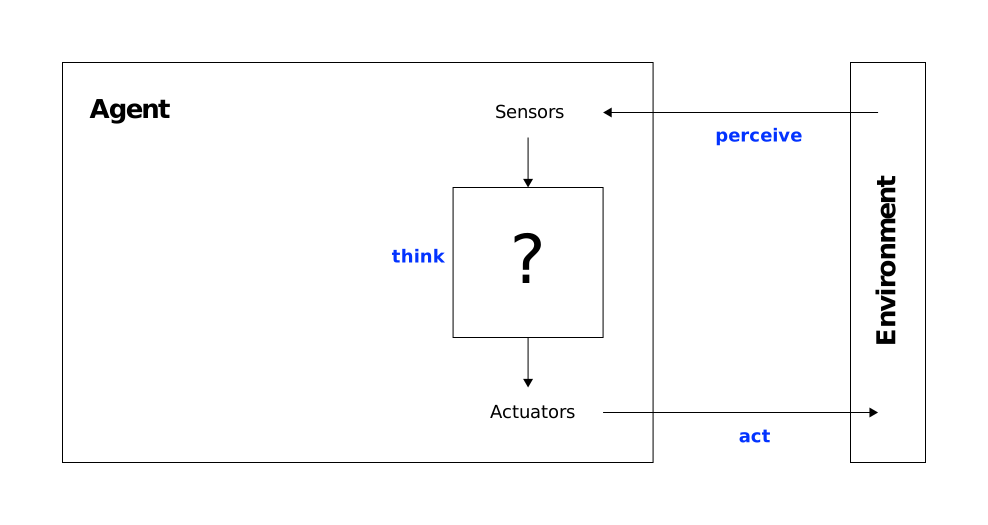
Agency is the capacity of a system to maintain a continuous feedback loop with its environment. Agency requires a mapping of a history of environmental percepts to a sequence of actions designed to achieve a goal or maximize a performance measure (Russel & Norvig, 2022).
Core components
To analyze systems exhibiting agency, we define the following core components. Note that sensors and actuators are part of the agent itself; percept and percept sequence describe what flows in from the environment.
- Agent: anything that perceives its environment through sensors and acts upon it through actuators.
- Sensors: mechanisms (cameras, GPS, microphones) within the agent that receive environmental input.
- Actuators: mechanisms (wheels, display screens, robotic joints) within the agent that execute actions.
- Percept: the agent’s perceptual inputs at any given instant.
- Percept sequence: the complete history of everything the agent has ever perceived; an agent’s choice of action depends on this sequence observed to date.
Architecture
We must distinguish between the abstract logic and the physical implementation:
- Agent function: An abstract mathematical mapping (\(f: \mathcal{P}^* \to \mathcal{A}\)) that describes how any given percept sequence results in an action, where \(\mathcal{P}^*\) denotes the set of all possible percept sequences and \(\mathcal{A}\) the set of all possible actions.
- Agent program: The concrete physical implementation (the actual code) running on a specific architecture.
Rational agents
Exercise
Under which circumstances does a vacuum cleaning agent act rational?
Performance measure
If we use, to achieve our purposes, a mechanical agency with those operation we cannot interfere once we have started it […] we had better be quite sure that the purpose built into the machine is the purpose which we really desire Wiener (1960, p. 1358)
It is difficult to formulate a performance measure correctly.
This is a reason to be careful.
Rationality vs. perfection
Rationality is not the same as perfection.
- Rationality maximizes expected performance.
- Perfection maximizes actual performance.
- Perfection requires omniscience.
- Rational choice depends only on the percept sequence to date.
Performance standards
To understand the engineering limits of rational agents (and the AI systems that implement them) we distinguish between three standards:
| Metric | Definition | Info Requirement | Feasibility |
|---|---|---|---|
| Rationality | Maximizing expected performance | Percept sequence + prior knowledge | High: The engineering standard |
| Omniscience | Knowing the actual outcome of actions | Complete future and present data | Impossible: Requires a “crystal ball” |
| Perfection | Maximizing actual performance | Requires Omniscience | Impossible in unpredictable worlds |
Information gathering & learning
To bridge the gap between initial ignorance and rational behavior, agents must utilize information gathering and learning.
Since agents lack omniscience, they must be designed to:
- Information gathering: take actions specifically to modify future percepts (e.g., looking both ways before crossing a street).
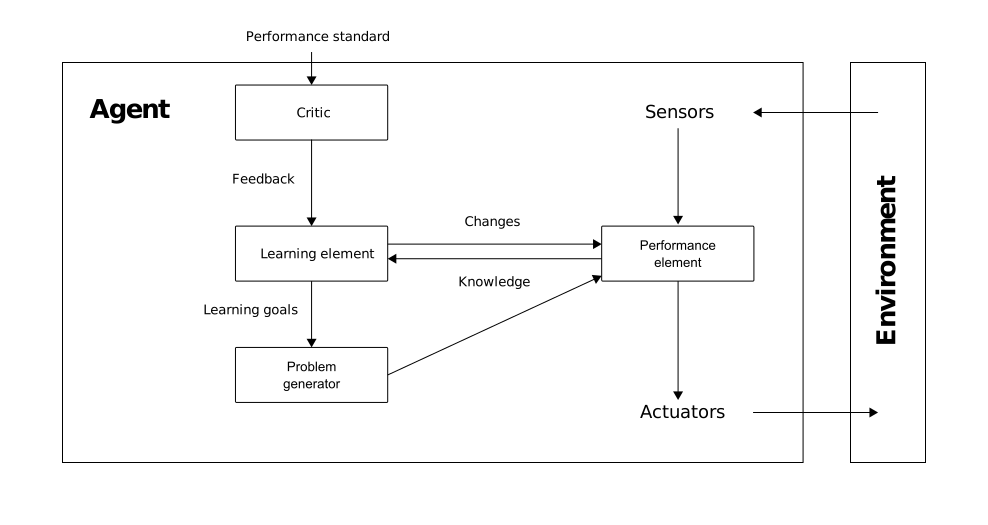
- Learning: modify their internal agent function based on experience to improve performance over time.
As the environment is usually not completely known a priori and not completely predictable, these are vital parts of rationality (Russel & Norvig, 2022, p. 59).
Environments
Specifying the task environment
Before designing an agent (i.e., the solution), the task environment (i.e., the problem) must be specified as fully as possible, including
- the performance measure (P),
- the environment (E),
- the actuators (A), and
- the sensors (S).
Russel & Norvig (2022) uses the short form PEAS to describe these parts of the task environment.
Properties
Task environments can be categorized along following dimensions:
- Fully observable ↔︎ partially observable
- Single agent ↔︎ multi-agent
- Deterministic ↔︎ nondeterministic
- Episodic ↔︎ sequential
- Static ↔︎ dynamic
- Discrete ↔︎ continuous
- Known ↔︎ unknown
The hardest case is partially observable, multi-agent, nondeterministic, sequential, dynamic, and continuous (Russel & Norvig, 2022, pp. 62–64).
Exercise
Describe the task environment of a taxi driver agent.
Agent types
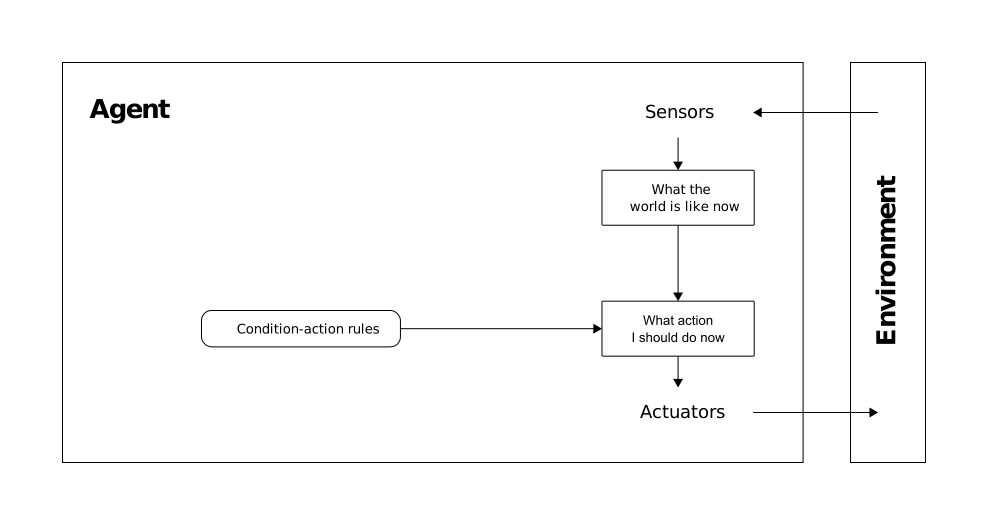
Simple reflex agents
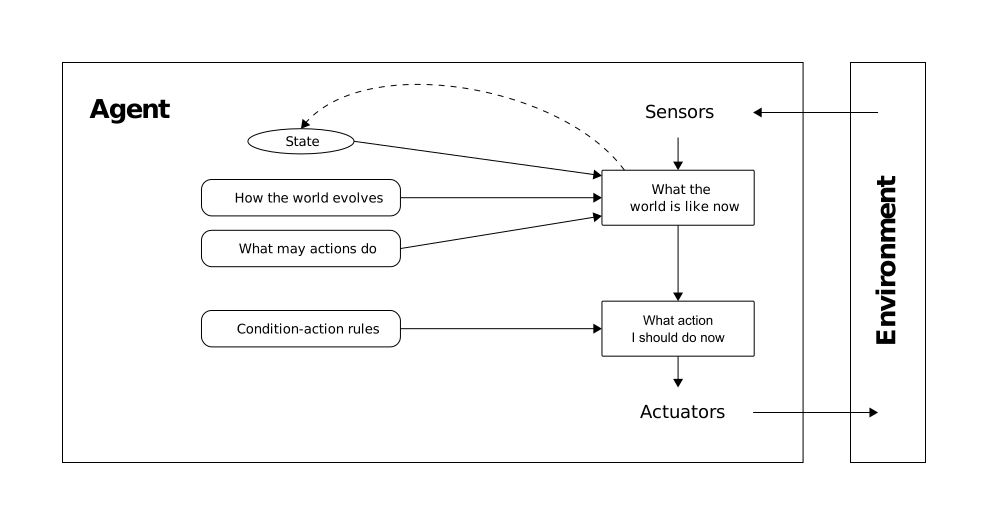
Model-based reflex agents
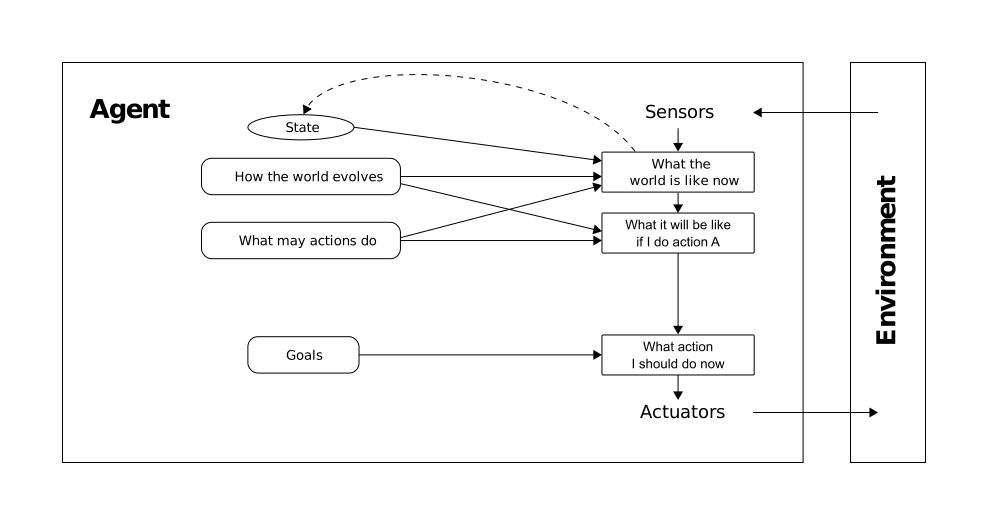
Goal-based agents
Utility-based agents
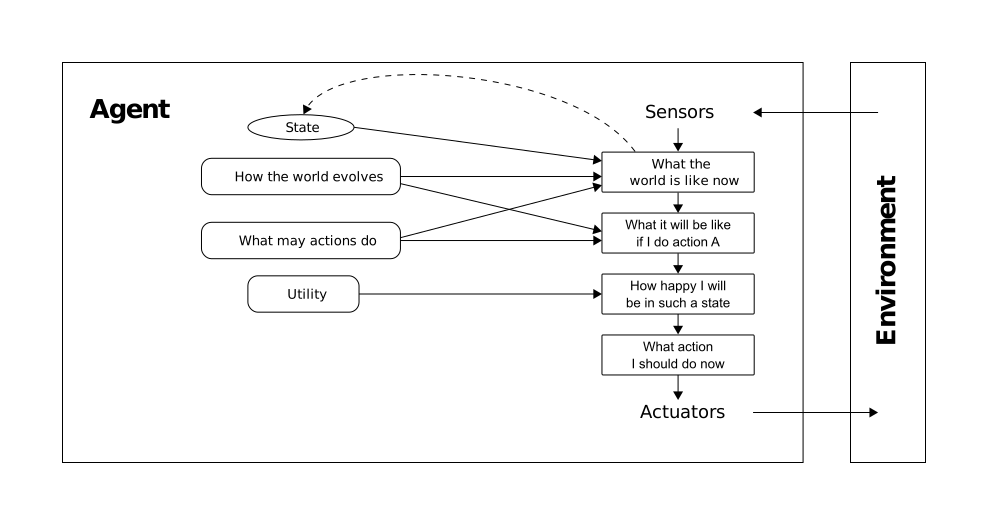
Recap
What are the main differences between the agents?
Learning agents
On rationality
A rational agent is one
that does the right thing.
Utility-based learning agents are rational agents as they act so as to achieve the best outcome or, when there is uncertainty, the best expected outcome. This means that for each possible percept sequence, a rational agent should select an action that is expected to maximize its performance measure, given the evidence provided by the percept sequence and whatever built-in knowledge the agent has, which evolves over time (Russel & Norvig, 2022, p. 58).
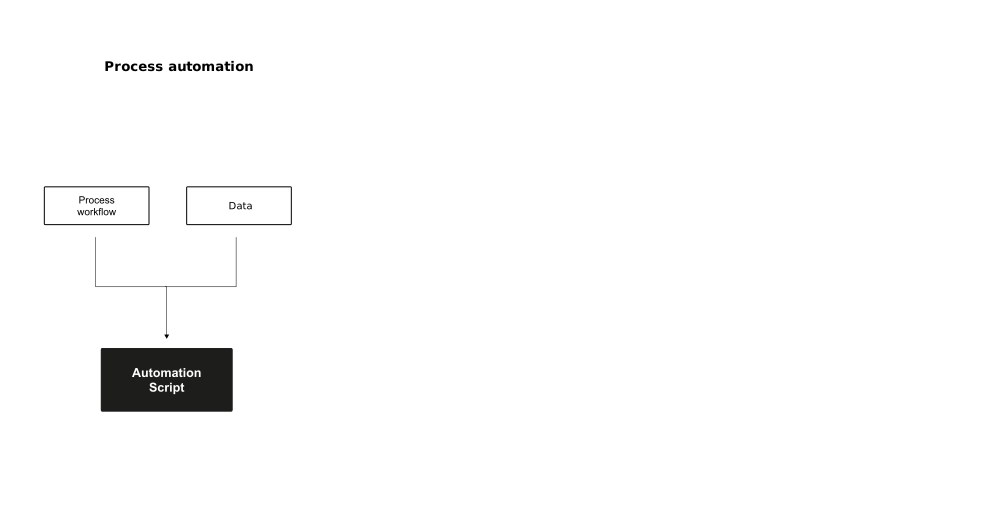
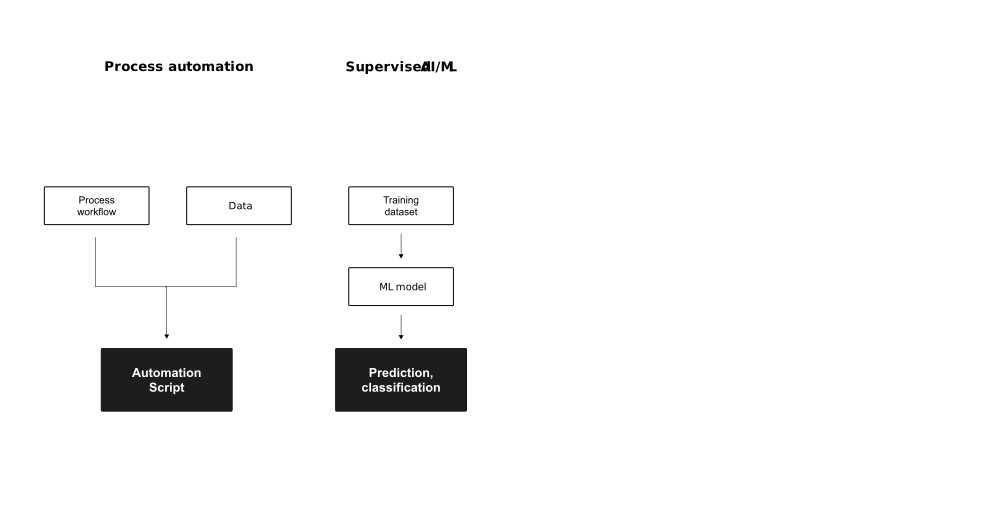
Evolution of agents
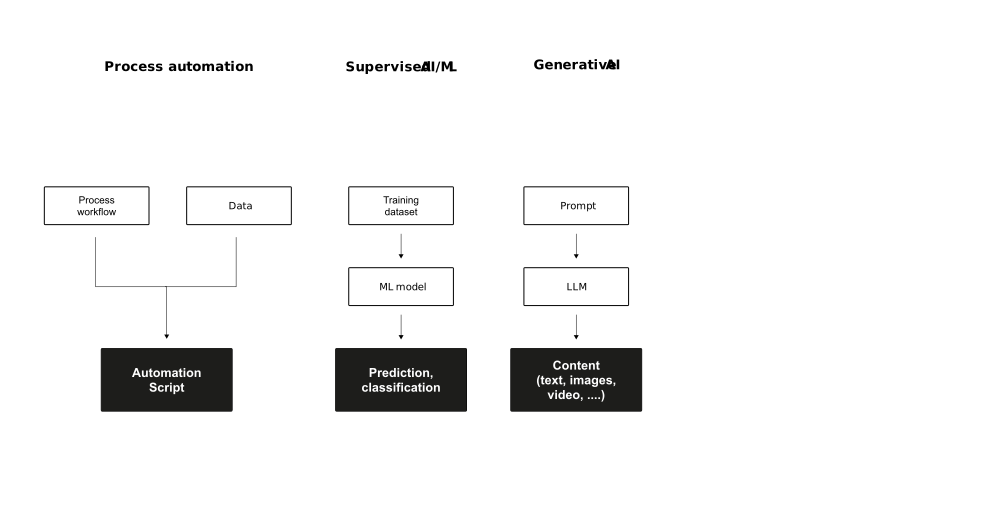
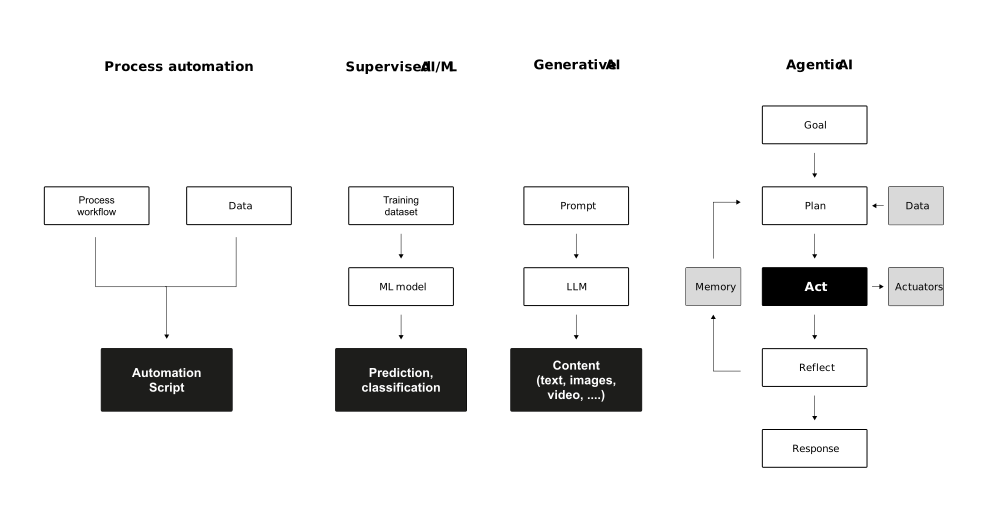
Agentic AI
Definition
Agentic AI is an emerging paradigm in AI that refers to autonomous systems designed to pursue complex goals with minimal human intervention. Acharya et al. (2025, p. 18912)
Core characteristics of Agentic AI are
- higher autonomy and goal complexity,
- ability to adapt to environmental and situational unpredictabilities, and
- independent decision-making.
Comparison with traditional AI
| Feature | Traditional AI | Agentic AI |
|---|---|---|
| Primary purpose | Task-specific automation | Goal-oriented autonomy |
| Human intervention | High (predefined parameters) | Low (autonomous adaptability) |
| Adaptability | Limited | High |
| Environment interaction | Static or limited context | Dynamic and context-aware |
| Learning type | Primarily supervised | Reinforcement and self-supervised |
| Decision-making | Data-driven, static rules | Autonomous, contextual reasoning |
Comparison of agent types
| Feature | Classical Agents | Learning Agents | Agentic AI |
|---|---|---|---|
| Primary Purpose | Fixed-task automation | Reward-driven optimization | Goal-oriented autonomy |
| Adaptability | Low | Moderate | High |
| Learning Type | Supervised | Reinforcement Learning | Hybrid, including RAG and Memory |
| Applications | Static systems | Dynamic environments | Complex, multi-objective tasks |
Q&A
Exercises
Concepts
Define in your own words the following terms:
- Rationality
- Autonomy
- Agent
- Environment
- Sensor
- Actuator
- Percept
- Agent function
- Agent program
Agent types
Explain the differences between the following agent types in your own words. Describe the component(s) that is/are specific for each type.
- Reflex agent
- Model-based agent
- Goal-based agent
- Utility-based agent
- Learning agent
Vacuum cleaner
Under which circumstances does a robotic vacuum cleaner act rational?
Describe the task environment of such an agent.
PEAS
For each of the following agents, specify the performance measure, the environment, the actuators, and the sensors.
- Microwave oven
- Chess program
- Autonomous supply delivery
Performance measure
Describe a task environment in which the performance measure is easy to specify completely and correctly, and a in which it is not.
Assertions
For each of the following assertions, say whether it is true or false and support your answer with examples or counterexamples where appropriate.
- An agent that senses only partial information about the state cannot be perfectly rational.
- There exist task environments in which no pure reflex agent can behave rationally.
- There exists a task environment in which every agent is rational.
- Every agent is rational in an unobservable environment.
- A perfectly rational poker-playing agent never loses.
- An agentic AI system always outperforms a classical goal-based agent.
- Agentic AI systems can be fully rational without learning capabilities.
- An agentic AI system that can decompose goals into sub-goals is always more rational than one that cannot.
Task environment
For each of the following activities characterize the task environment it in terms of the properties discussed in the lecture notes.
- Playing soccer
- Exploring the subsurface oceans of Titan
- Shopping for used AI books on the internet
- Playing a tennis match
Task environment properties
For each of the following task environment properties, rank the example task environments from most to least according to how well the environment satisfies the property.
Lay out any assumptions you make to reach your conclusions.
- Fully observable: driving; document classification; tutoring a student in calculus; skin cancer diagnosis from images
- Continuous: driving; spoken conversation; written conversation; climate engineering by stratospheric aerosol injection
- Stochastic: driving; sudoku; poker; soccer
- Static: chat room; checkers; tax planning; tennis
Task environment for Agentic AI
For an AI agent that independently conducts scientific literature reviews, characterize the task environment in terms of the properties discussed in the lecture notes.
Then argue why the scenario requires an agentic AI approach rather than a classical agent design.
Appendix
Glossary
| Term | Definition |
|---|---|
| Agency | The capacity of a system to maintain a continuous feedback loop with its environment by mapping percept sequences to actions. |
| Agent | The conceptual unit of analysis in AI: anything that perceives its environment through sensors and acts upon it through actuators. The term is framework-neutral and applies to systems as simple as a thermostat. |
| AI system | A concrete computational implementation designed to exhibit intelligent behavior. An AI system typically realizes one or more agents, combining hardware, software, and data to perceive, reason, and act in pursuit of goals. |
| Agentic AI | An AI system capable of autonomous, goal-directed behavior over extended tasks — decomposing goals into sub-goals, gathering information, learning from experience, and acting with minimal human intervention. |
| Percept | The agent’s perceptual input at any given instant. |
| Percept sequence | The complete history of everything an agent has ever perceived; the basis for its action choices. |
| Sensors | Mechanisms within the agent (e.g., cameras, GPS, microphones) that receive environmental input. |
| Actuators | Mechanisms within the agent (e.g., wheels, display screens, robotic joints) that execute actions. |
| Agent function | An abstract mathematical mapping (\(f: \mathcal{P}^* \to \mathcal{A}\)) from percept sequences to actions. |
| Agent program | The concrete implementation of the agent function running on a physical architecture. |
| Performance measure | The criteria by which an agent’s behavior is evaluated; defines what counts as success. |
| Rationality | The property of an agent that maximizes its expected performance given its percept sequence and built-in knowledge. |
| Task environment | The problem context in which an agent operates, specified via PEAS. |
| PEAS | A framework for specifying task environments: Performance measure, Environment, Actuators, Sensors. |
| Environment | The external context surrounding the agent that provides perceptual inputs and is affected by the agent’s actions. |
| Autonomy | The degree to which an agent relies on its own experience and learning rather than built-in knowledge. |
Literature
Footnotes
Rectangles are used to denote the current internal state of the agent’s decision process, rectangles with rounded corners to represent the background information used in the process.