A computer is said to learn from experience E with respect to some task T and some performance measure P, if its performance on T, as measured by P, improves with experience E. Mitchel (1997, p. 2)
Traditional programming: humans encode rules; the computer follows them
Machine learning: the computer discovers rules from data (the “experience”)
T and E are usually tractable to define; P is the hardest to get right
Goodhart’s Law: once a measure becomes the explicit optimization target, it loses value as a proxy for what we actually care about
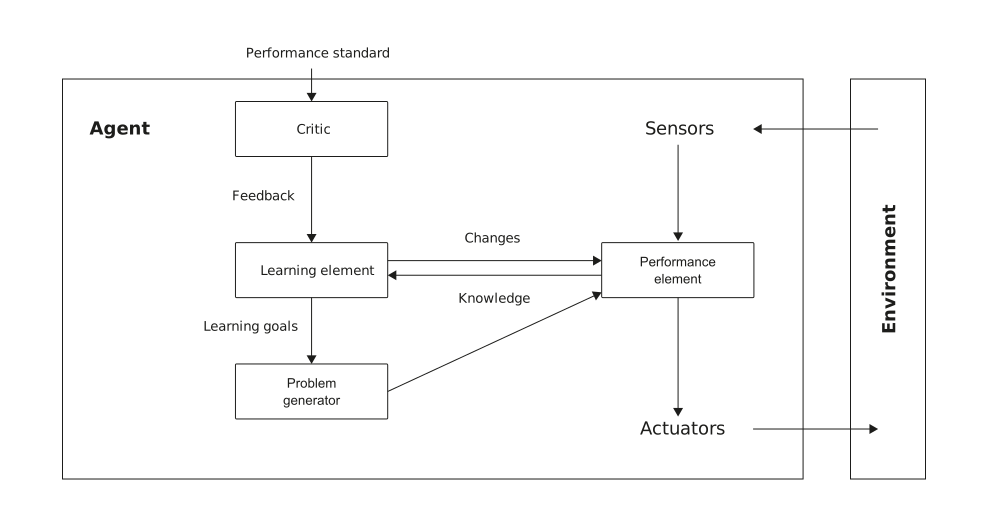
Learning agent architecture
Figure 1: A learning agent based on Russel & Norvig (2022, p. 74)
Performance element: processes percepts and selects actions
Learning element: carries out improvements using feedback from the critic
Critic: evaluates behavior against an external performance standard
Problem generator: suggests explorative actions that lead to new experience
Map the Scenario
Consider: Me learning to play tennis.
Tasks
What is the task T, the experience E, and the performance measure P?
Who or what acts as the critic and the problem generator?
What type of feedback is available: supervised, unsupervised, or reinforcement?
10:00
Three learning paradigms
Three paradigms visualized
Supervised
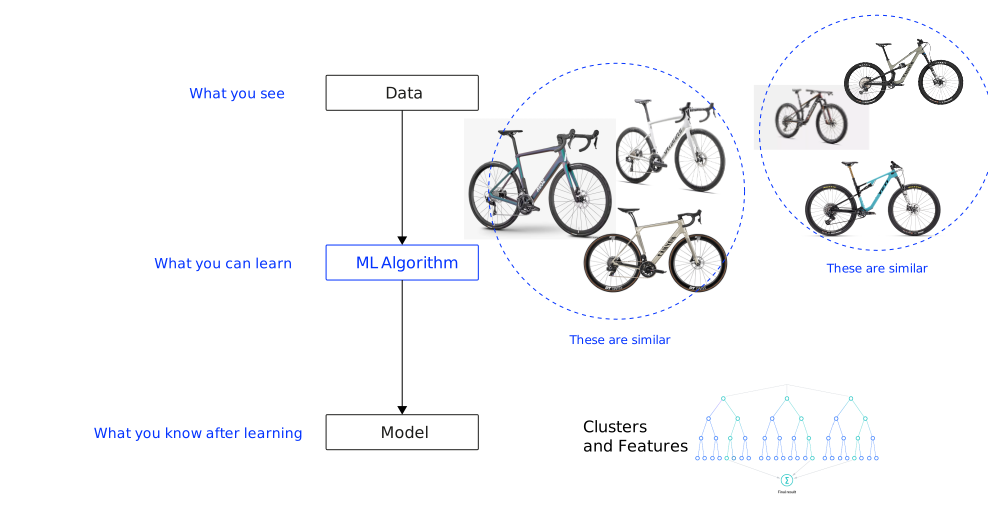
Unsupervised
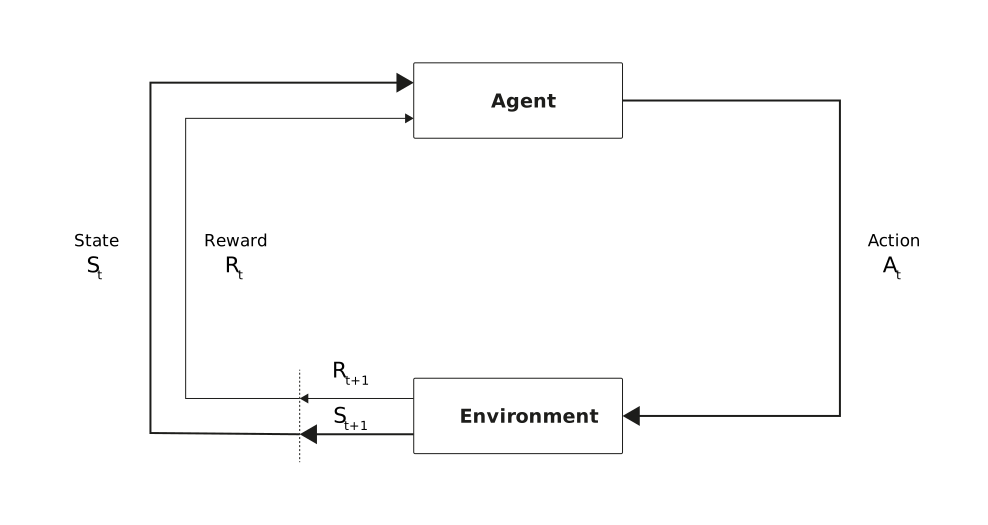
& Reinforcement
What type of feedback does the agent receive?
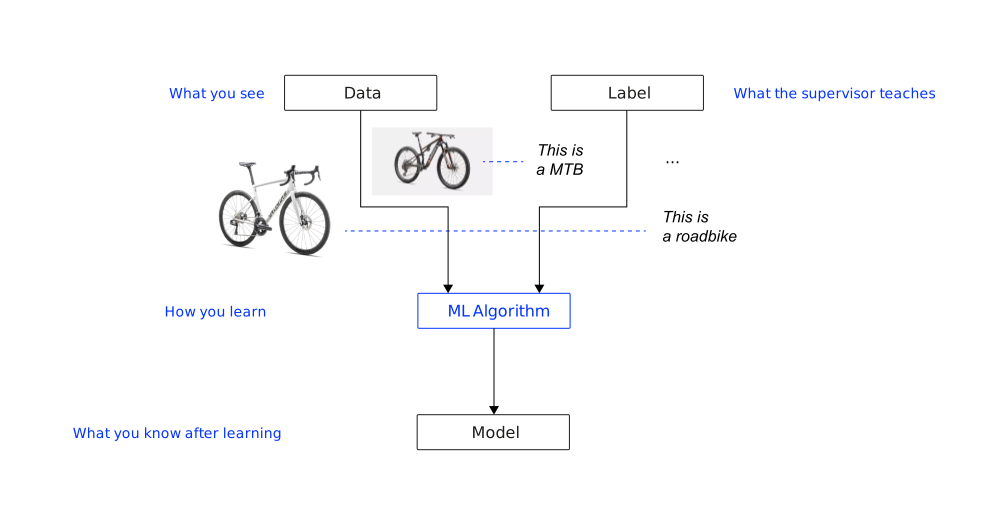
Figure 2: Supervised learning
Figure 3: Unsupervised learning
Figure 4: Reinforcement learning
Learning paradigm comparison
Supervised
Unsupervised
Reinforcement
Feedback
Correct answer per instance
None (structure only)
Reward/punishment signal
Goal
Learn input, map output
Discover hidden patterns
Learn optimal policy
Examples
Classification, regression
Clustering, dimension reduction
Game play, robotics
Table 1: Three learning paradigms compared
The boundaries are not rigid:
Semi-supervised and self-supervised learning blend elements of multiple paradigms.
Semi-supervised learning uses a small amount of labeled data together with a large amount of unlabeled data
Self-supervised learning creates its own supervision signal from unlabeled data by defining a “pretext task” derived from the data’s structure (e.g., masked language modelling; next-token prediction)
Classify & Justify
For each scenario, decide: supervised, unsupervised, or reinforcement learning?
For each, specify T, E, and P.
A streaming service groups its catalog into clusters of similar movies to improve its recommendation interface.
A bank builds a model to predict whether a loan applicant will default, trained on 10 years of labeled application outcomes.
A warehouse robot learns to pick and place objects by trying different grasping strategies and receiving a success/failure signal.
An email provider trains a filter using a dataset of messages manually labeled “spam” or “not spam.”
A retailer analyzes purchase histories to discover which products are frequently bought together.
A self-driving car’s lane-keeping system is trained on thousands of hours of human driving footage with the correct steering angle recorded for each frame.
15:00
Learning
The learning process
flowchart LR
TD[(Training Data)] --> T[Training]
T --> M[Model]
VD[(Validation Data)] --> V[Validation]
M --> V
V --> |"Hyperparameter Tuning"| T
V --> |"Model Selection"| SM[Selected Model]
TestD[(Test Data)] --> TE[Testing]
SM --> TE
TE --> |"Performance Estimation"| FM[Final Model]
ND[(New Data)] --> AP[Application]
FM --> AP
AP --> PR[Predictions]
style TD fill:#f9f9f9,stroke:#333,stroke-width:1px
style VD fill:#f9f9f9,stroke:#333,stroke-width:1px
style TestD fill:#f9f9f9,stroke:#333,stroke-width:1px
style ND fill:#f9f9f9,stroke:#333,stroke-width:1px
style M fill:#c0f0c0,stroke:#333,stroke-width:1px
style SM fill:#c0f0c0,stroke:#333,stroke-width:1px
style FM fill:#c0f0c0,stroke:#333,stroke-width:1px
style PR fill:#ffe0c0,stroke:#333,stroke-width:1px
Three separate datasets
Training = dataset to learn a general model
Validation = dataset for selection and tuning
Test = dataset to detect problems in a controlled environment
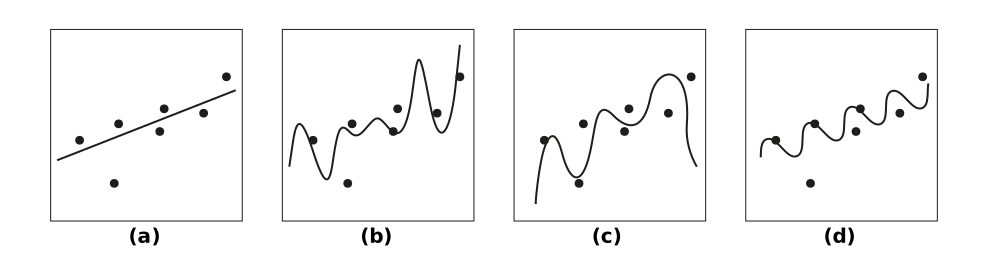
Bias-variance tradeoff
Figure 5: Underfitting, good fit, and overfitting in polynomial curve fitting
Underfitting (high bias, low variance): the model is too simple to capture the underlying pattern
Good fit (balanced): complexity matches the data; the model generalizes
Overfitting (low bias, high variance): the model memorizes training noise and fails on new data
What Went Wrong?
For each case, diagnose the problem (name it) and propose a fix.
Case 1: A sentiment classifier trained on electronics reviews achieves 99.2% training accuracy. After deployment to restaurant and hotel reviews, accuracy drops to 61%.
Case 2: A student fits a degree-15 polynomial to 20 data points. The curve passes through every training point (training error ≈ 0). With 10 new measurements, predictions are wildly off.
Case 3: A hospital trains a readmission model. Training accuracy: 58%. Validation accuracy: 57%. Adding more training data does not improve performance.
18:00
Ockham’s razor & wrap-up
Ockham’s Razor
In your own words, explain what Ockham’s razor is. Find an example from everyday life or from ML that you can use to enrich your explanation.
08:00
Key takeaways
What is ML?
ML is improvement through experience; define T, E, and P carefully, especially P
Goodhart’s Law: once a metric becomes the optimization target, it loses value as a proxy for the goal
Three learning paradigms
The distinguishing criterion is the feedback type, not the application domain
Supervised: correct answer per instance. Unsupervised: structure only. Reinforcement: reward signal
Key takeaways #2
The learning process
Train/validate/test separation protects the evaluation from contamination; the test set is touched exactly once
Distribution shift between training and deployment is a silent failure mode
Bias, variance, and Ockham’s razor
High bias: the model is too simple and underfits. High variance: the model is too complex and overfits
The simplest model that adequately explains the data is preferred (Ockham’s razor)