Managing AI
Introduction to AI (I2AI)
June 5, 2026
The chain of argumentation
Why does AI specifically require its own strategy? Urbach, Feulner, Mayer, & Meierhöfer (2026) lay out a four-step chain of reasoning:
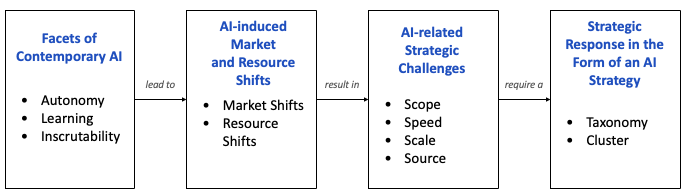
Figure 1: Chain of argumentation for the need for an AI strategy. Adapted from Urbach, Feulner, Mayer, & Meierhöfer (2026, p. 163).
Facets of contemporary AI: three properties set AI apart from prior technology
- Autonomy: acts without per-decision human instruction
- Learning: behaviour changes over time
- Inscrutability: internal logic is opaque to observers
AI-induced shifts: these properties cause
- Market shifts: competitive dynamics change
- Resource shifts: what constitutes a scarce, valuable capability changes (the “4S”)
Strategic challenges: new tensions across all four dimensions
- Scope: how AI is organized and governed (e.g., strategic ownership, governance level)
- Scale: how AI capabilities are acquired (e.g., knowledge acquisition, technology sourcing)
- Speed: how AI use cases are identified and grown (e.g., use case identification, use case expansion)
- Source: how AI affects the business model (e.g., technology aspiration, value creation)
Strategic response: a coherent AI strategy addressing all four dimensions simultaneously
Why inscrutability matters strategically
Most technologies fail in predictable, traceable ways. AI can fail silently, confidently, and in ways that are difficult to attribute. This inscrutability makes standard oversight mechanisms insufficient and creates accountability gaps that a strategy, not just an IT process, must address. Berente et al. (2021) argue that autonomy, learning, and inscrutability must be managed together, not in isolation — each interacts with the others.
Structural mechanisms
Define the formal organisational architecture within which AI decisions are made and accountability is assigned.
- Roles and responsibilities: operational (project leads, product owners) and strategic (executive sponsors, Chief AI Officer — CAIO)
- Cross-functional governance bodies: AI steering committees integrating legal, compliance, technical, and business perspectives
- Centres of Excellence: centralise expertise, set standards, reduce fragmentation across business units
Procedural mechanisms
Define how AI is developed, validated, deployed, and monitored.
- Documentation standards: traceability of model development, testing, and known limitations
- Quality assurance: coding guidelines, testing protocols, and validation procedures across the AI lifecycle
- Compliance monitoring: continuous checks against legal and internal standards
- Escalation procedures: defined pathways for flagging unexpected model behaviour or performance degradation
Relational mechanisms
Address the collaborative dynamics across the people and teams involved in AI.
- Interdisciplinary team design: technical, legal, domain, and ethical expertise in working teams — not sequential handoffs
- Training and onboarding: AI fundamentals, governance structures, and ethical implications for all team members
- Transparency practices: explainability tools and accessible reporting for non-technical stakeholders
- Dialogue and feedback loops: regular alignment, workshops, channels for surfacing concerns early