Change
How to change things when change is hard?
Neu-Ulm University of Applied Sciences
November 19, 2025
Motivation
All change
= behavior change
For something to change, somebody somewhere has to start behaving differently—in other words, all change is ultimately behavior change. Chip Heath, American author
Exercise
A bad habit is something where you have all the information you need to see it’s a bad behavior, yet your keep doing it anyway.
Are you engaged in some kind of behavior you want to change but struggle with? Why?
Knowing vs. doing
A fundamental tension of psychology: knowing what the right answer is vs. doing it.
Let’s have a look how this can be explained and turn to the theoretical foundations.
Theoretical foundations
The need for theory
Theory helps us to understand why interventions work (or fail), to predict outcomes in new situations, to generalize beyond specific cases, and to justify our change strategies.
Dual-process theory
System 1 vs. System 2
Psychology assumes that the brain has two independent systems at work at all times (Kahneman, 2011).
| System 1 | System 2 |
|---|---|
| Fast, automatic | Slow, deliberate |
| Effortless | Effortful |
| Associative | Rule-based |
| Intuitive | Controlled |
Both systems operate simultaneously and often conflict (Kahneman, 2011).
Ego depletion & self-regulation
Self-control acts like a muscle.
Self-control and willpower function as limited cognitive resources that deplete with use (Baumeister et al., 2007).
- Each decision depletes cognitive resources
- Emotional regulation and decision-making draw from same pool
- When depleted, people default to habitual responses
- Recovery requires rest and replenishment
Change strategies relying purely on willpower are likely to fail, especially under stress or cognitive load.
The fundamental attribution error
People vs. situation problems
We systematically overestimate personal factors and underestimate situational factors when explaining behavior (Ross, 1977).
Classic demonstration
- Seminary students preparing a talk on Good Samaritan
- Manipulated time pressure (situation)
- Encountered person in need en route
- Rushed students rarely helped, regardless of personality (Darley & Batson, 1973)
“People problems” are often “situation problems”—change the context, change the behavior.
Implementation intentions
Pre-loading decisions through action triggers
Specifying the when, where, and how of goal pursuit significantly increases success rates (Gollwitzer, 1999).
| Simple Goal | Implementation Intention |
|---|---|
| “I intend to exercise more” | “If it’s Monday at 7am, I will put on running shoes and run for 20 minutes” |
| Weak commitment | Strong commitment |
| Moment-of-choice decision | Pre-decided action |
Creating automatic links between situational cues and actions reduces reliance on willpower (Gollwitzer, 1999).
The Switch framework
Foundations
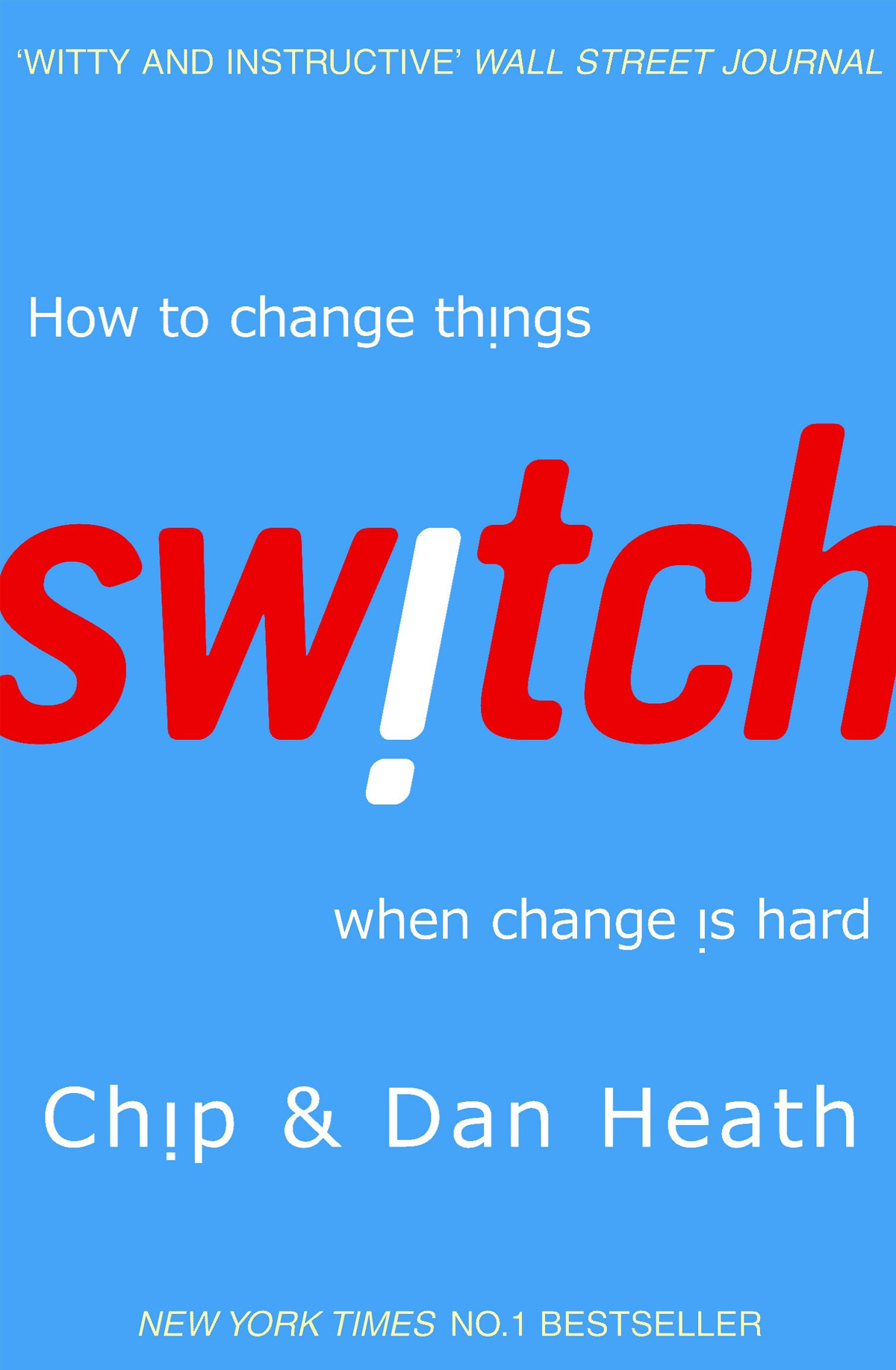
Heath & Heath (2011) elegantly integrate these foundations into a unified framework — Switch.
Chip and Dan Heath have mined the latest psychological research to work out how to engage our emotional brain, and encourage us to focus on “bright spots”—techniques proven to help us change bad habits—rather than merely telling us what we’re doing wrong. Psychologies Magazine
The elephant, the rider and the path
Leading change
Rider + elephant + path
If you want to change things, you’ve got to appeal both. The rider provides the planning and direction, and the elephant provides the energy. [..] A reluctant elephant and a wheel-spinning rider can both ensure that nothing changes. But when elephants and riders move together, change can come easily. Heath & Heath (2011)
Three hypotheses about change
Direct the rider
Motivate the elephant
Shape the path
Exercise
Now that you understand the framework …
… analyze behavior you want to change but struggle with identified before.
- Rider: What does your rational mind know/understand?
- Elephant: What does your emotional self want/feel/fear?
- Path: What environmental factors support the current behavior?
05:00
From theory to practice
We’ve seen the theoretical foundations … but how do you actually use this framework?
Each component has specific, research-backed strategies:
- Rider: Clarity, direction, bright spots
- Elephant: Emotion, identity, momentum
- Path: Environment, habits, social proof
Let’s explore each in depth using examples reported in Heath & Heath (2011).
Direct the rider
Exercise
Paralysis in the face of …
Tell us about a time when you experienced mental paralysis.
- How did it manifest?
- How could it have been avoided?
Discuss these questions in small groups and come up with one example you could present to the plenum.
Mental paralysis is the feeling of being overwhelmed and unable to think or act, often caused by too many thoughts, emotions, or stimuli. It can feel like a “brain freeze” or “brain crash,” making it difficult to organize thoughts, process information, and start tasks.
05:00
Strategies
What can you do to resolve mental paralysis and/or resistance?
Follow the bright spots
Script the critical moves
Point to the destination
Follow the bright spots
Investigate what’s working and clone it. Heath & Heath (2011)
Example: Jerry Sternin and mothers in Vietnam
In 1990, Jerry Sternin was working for Save the Children, asked to open a new office in Vietnam “to make a difference” within 6 months (see e.g., Marsh et al., 2004).
- Many children suffered malnutrition—a result of many intertwined problems: poor sanitation, universal poverty, no clean water, etc. (true but useless analysis).
- Sternin synthesized the “conventional wisdom” about feeding kids (norms).
- Sternin looked for very poor kids who are bigger and healthier than the typical child and analyzed what the mothers were doing differently (positive deviations).
- Sternin organized cooking groups where the mothers got highly specific instructions (Rider) and the feeling that they can make their kids healthier (Elephant), which also changed the culture of the village (Path).
- Six months later, 65 percent of the kids were better nourished and stayed that way; years later the program reached 2.2 million Vietnamese people.
Conclusion
Switch from a problem focus to a solution focus.
Script the critical moves
Don’t just think big picture,
think in terms of specific behavior. Heath & Heath (2011)
Example: Brazilian southern line
In 1996, GP Investimentor Limited bought parts of the Brazilian railway network (a deteriorating mess) and set a young talent in charge—Alexandre Behring.
- Behring only had 30 million Brazilian reals in cash on its balance sheet (i.e., nothing).
- To change direction and guide decision-making, Behring developed four rules:
- Money is only invested in projects that provide higher revenue in the short term.
- The best solution to a problem is the one that costs the least money up front.
- Quick fixes are preferred to slower options that provide superior long-term fixes.
- Reusing or recycling existing materials is better than acquiring new materials.
- In 2000, the company’s performance improved from a net loss of 80 million reals to a net profit of 24 million reals.
Conclusion
If you want to change things, be clear about how people should act.
Point to the destination
Change is easier when you know where you’re going and why it’s worth it. Heath & Heath (2011)
Example: No dry holes at BP
After decades of success, in the 90s, BP had issues to find untapped oil resources.
- In 1989, BP had an average accuracy rate of just 1 out of 5 (global standard).
- The oil explorers behaved like salesmen and put pressure to drill every well (the logic behind: the payoff on hitting one big well will cover for the ones they did not hit).
- To reduce cost per Barrel, the CEO posed a clear destination: “No Dry Holes”—meaning no random shots, but systematic tests (using the knowledge they had).
- But No Dry Holes created an even bigger shift in BP’s culture—no one rationalized failure buy saying ‘Oh, we hit a dry well, but we learned’.
- In 2020, BP’s hit rate was 2 out of 3.
Conclusion
Paint a specific, rich, detailed picture of what the destination looks like to motivate people.
Motivate the elephant
Exercise
Information vs. feeling
Can you think of any situations in life where you or others have tried to get people to change their minds with information, rather than with feelings?
How could those situations be approached differently to be more effective?
03:00
Strategies
What can you do to prevent exhaustion?
Find the feeling
Shrink the change
Grow your people
Find the feeling
Knowing something isn’t enough to cause change. Make people feel something. Heath & Heath (2011)
Example: Chemotherapy game
After enduring weeks of brutal chemotherapy in the hospital, the children struggled to faithfully take their medications at home.
If you skip 20 percent of your doses, you don’t have a 20 percent higher chance of getting cancer again. Your odds go up 200 percent. Steve Cole, research director for HopeLabs
Hope labs developed a game called Re-Mission (Kato et al., 2008).
- They played Roxxi, a nanorobot in a silver suit that moved through the bloodstream and bombarded tumor cells with electro-green chemo beams; in between, Smitty, a mentor robot, provided additional information about chemotherapy and recovery.
- Kids adherence to their medication plans increased significantly.
Conclusion
Things you see are more likely to evoke emotion than things you read.
Make the need for change clear (tangible).
Shrink the change
Downsize the change until it no longer frightens the elephant.
Example: Wash loyalty card
A local car wash ran a promotion featuring loyalty cards (Nunes & Dreze, 2006).
- Group A: For every car wash bought, customers got a stamp on their card.
Eight stamps meant a free car wash. - Group B: Customers needed to collect ten stamp, but they were given a “head start”
(2 stamps have already been added). - A few months later, only 19% of group A had earned a free wash vs. 34% of group B.
People find it motivating to be partly finished with a longer story then to be at the starting gate of a shorter one Heath & Heath (2011)
Conclusion
Small targets lead to small victories, small victories can trigger momentum. Heath & Heath (2011)
Grow your people
Identities are central to the way people make decision (March, 2009).
Example: Junior-high math students
Blackwell et al. (2007) set up a study for seventh-grade math students in school in a low socioeconomic environment.
- The experimental group was taught that the brain is like a muscle that can be developed with exercise (two hours over eight weeks).
- The control group was taught generic study skills.
- The teachers, unaware of which group their students were assigned to, identified students who they thought had experienced a positive change during the term, whereof 76% were in the experimental group.
One hardcore, turned-off, low effort kind in the group said, ‘You mean I don’t have to be dumb?’ From that day on, he worked. Heath & Heath (2011)
Conclusion
Create a sense of identity and convey a growth mindset.
Shape the path
Exercise
Environment shapes behavior.
Think back over your day — when and where did your environment significantly shape your behavior?
04:00
Strategies
What can you do to make change more likely?
Tweak the environment
Build habits
Rally the herd
Tweak the environment
When the situation changes, the behavior changes. So change the situation. Heath & Heath (2011)
Example: Medication at Kaiser South
At Kaiser South Sans Francisco Hospital, nurses administer about 800 medications a day.
- Nurses are impressively accurate: on average, they commit approx. 1 error per 1,000 medications administered.
- However, a single error can be harmful or even deadly.
- In an effort to reduce medication errors, distraction was identified as a cause.
- Distraction isn’t a Rider (understanding) nor an Elephant problem (motivation).
- Instead of changing nurses behavior, medication vests have been installed, showing that nurses are administering drugs and should be left alone.
- Errors dropped by 47 percent.
Conclusion
Situations trump personal attributes.
Build habits
When behavior is habitual, it’s “free”—it doesn’t tax the rider. Look for ways to encourage habits. Heath & Heath (2011)
Rally the herd
Behavior is contagious.
Help it spread. Heath & Heath (2011)
Conclusion
Rider x Elephant x Path
All three components matter.
- Rider without elephant — clear plans, but no motivation to act
(Example: detailed New Year’s resolutions abandoned by February) - Elephant without rider — energy without direction
(Example: enthusiasm for “change” but no clear path forward) - Both without path — fighting against the environment
(Example: asking people to do things digitally in a paper-loving bureaucracy)
Success = all three aligned
Discussion
Think of a change initiative you’ve witnessed that failed.
- Which component(s) were missing or weak?
- How did that manifest?
- What could have been done differently?
05:00
Challenges
You want to learn how to lead change more efficiently? Here are three challenges that might help you along the way.
- Level 1: Analyze a personal change problem, identify bright spots, analyze them and find ways to reproduce the practices.
- Level 2: Apply the framework to one personal change problem—find ways to direct the rider, motivate the elephant and shape the path in order to support your change.
- Level 3: Identify a change problem within a group (e.g., at work); try to get the mandate for the change; develop a picture of what the goal looks like, script the critical moves, create positive emotions, shrink the change or make people grow, and try to tweak the environment path wherever necessary.
Reading list
For digging deeper, I recommend reading the articles cited here, plus:
- The endowed progress effect: Nunes & Dreze (2006)
- Lewin’s change theory: Lewin (1951)
- Identities and identity work in organizations: Brown (2015)
as well as following books:
Q&A
Literature
Footnotes
Steve Booth-Butterfield and Bill Reger, professors at West Virginia University, were contemplating ways to persuade people to eat a healthier diet. They concluded that you don’t need to change drinking behavior, but purchasing behavior. Thus, they launched a campaign that was punchy and specific in motivating people to buy skimmy milk (instead of the fuzzy message to act healthier) (Booth-Butterfield & Reger, 2004).
In 2004, Donald Berwick, a doctor and the CEO of the Institute of for Healthcare Improvement, wanted to save a massive number of lives by reducing the “defect” rate in healthcare (e.g., administration of medication at the wrong time). Besides providing a crystal clear direction, he also motivated people by making them feed the need for change—he confronted hospital administrators with the mother of a girl who’d been killed by a medical error (Berwick et al., 2006).
A study of Brian Wansink of the Food and Brand Lab at Cornell University shows in his popcorn studies that “people eat more when you give them a bigger container. Period.” (Wansink, 2006, pp. 16–19)
Bright spots don’t have to be shining success stories, just look for situations when things are working better than others.
How it can be that more choice is actually bad for us? (Schwartz, 2009; Schwartz & Ward, 2004)
When the elephant really wants something, the rider can be trusted to find rationalizations for it.
Please consider that black and white goals create a danger of demoralization if you don’t meet them consistently.
Social learning
If others do it, it must be appropriate.
Behavior is learned through observation and shaped by what others do (“social proof”) (Bandura, 1977; Cialdini, 2006).
Highlighting positive examples can accelerate diffusion of new behaviors through social proof.