Human-AI Collaboration
How can human-AI collaboration exceed the sum of its parts?
Neu-Ulm University of Applied Sciences
October 22, 2026
Agenda
- Motivation & reflection 20 min
- The light side 25 min
- The dark side 40 min
- Break 15 min
- The jagged frontier 30 min
- Exercise: probe the frontier 15 min
- Interaction modes 20 min
- Exercise: rewrite the moment 15 min
- Challenges & wrap-up 10 min
Motivation
Generation is cheap.
Verification not.
How can we structure our work with AI to ensure that the sum is greater than the parts, rather than less?
Exercise
Think about the last time you used an AI tool for university or work.
Did it save you time overall, once you count the time spent reviewing, correcting, and rewriting what it produced?
Discuss with a neighbor.
03:00
The Light Side
Execution Velocity
AI reduces the time it takes to progress from a blank page to a first draft.
- Substantial completion-time reductions in routine writing and standard coding tasks (Merali, 2025; Noy & Zhang, 2023; Peng et al., 2023)
- Rapid prototyping and cold-start knowledge retrieval
- Reduced friction when summarizing unfamiliar material
Equalizer Effect
AI narrows the gap between novices and experts, at least initially.
According to brynjolfsson2023generative and Cruces et al. (2025), disproportionate performance gains accrue to novices and bottom-quartile performers.
Divergent Thinking
More ideas, further apart, faster.
Higher ideation fluency and greater semantic distance between ideas when individuals brainstorm with an LLM (Doshi & Hauser, 2024; Hubert et al., 2024).
Summary
| Mechanism | Changes | Evidence |
|---|---|---|
| Execution velocity | Faster drafts, faster prototypes, faster orientation | Noy & Zhang (2023); Peng et al. (2023); Merali (2025) |
| The equalizer effect | Novices and low performers gain the most | Brynjolfsson et al. (2023); Cruces et al. (2025) |
| Individual divergent thinking | More ideas, greater semantic distance | Doshi & Hauser (2024); Hubert et al. (2024) |
The Dark Side
Cognitive Offloading
Faster answers today,
weaker retrieval tomorrow.
- Immediate problem-solving speed increases with AI help
- Independent exam performance drops significantly afterward (Bastani et al., 2025)
- Continuous assistance is associated with erosion of unaided professional judgment in high-stakes domains (Budzyń et al., 2025)
Review Bottleneck
AI writes faster than humans can review.
Fast generation produces high volumes of superficially correct but subtly flawed work (He, Agarwal, et al., 2026; He, Miller, et al., 2026); downstream, this shows up as silent coupling and structural complexity in code and analysis (Borg et al., 2026; Xu et al., 2025).
Fixation and Homogenization Trap
Everyone converges on the model’s first idea.
- Micro-mechanism: early exposure to AI output anchors the human’s own search space (Lin & Xie, 2026; Wadinambiarachchi et al., 2024)
- Macro-outcome: because LLMs sample around dense semantic centroids, many independent users converge on similar solutions, collapsing collective variance (Boussioux et al., 2024; Doshi & Hauser, 2024; Zhou et al., 2025)
- AI evaluation models tend to favor smooth, conventional structures over genuinely novel or eccentric ideas (Williams, 2026)
Reasoning Biases
Confident answers are persuasive, correct or not.
- Automation bias: high-confidence, incorrect AI suggestions mislead decision-makers (Goh et al., 2024; Qazi et al., 2025)
- Selective adherence: people accept wrong AI advice that confirms their priors, and reject correct advice that contradicts them (Alon-Barkat & Busuioc, 2023)
Summary
| Issue | Mechanism | Evidence |
|---|---|---|
| Cognitive atrophy | Offloaded effort stops building the underlying skill | Bastani et al. (2025); Budzyń et al. (2025) |
| Reviewer’s bottleneck | Generation outpaces verification, debt accumulates silently | He, Agarwal, et al. (2026); He, Miller, et al. (2026); Xu et al. (2025); Borg et al. (2026) |
| Fixation & homogenization | Individual anchoring plus collective variance collapse | Wadinambiarachchi et al. (2024); Doshi & Hauser (2024); Zhou et al. (2025) |
| Reasoning biases | Automation bias and selective adherence to AI advice | Vasconcelos et al. (2023); Alon-Barkat & Busuioc (2023) |
The Jagged Frontier
The Experiment
Task A: Shoe Launch
Conceptualize and launch a new shoe, across 18 subtasks covering creativity, analytical thinking, writing, and persuasiveness. Open-ended work, graded with rubrics.
Task B: Strategy Case
Recommend to the CEO which brand to invest in, using spreadsheet data and interview notes. The spreadsheet looks complete; the decisive details appear only in the interviews.
758 BCG consultants, randomly assigned to no AI, GPT-4, or GPT-4 plus a prompt-engineering overview (Dell’Acqua et al., 2026).
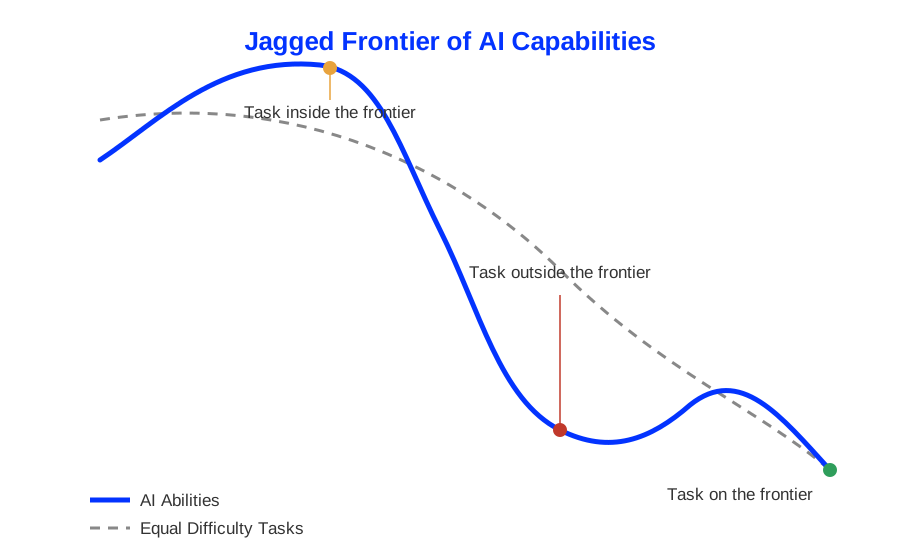
For which task did GPT-4 improve consultants’ performance?
The Result
| Outcome | Task A: Shoe Launch | Task B: Strategy Case |
|---|---|---|
| Without AI | 4.4 / 10 quality | 84.5 % correct |
| With AI | 5.7 to 5.9 / 10 | 60.0 to 70.6 % correct |
On Task B, wrong answers written with AI were rated 29 % more convincing than wrong answers written without it.
The Jagged Frontier
Exercise
Probe the frontier.
In pairs plus AI:
- Pick one real task from your own coursework or work that you’d consider delegating to AI. (2 min)
- Try it. Then actively try to break it: push an edge case, add an unusual constraint, or ask the model to show its work, looking for a spot where the output looks right, but you can’t actually tell if it is. (5 min)
- Report: what did you try, did you find a spot where the output was wrong or unverifiable, and what made that spot different from where it worked fine? (3 min)
10:00
Conclusions
Human-AI Pairing helps under following conditions:
- Verifiability: an error can be caught by a cheap mechanical check.
- Modularity: the subtask can be isolated from the rest of the analysis.
- Expertise: the gain is largest for weaker performers and smallest for experts.
Interaction Modes
Overview
Four interaction modes that relate to the failure risks.
- Socratic Scaffold protects skill acquisition
- Centaur Modularizer structures large workflows
- Cognitive Forcer mitigates overreliance
- Delayed Access preserves creative variance
The Socratic Scaffold
Cognitive protection for skill acquisition
The model is prohibited from giving direct solutions. It is prompted to act as an examiner: asking guiding questions, hinting at missing boundary conditions, checking the human’s mental model.
The Centaur Modularizer
Structural separation for large, multi-step workflows
The human owns strategy, problem architecture, and final synthesis. The AI is delegated bounded, non-overlapping subroutines, formatting, extraction, boilerplate.
The Cognitive Forcer
Adversarial review for high-stakes decisions
The human commits to an independent hypothesis in writing first. The AI is then prompted as an adversarial red team to find edge-case failures and unstated assumptions.
Exercise
Rewrite the moment
- Recall a specific time an AI tool gave you a confident answer that turned out to be wrong, or that you never actually checked. What was the task? What made you trust it? (3 min, individually)
- Share your story. Together, diagnose: could you have caught the flaw if you had formed your own view first? What was missing from how you used the AI in the moment? (5 min, in pairs)
- Draft the Cognitive Forcer rewrite: the one-paragraph hypothesis you would have written before consulting the AI, and the prompt that would have turned it into your adversarial reviewer instead of your source. (5 min, in pairs)
It would be great if a few share the most surprising or relatable story with the plenum.
13:00
Delayed AI Access
Preserving variance in creative and strategic work
Enforce an initial period of unassisted divergent thinking. Introduce AI downstream, using diverse prompting personas to break out of central semantic distributions.
Challenges
You want to become a more deliberate collaborator with AI, not just a faster one? Here are three challenges that might help you along the way.
- Level 1 (Reflect): Keep a 14-day AI reliance diary. Log every AI interaction relevant to your studies or work, noting where the task sat on the jagged frontier, whether your stance was passive or active, how long verification took, and any moment you noticed automation bias in yourself. Close with a written reflection on your personal dependency and verification bottlenecks.
- Level 2 (Change): Over three weeks, commit to applying at least two of the four protocols above (Cognitive Forcer and Delayed Access work well together) across your coursework or projects. Compare your outputs against your usual habits: what changed in cognitive effort, in the maintainability of what you produced, and in what you actually remember afterward?
- Level 3 (Grow): Design and run a small field experiment (4 to 8 people, a study group or a work team). Compare a human-only team, a naive-AI team, and a Centaur-style team on the same complex deliverable. Write up whether true complementarity appeared, whether technical debt accumulated, and whether the AI-assisted teams’ outputs converged more than the human-only team’s did.
Reading List
For digging deeper, I recommend the sources cited here, organized by theme.
Frontiers and productivity
- The jagged technological frontier: Dell’Acqua et al. (2026)
- Productivity effects of generative AI: Noy & Zhang (2023)
- Generative AI at work: Brynjolfsson et al. (2023)
- Generative AI and developer productivity (GitHub Copilot): Peng et al. (2023)
- Scaling laws for AI-assisted knowledge work: Merali (2025)
- Generative AI and education-based productivity gaps: Cruces et al. (2025)
Cognitive offloading and reliance
- Generative AI and learning: Bastani et al. (2025)
- Endoscopist deskilling after AI exposure: Budzyń et al. (2025)
- Cognitive forcing functions: Buçinca et al. (2021)
- Explanations, overreliance, and the cost of verification: Vasconcelos et al. (2023)
- Generative AI and critical thinking: Lee et al. (2025)
Fixation and collective homogenization
- Individual creativity vs. collective diversity: Doshi & Hauser (2024)
- AI more creative than humans on divergent thinking: Hubert et al. (2024)
- Generative AI and design fixation: Wadinambiarachchi et al. (2024)
- Generative AI and divergent thinking in product design: Lin & Xie (2026)
- The crowdless future: generative AI and collective problem-solving: Boussioux et al. (2024)
- When ChatGPT is gone: creativity and homogeneity over time: Zhou et al. (2025)
- Diverse AI personas and homogenization: Wan & Kalman (2026)
- Diagnosing the limits of convergent AI: Williams (2026)
Reasoning biases and verification
- Automation bias and selective adherence in public-sector decisions: Alon-Barkat & Busuioc (2023)
- Automation bias in AI-assisted diagnostic reasoning: Qazi et al. (2025)
- LLM influence on diagnostic reasoning: Goh et al. (2024)
- LLM assistance and physician decision-making: Rounding et al. (2025)
Complementarity and downstream technical debt
- AI-assisted teams vs. AI-led vs. human-only teams: Brodeur et al. (2026)
- Field experiment on generative AI and teamwork: Dell’Acqua et al. (2025)
- AI writes faster than humans can review: He, Agarwal, et al. (2026)
- Speed at the cost of quality (Cursor AI): He, Miller, et al. (2026)
- AI-assisted programming and developer productivity: Xu et al. (2025)
- Downstream effects of AI assistants on maintainability: Borg et al. (2026)
- The expert penalty in high-skilled work: Cui et al. (2025)
- Early-2025 AI and experienced developer productivity: Becker et al. (2025)
- When combinations of humans and AI are useful: Vaccaro et al. (2024)
- Complementarity in human-AI collaboration: Hemmer et al. (2025)
- Prompt problems for learning programming: Prather et al. (2024)