Knowledge, Science and Epistemology
Research Project 1 (RP1) — U3
Neu-Ulm University of Applied Sciences
August 26, 2026
Opening Remarks
What does it mean to know something?
And what makes a knowledge claim scientific?
Learning Outcomes
By the end of this unit, you will be able to:
- Distinguish ontological (objectivist or subjectivist) and epistemological (positivist or interpretivist) commitments, and name which ones a given research design assumes.
- Apply the four principles of scientific knowledge, replicability, independence, precision, and falsification, to judge whether a claim counts as rigorous.
- Assess what a fast-moving phenomenon like agentic AI demands of these principles that a stable, slow-moving phenomenon does not.
Science
Origins
The history of humankind (Harari, 2015):
willingness to admit ignorance
+ centrality of observation
= acquisition of new capabilities
Definition
Science is the attempt to derive knowledge from facts through certain methods in a systematic and organized way. Recker (2021, p. 17)
Types of Sciences
Natural sciences
and social sciences
What is the difference?
Knowledge
Knowledge and Truth
We can only know things from our own perspective. Plato
What can we know, what do we believe?
Ontology and Epistemology
Ontology is concerned with assumptions about existence and definitions of reality.
- Objectivism is the belief in an external reality whose existence is independent of knowledge of it; the world exists as an independent object waiting to be discovered (Trivedi, 2021).
- Subjectivism is the belief that you cannot know an external or objective reality apart from your subjective awareness of it. Social reality only exists when we experience it and give it meaning (Trivedi, 2021).
Epistemology is the theory of knowledge, concerned with how we know and what knowledge is.
- Positivism is the belief that truth or knowledge can be discovered through valid conceptualization and reliable measurement, which allows the testing of knowledge against the objective world (Trivedi, 2021).
- Interpretivism is the belief that all knowledge is relative to the knower and can only be understood from the point of view of individuals who are directly involved; truth is socially constructed via multiple interpretations by the subjects of knowledge (Trivedi, 2021).
Exercise
A rain dance ceremony performed by all participants
with a pure heart will cause rain the next day.
Why is this (not) scientific knowledge?
Discussion
What is scientific knowledge, then?
Scientific Knowledge
To gain scientific knowledge, sciences need to follow the principles of
replicability,
independence,
precision &
falsification
Discussion
What does falsifiability mean when the thing you are studying changes faster than knowledge about it can accumulate?
This is not a hypothetical problem for your project.
A field as young as agentic AI moves faster than the review cycle of the journals that would report on it. A claim can be well-supported by the evidence available in March and already out of date by October because the phenomenon it described has changed shape, even though the claim itself was never falsified.
Body of Knowledge
Definition
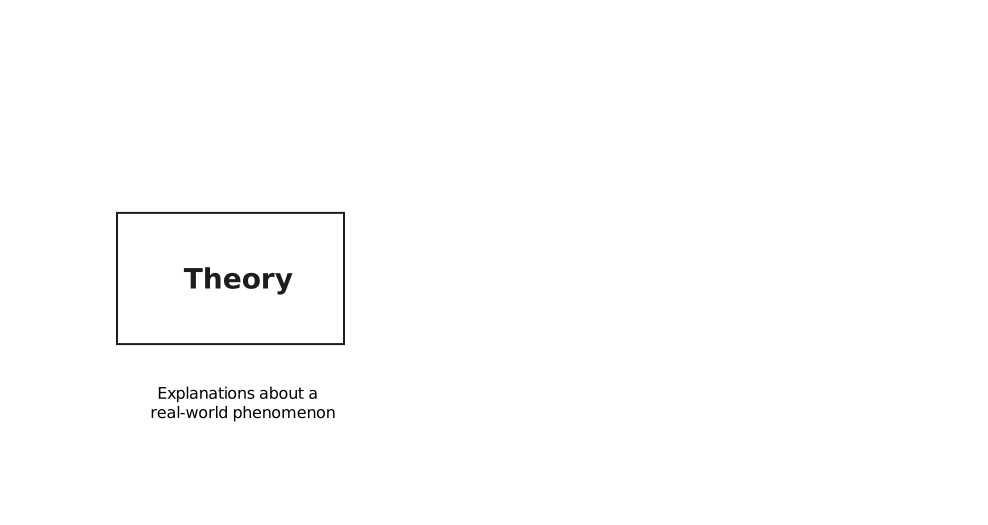
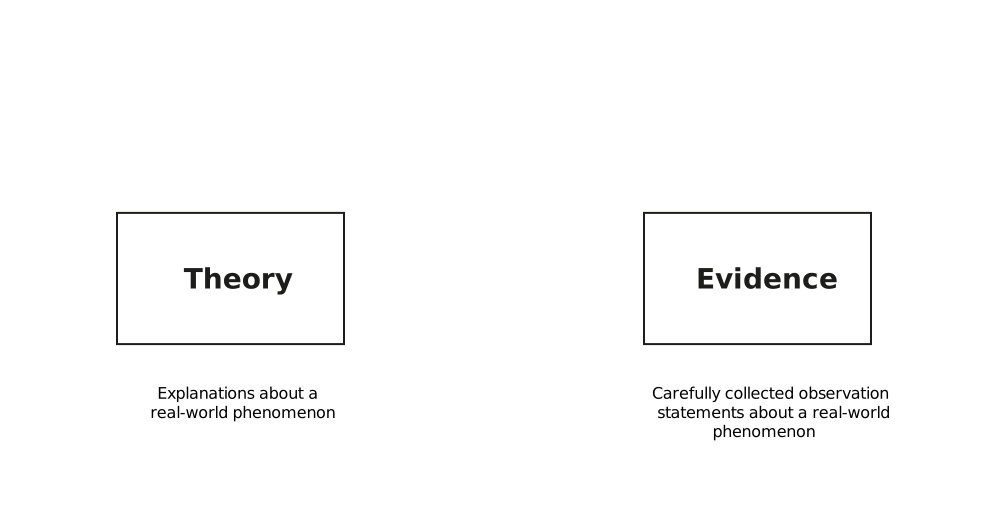
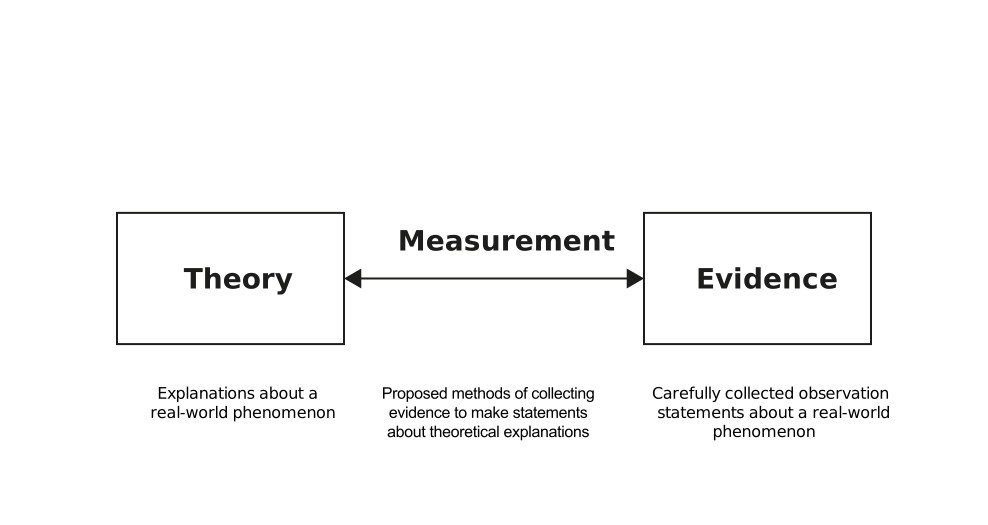
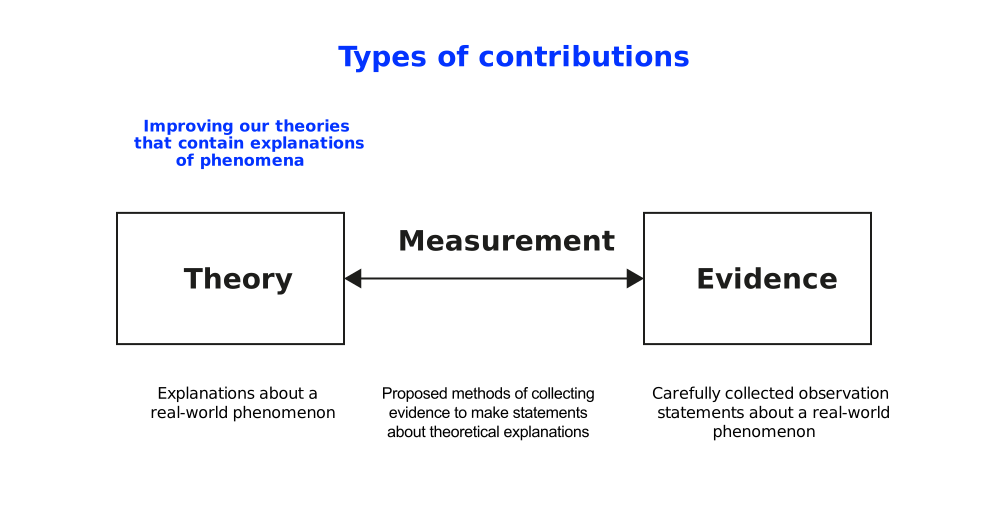
The body of scientific knowledge in a domain, that is, the outcome of all research to date, is always the current accumulation of suggested theories, evidence, and measurement methods in that domain (Recker, 2021, p. 20).
Progress in scientific research, that is, progress in general human knowledge, can be studied by comparing how well we are improving the body of knowledge, the current accumulation of theories, evidence, and measurements in a given area.
Contributions
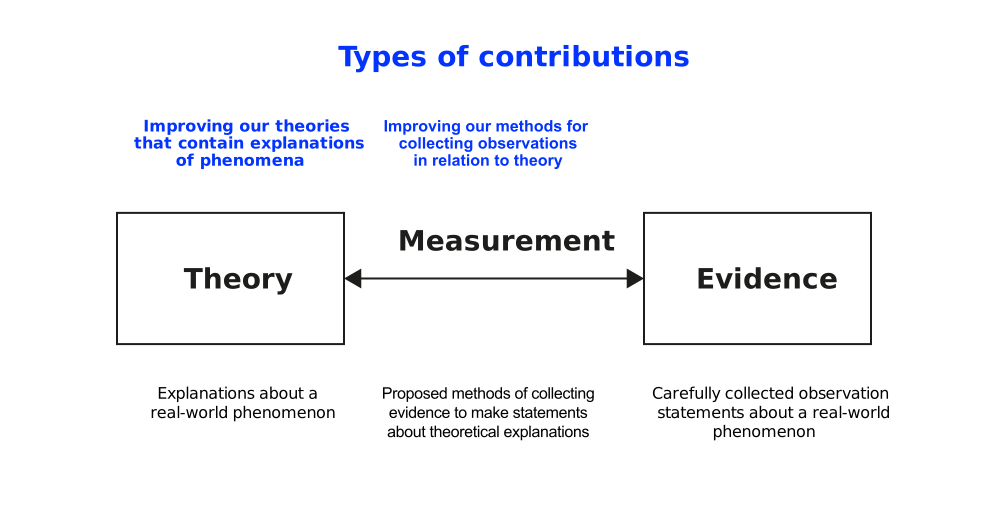
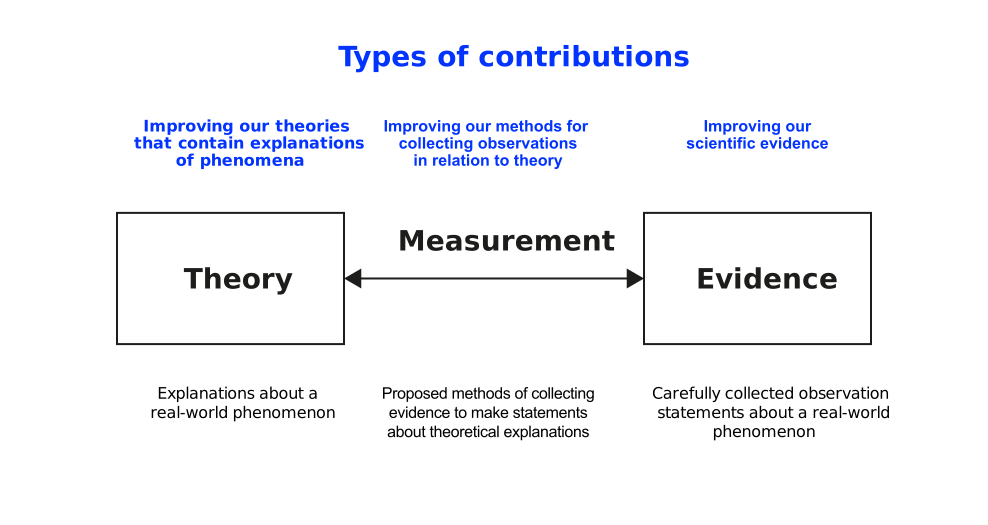
Conclusion
Research aims at improving scientific knowledge of a particular phenomenon.
All scientific knowledge is, by definition, a set of suggested explanations of particular phenomena.
Homework
Go back to your individual perspective notes.
Pick one of the eight industry inputs and answer:
- Which ontological stance does that practitioner’s account implicitly take: is the problem “out there” waiting to be discovered, or is it constituted by how people in the organization talk about and act on it?
- Which epistemological stance follows from that: would you expect this practitioner to trust a large-sample measurement, or a rich account from someone close to the situation, more?
- If two practitioners you heard from would disagree on the answers to (1) and (2), what does that tell you about the tension you are considering pursuing?
Q&A
Footnotes
Falsification is probably the most important principle in scientific research. It originates from the thinking of philosopher Popper (2005), who argued that it is logically impossible to prove theories in scientific research. Instead, he argued that scientific theories can only be disproven or falsified.