Adaptive Behavior
What tensions do leaders face and how do they adapt?
Neu-Ulm University of Applied Sciences
February 14, 2026
Agenda
- Warm-up 15 min
- Paradox & behavioral complexity 50 min
- Break
- Competing Values Framework 30 min
- Adaptive leadership 25 min
- Synthesis 20 min
- Wrap-up 10 min
Learning Objectives
After completing this unit, you will be able to:
- Distinguish paradox from contradiction and explain why paradox is fundamental to contemporary organizations.
- Explain the Competing Values Framework as a diagnostic tool for leadership tensions.
- Differentiate technical problems from adaptive challenges using Heifetz’s framework.
- Apply the concept of behavioral complexity to analyse leadership situations.
Opening Remarks
The hallmark of a first-class leader is the ability to demonstrate contrary or opposing behaviors while maintaining a certain level of integrity, credibility and direction. Denison et al. (1995)
Warm-up
Individual Reflection
What interesting insights did you get from reading Lavine (2014)?
Write down
- One insight that confirmed something you expected.
- One finding that surprised you.
03:00
Pair Share
On which surprising insight can you agree on?
Pair with your neighbor(s) and share your individual notes.
Agree on your one most surprising insight.
04:00
Plenum
Share one finding with the plenary.
05:00
Each pair presents their top insight.
Paradoxes in Leadership
Opening Remarks
Leadership requires the capacity to recognize and react to paradox, contradiction, and complexity. Denison et al. (1995)
Definitions #1
What is a contradiction,
what a paradox?
Think before you share your thoughts.
03:00
Paradox
Contradiction refers to bipolar opposites that are mutually exclusive and interdependent such that the opposites define and potentially negate each other (Putnam et al., 2016, p 6).
Example: A supervisor manages a remote team by strictly enforcing a ‘9-to-5’ login policy. If an employee attends a child’s school play, they are physically and legally ‘not at work.’ Here, work and family are treated as mutually exclusive blocks of time: the presence of one necessitates the absence of the other.
Paradox refers to contradictions that persist over time, impose and reflect back on each other, and develop into seemingly irrational or absurd situations because their continuity creates situations in which options appear mutually exclusive, making choices among them difficult (Putnam et al., 2016, p 8).
Example: An organization implements ‘Unlimited Paid Time Off’ to give employees total autonomy. However, because employees want to prove they are worthy of such trust, they feel pressured to work harder and take less leave than before. The very policy designed to provide freedom (autonomy) ends up tightening the ‘invisible’ leash of self-surveillance (control). This is paradoxical because the increase in freedom directly causes an increase in constraint, creating an absurd cycle that persists regardless of how many ‘days off’ are offered.
Definitions #2
What is ambidexterity,
what is behavioral complexity?
Think before you share your thoughts.
03:00
Ambidexterity
Ambidexterity refers to “an organization’s capacity to address two organizationally incompatible objectives equally well.” Birkinshaw & Gupta (2013, p. 291)
The ability of senior leadership teams to embrace tension between old states and activities and new ones is a key predictor of firm success (Tushman et al., 2011).
Leaders must “embrace inconsistency by maintaining multiple and often conflicting strategic demands.” O’Reilly III & Tushman (2011, p. 76)
Behavioral Complexity
It takes complexity to defeat complexity. Uhl-Bien et al. (2007, p. 301)
Increasing social and organizational complexity requires cognitive complexity and behavioral complexity: to “conceive and perform” (Denison et al., 1995, p. 524).
Effective leaders are those who have the cognitive as well as the behavioral capacity to recognize and react to paradox, contradiction, and complexity in their environments (Denison et al., 1995; Lawrence et al., 2009; Spreitzer & Quinn, 1996).
Effective leadership is dependent on behavioral complexity, “the ability to perform the multiple roles and behaviors that circumscribe the requisite variety implied by an organizational or environmental context”. (Denison et al., 1995, p. 526)
This capacity to act flexibly across competing demands is exactly what adaptive leadership theory formalizes.
Paradoxes in Practice
Think of a leader you have observed (boss, coach, teacher, project lead).
- Identify a paradox they faced (i.e., two contradictory demands at the same time).
- How did they handle it? Did they choose a side, oscillate, or hold both?
- Would you describe their approach as showing behavioral complexity?
05:00
Competing Values Framework
Opening Remarks
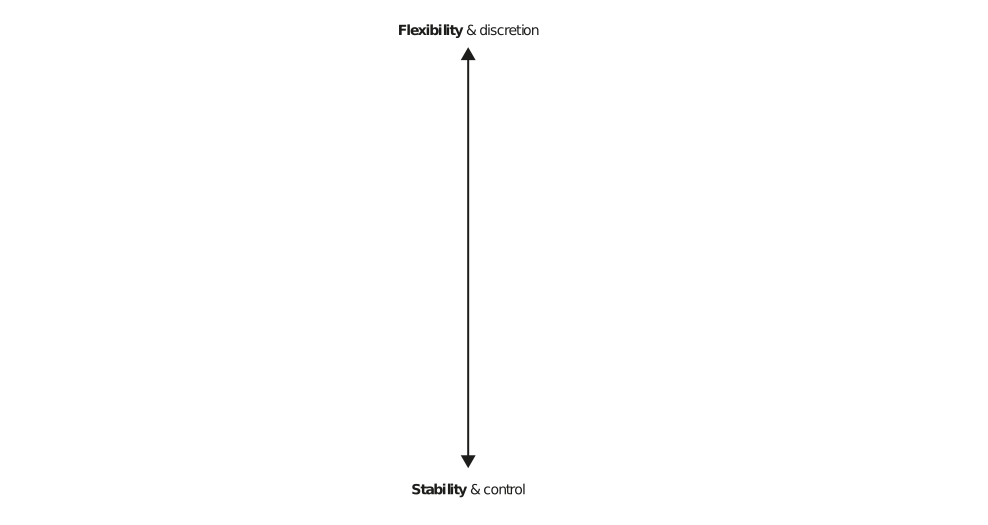
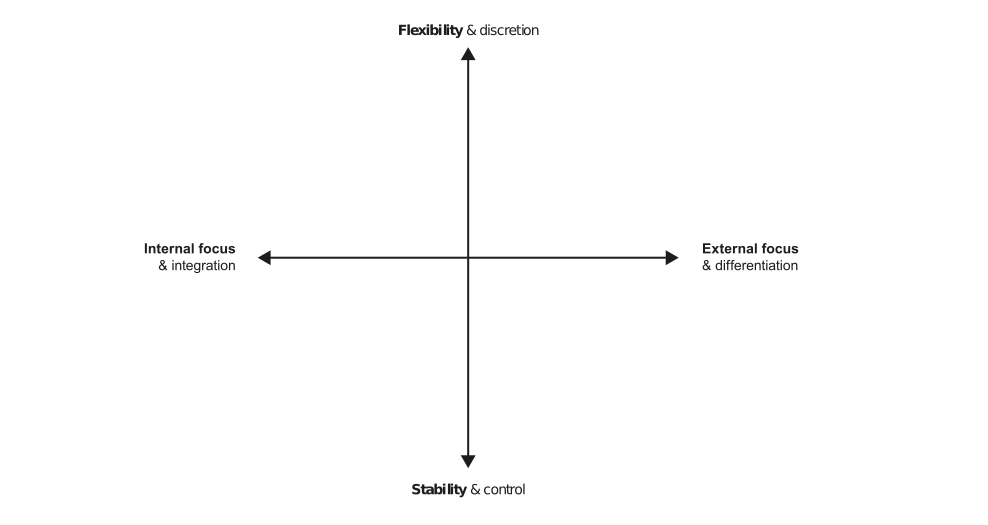
The competing values framework highlights the trade-offs, tensions, contradictions, and paradoxes inherent in organizations and their leaders. Lavine (2014, p. 194)
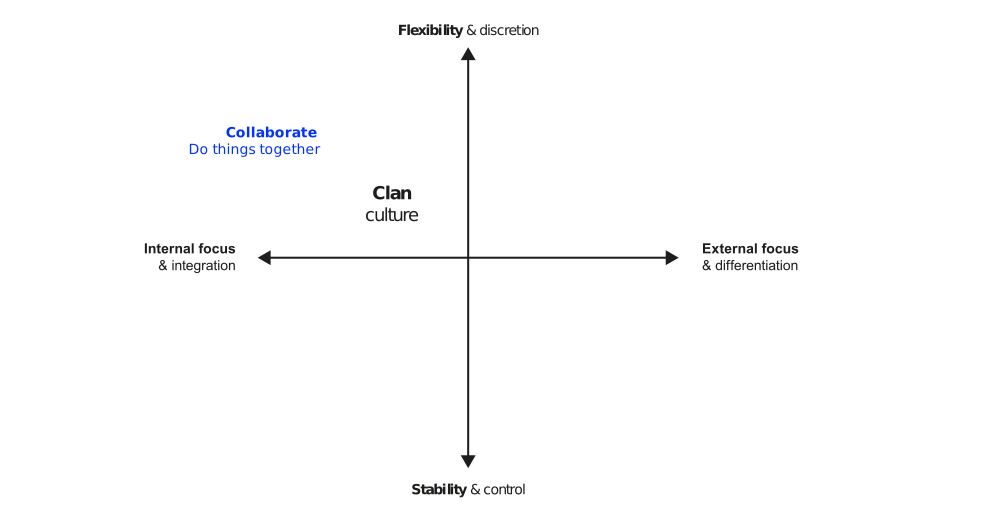
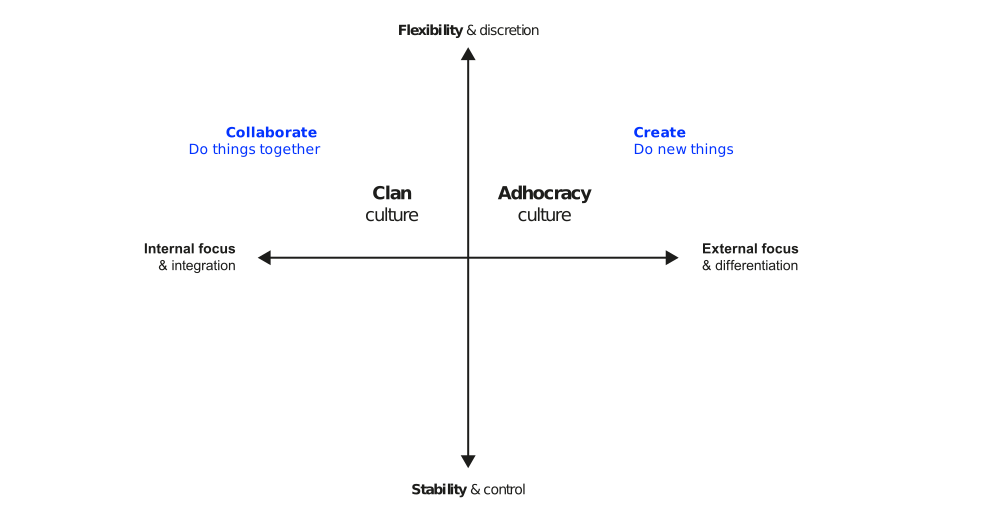
Competing Values (Complexities)
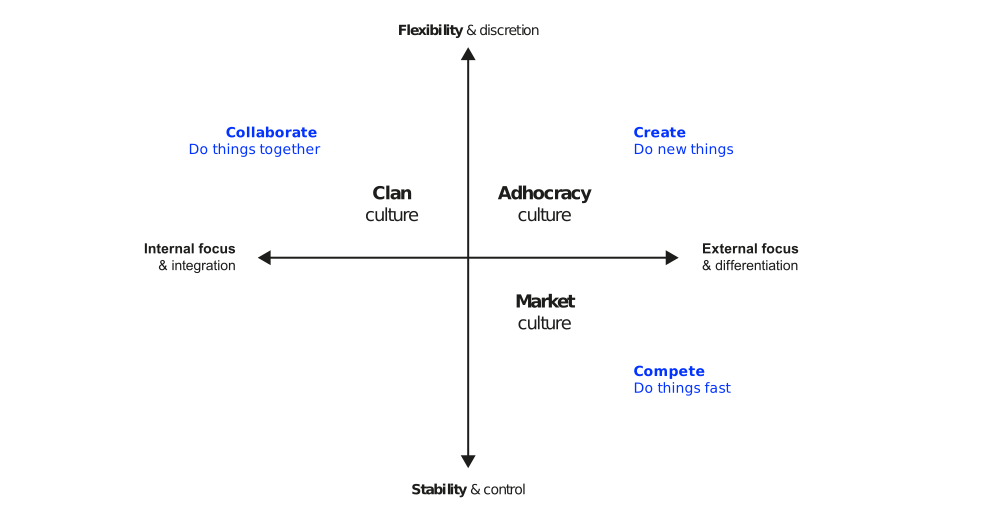
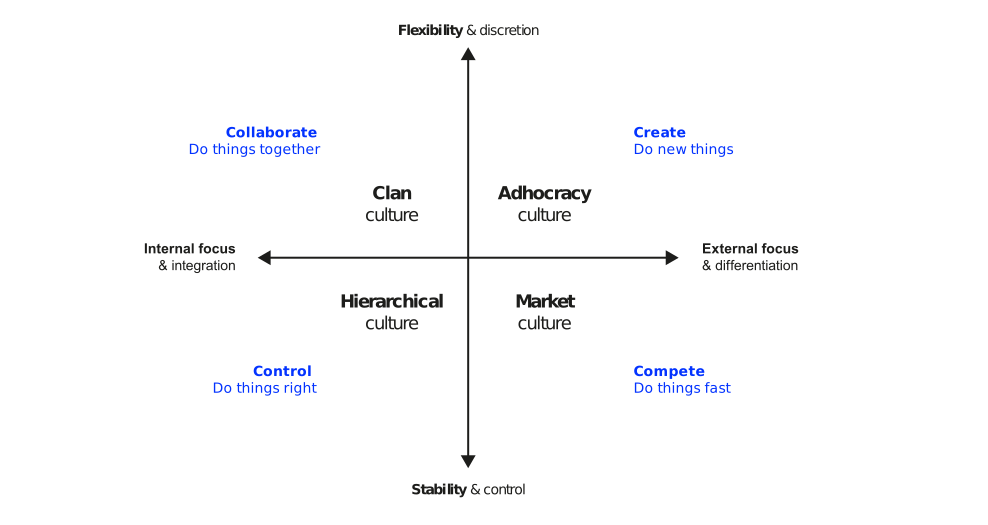
Leadership Roles
| Clan (collaborate) | Adhocracy (create) |
| Mentors, facilitators or team builders: they hold everything together when times are tough, and encourage the pursuit of shared objectives. They’ll help members of their team develop the skills needed to work together more effectively. | Visionaries: they embrace change and new thinking, and are often not overly worried about risk. They’re not just imaginative, but eager to turn their ideas into reality. |
| Hierarchy (control) | Market (compete) |
| Managers: they’re focused on organizing, problem solving, and ensuring things are done correctly. They’re scrupulous about paying attention to detail, staying informed, and being rigorous in their analyzes. | Deal makers: they are results-driven, and usually focused on the short-term. They like to take charge, and act fast to close deals with customers. |
Implications
Leadership qualities seem to be best demonstrated by more movement throughout the framework, suggesting complex adaptation to changing circumstances (Denison et al., 1995).
Complex situations require complex responses. Sometimes organizations benefit from stability, and sometimes they benefit from change. Often organizations need both stability and change at the same time. In contrast to earlier approaches, the development of the competing values framework did not assume that stability and change were mutually exclusive, an either/or decision. Quinn et al. (2020, p. 12)
Digital Paradoxes
How does the digital age influence these paradoxes?
How do digital technologies amplify the paradoxes and/or enable leaders to manage them?
05:00
Break
Situational & Adaptive Leadership
Situational Leadership
The Situational Leadership model (Hersey & Blanchard, 1977) proposes that leaders should adapt their style based on the readiness level of their followers: their ability and willingness to perform a specific task.
| Follower readiness | Leadership style | Leader behavior |
|---|---|---|
| Low ability, low willingness |
Telling | High task, low relationship Provide specific instructions and close supervision |
| Low ability, high willingness |
Selling | High task, high relationship Explain decisions and provide opportunity for clarification |
| High ability, low willingness |
Participating | Low task, high relationship Share ideas and facilitate decision-making |
| High ability, high willingness |
Delegating | Low task, low relationship Turn over responsibility for decisions and implementation |
Adaptive Leadership
Heifetz (1994) distinguishes between two fundamentally different types of challenges leaders face, which require different behaviors:
Technical problems
- Problem definition is clear
- Solution is known
- Expert knowledge can solve it
- Implementation through authority
Example: A hospital needs to upgrade its IT system. The requirements are known, vendors can be evaluated, and the project can be managed.
Adaptive challenges
- Problem definition is unclear
- No known solution exists
- Requires learning and changed behavior
- Implementation through engagement
Example: A hospital needs to fundamentally change its culture to reduce medical errors. This requires changed beliefs, behaviors, and relationships at every level.
Exercise
Think of a challenge from your own experience
(work, study, personal project).
Discuss with your neighbor:
- Was it a technical problem or an adaptive challenge?
- How was it treated (i.e., technically or adaptively)?
- If there was a mismatch, what were the consequences?
05:00
Adaptive Leadership Practices
Heifetz & Linsky (2002) identify four key practices for leading through adaptive challenges:
- Getting on the balcony: Step back from the action to observe patterns, political dynamics, and systemic issues. Leaders who are only “on the dance floor” cannot see the larger picture.
- Regulating distress: Adaptive work generates discomfort because it challenges existing beliefs and competencies. Leaders must create enough disequilibrium to motivate change, but not so much that people become overwhelmed.
- Giving the work back: The leader cannot solve adaptive challenges alone. The people with the problem must do the work of adapting. The leader’s role is to create the conditions for this learning.
- Protecting voices of leadership from below: People closest to the problem often have critical insights, but their views may be suppressed. Adaptive leaders protect and amplify dissenting voices.
Behavioral Complexity
Adaptive challenges require behavioral complexity: the movement across all four CVF quadrants:
- Collaborate: facilitate group learning and create psychological safety for experimentation
- Create: experiment with novel approaches and tolerate productive failure
- Compete: make difficult trade-off decisions when resources are scarce
- Control: establish structures that provide enough stability for people to take risks
Synthesis
An Integrated View
Three frameworks, one challenge:
| Framework | Asks | Insight |
|---|---|---|
| CVF | What competing demands exist? | Map the tension landscape |
| Situational | What do followers need? | Match style to readiness |
| Adaptive | Is the problem technical or adaptive? | Choose the right mode of leadership |
Together, they provide a diagnostic toolkit
for behavioral complexity.
Exercise
Analyze a leadership challenge
using all three frameworks.
Scenario: A mid-sized company is implementing AI-driven customer service, replacing 30% of human agents. The remaining team is anxious, the technology is unproven, and customer satisfaction is dropping.
- CVF: Which quadrants are in tension?
- Situational: What do different stakeholders need (e.g., transformation lead, CEO, anxious customer-service agent, customer representative)?
- Adaptive: Technical problem, adaptive challenge, or both?
- Synthesis: What would a behaviorally complex leader do?
08:00
Leading Innovation
Opening Remarks
Leading innovation takes a distinctive kind of leadership, one that unleashes and harnesses the “collective genius” of the people in the organization. Linda A. Hill
Innovation
What is an innovation?
An innovation can be defined as an idea, practice, or material artifact perceived to be new by the relevant unit of adoption and offers worthwhile benefits (Dewar & Dutton, 1986).
Nature of Innovating
Innovating is not about some genius having an aha moment.
Innovating is a team sport: combining individual’s member’s separate slices of genius into a single work of collective genius. Innovation requires a place where people are willing and able to do the hard work that innovative problem solving requires (Hill et al., 2014a).
Significance
Competitiveness depends to a large extent on the ability to innovate. So the ongoing challenge is to build an organisation that is able to innovate all the time.
The rhetoric of innovation is often about fun and creativity, but the reality is that innovation can be very taxing and uncomfortable, both emotionally and intellectually. Hill et al. (2014a, pp. p. 5)
This requires a different kind of leadership.
Leadership
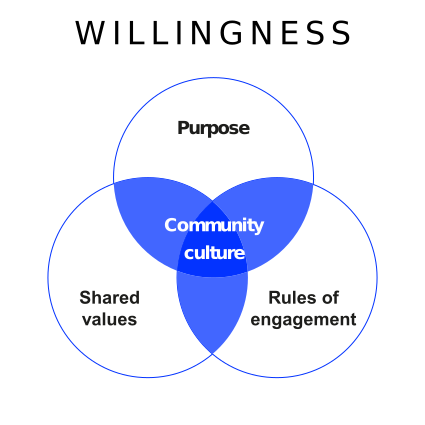
The role of a leader of innovation is to create a community that is willing and able to generate new ideas. (Hill et al., 2014a, p. 4)
So the guiding question becomes “how do I set the stage for it to happen?”
rather than “how do I make innovation happen?”
Paradoxes of Innovation
The paradox at the heart of innovation is the need to unleash the talents of individuals and to harness those talents in the form of collective innovation (Hill et al., 2014b).
Hard Work of Innovation
The role of an innovation leader is to create a community that is willing and able to innovate over time (Hill et al., 2014a).
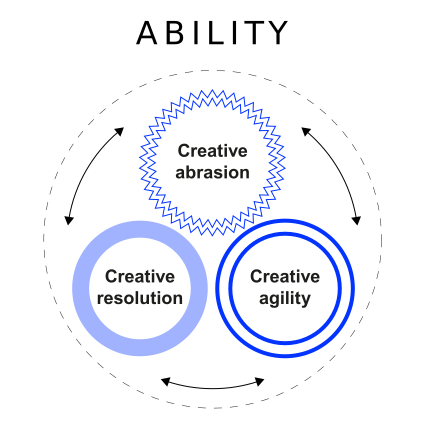
Creative Abrasion
Art challenges technology.
Technology challenges art.
Part of the magic of Pixar is that these two disciplines bump up against each other and create something better than either could create by itself. Greg Brandeau, Pixar Animation Studios
Creative Agility
Pursue. Reject. Adjust.
We used to launch products in an “all or nothing” mode to all of our users. Now we had the capability to test multiple different live versions of new products on 1 percent samples of our users. This yielded huge data sets and brought with it a change in mind-set for approaching innovation. We began to avoid projects that only allowed for “zero or one” decisions, instead choosing projects that could be rolled out and evaluated in small slices. Philipp Justus, eBay Germany
Creative Resolution
From either or
to both-and thinking
We hired innovators and if I were to forbid a passionate team to do something, it really would have misused their talents. I wanted people with a vision, and the ambition to build the next great thing. We needed to let teams go far enough so they could in fact discover this great new thing. Or, in another scenario, they had to recognize it was not quite right, then decide to work on something else, in the best-case scenario integrating their knowledge to another solution. Bill Coughran, Google
Innovation Leaders
The leaders Hill et al. (2014b) studied had some things in common. They call it the right stuff
They are found to be:
Wrap-up
Latticework Update
Which new models have you added to your latticework?
- Competing values as a diagnostic framework
- Technical vs. adaptive problem distinction
- Inversion and both/and thinking for navigating paradox
Closing Remark
Leadership requires the capacity to recognize and react to paradox, contradiction, and complexity. (Denison et al., 1995)
Q&A
Homework
Read House (1996) and answer following questions:
- What is the essence of the theory?
- How does leader behavior impact subordinates’ motivation, satisfaction, and performance?
- What leader behaviors have you experienced?
- Do you have empirical evidence on the propositions made?
Look for connections between the CVF quadrants and the leader behaviors described by House.
Literature
Footnotes
Generosity here means the willingness, based on their own sense of personal security, to share power, control and credit
This includes the willingness to admit imperfections and asking for help