Learning Objectives
After completing this unit, you will be able to:
- Trace the evolution of leadership thought from Great Man theory to complexity leadership.
- Analyze how the Big Five personality traits relate to leadership emergence and effectiveness.
- Explain the LTEE model and the interplay of genetics, traits, and context in leader emergence.
- Assess both the bright and dark sides of personality traits in leadership contexts.
- Reflect on your own trait profile and emotional intelligence as a foundation for leadership development.
Evolution of Leadership
A Brief History
Before we examine what specific traits matter, it helps to understand how our thinking about leadership has evolved.
Each era emphasized different aspects and each provided useful mental models.
Great Man Theory (1840s)
Great leaders are born, not made.
Carlyle (1841) argued that history is shaped by exceptional individuals with innate heroic qualities. Leadership was seen as a gift bestowed on a select few (typically male, aristocratic, and military).
The Great Man Theory reflects the 19th-century belief that leadership capacity is inherent and cannot be developed. While largely discredited, it planted the seed for trait-based research: if great leaders are “different,” what exactly makes them different? This question drove decades of subsequent research.
Trait Approaches (1930s–1940s)
Leadership depends on the personal qualities of the leader.
Early researchers sought universal traits that distinguish leaders from non-leaders.
Initial reviews (e.g., Stogdill, 1948) found inconsistent results, leading many to abandon the trait approach until meta-analyses revived it decades later (e.g., Judge et al. (2002)).
The trait approach represents a more scientific evolution of the Great Man idea. Rather than assuming leaders are “born great,” researchers tried to measure what traits correlate with leadership. The approach fell out of favor mid-century because no single trait seemed universally predictive. It was later revived with more sophisticated methods, notably the Big Five framework and meta-analyses like Judge et al. (2002).
Behavioral Theories (1950s–1960s)
If traits alone don’t explain leadership, perhaps what leaders do matters more than who they are.
Two important research programs:
- Ohio State Studies identified initiating structure (task-oriented) and consideration (relationship-oriented) as key leadership behaviors (Fleishman, 1953).
- Michigan Studies distinguished production-oriented and employee-oriented leadership (Katz et al., 1950).
The behavioral approach shifted the focus from traits to observable actions. Its key insight: leadership can be learned through developing the right behaviors, not just born. This opened the door to leadership development programs. However, the approach struggled to account for the fact that the same behaviors work well in some situations but not others, which led to contingency theories.
Contingency Theories (1960s–1970s)
There is no single best way to lead.
Effectiveness depends on the situation.
Key models:
- Fiedler’s Contingency Model (Fiedler, 1967) states that leader effectiveness depends on the match between leadership style and situational favorability.
- Hersey & Blanchard’s Situational Leadership (Hersey & Blanchard, 1977) advises leaders to adapt their style (i.e., telling, selling, participating, delegating) based on follower readiness.
Contingency theories represent a major conceptual leap: they reject the idea of universally effective leadership and instead argue that context matters. Fiedler (1967) proposed that leaders have relatively fixed styles and should be matched to appropriate situations. Hersey & Blanchard (1977) took a more flexible view, arguing leaders can and should adapt. We will revisit situational and adaptive leadership in depth in Unit 3.
Transformational Leadership (1980s–1990s)
Leaders transform followers by inspiring them to transcend self-interest for the sake of the organization.
Transformational leadership theory brought emotion, vision, and meaning back into the leadership conversation. It explained why some leaders inspire extraordinary commitment while others, equally competent, do not. The theory has strong empirical support and remains one of the most widely studied leadership frameworks. Its emphasis on vision and inspiration connects directly to our later unit on storytelling (Unit 9).
Complexity Theories (2000s+)
In complex adaptive systems, leadership is distributed, emergent, and contextual.
Complexity and adaptive leadership theories reflect the realities of the VUCA world we discussed in Unit 1. They argue that in highly complex, interconnected environments, the “heroic leader” model is insufficient. Instead, leadership must be understood as a system-level phenomenon that emerges through interactions. We will explore the adaptive leadership framework (Heifetz, 1994) in depth in Unit 3.
Overview
Each paradigm offers a mental model for understanding leadership, and each remains partially useful:
| Era | Core mental model | Still useful for… |
|---|---|---|
| Traits | Individual differences matter | Self-awareness, selection |
| Behavioral | Actions can be learned | Leadership development |
| Contingency | Context determines effectiveness | Situational judgment |
| Transformational | Vision inspires commitment | Organizational change |
| Complexity | Systems produce emergence | Digital transformation |
No single paradigm “won.” Each captured something the others missed. This is precisely the latticework idea from Unit 1: effective leadership thinking requires multiple models. In this unit, we focus on traits, with the understanding that it is one map among many.
The Big Five
Big Five Traits
The Big Five traits have been found to be relevant to many aspects of life, such as subjective well-being (e.g., DeNeve & Cooper, 1998) and even longevity (Friedman et al., 1995). They also provide a valuable taxonomy for the study of leadership (Judge et al., 2002).
- Openness to Experience
- This trait reflects a person’s willingness to explore new ideas, be curious, and engage with novel experiences. Those high in openness tend to be creative, imaginative, and interested in art, music, and diverse cultural experiences. They’re often intellectually curious and comfortable with abstract thinking. Those lower in openness may prefer familiarity, concrete thinking, and conventional approaches.
- Conscientiousness
- This trait describes a person’s tendency to be organized, disciplined, and achievement-oriented. Highly conscientious individuals are typically reliable, thorough, and methodical in their approach to tasks. They value planning, order, and completing responsibilities. Those lower in conscientiousness may be more spontaneous, disorganized, and might prioritize flexibility over structure.
- Extraversion
- This trait reflects a person’s preference for social interaction and external stimulation. Extraverts tend to be energetic, talkative, and gain energy from being around others. They often seek excitement and are comfortable in group settings. Introverts (those low in extraversion) typically prefer quieter environments, deeper one-on-one interactions, and need time alone to recharge.
- Agreeableness
- This trait describes a person’s tendency toward cooperation and social harmony. Highly agreeable individuals are typically compassionate, considerate, and eager to help others. They value getting along with people and avoiding conflict. Those lower in agreeableness tend to be more competitive, skeptical, and willing to challenge others’ views.
- Neuroticism (sometimes referred to as Emotional Stability)
- This trait reflects a person’s tendency to experience negative emotions and psychological distress. Individuals high in neuroticism may experience more anxiety, mood swings, irritability, and emotional reactivity. Those low in neuroticism (high in emotional stability) tend to be more calm, emotionally resilient, and less easily upset by stressors.
Big Five x Leadership
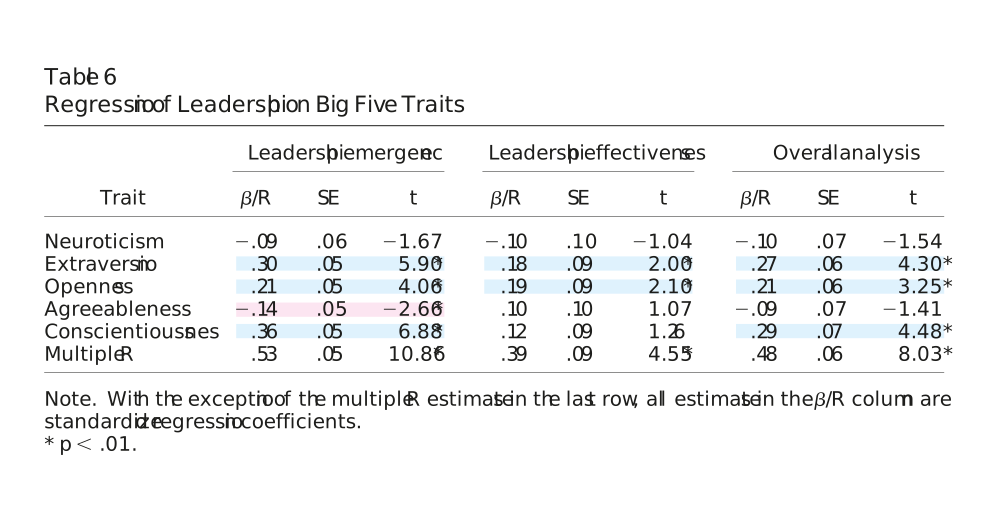
Leadership effectiveness refers to a leader’s performance in influencing and guiding the activities of his or her unit toward achievement of its goals (Stogdill, 1950).
Leadership emergence refers to whether (or to what degree) an individual is viewed as a leader by others, who typically have only limited information about that individual’s performance (Hogan et al., 1994).
Leadership effectiveness and emergence represent two levels of analysis. Leadership emergence is a within-group phenomenon. In contrast, leadership effectiveness represents a between-groups phenomenon.
Regarding these two constructs and personality traits, the meta-analysis of Judge et al. (2002) shows that:
- The Big Five typology is a fruitful basis for examining the dispositional predictors of leadership.
- Extraversion is the most important trait of leaders and effective leadership.
- Extraversion is more strongly related to leader emergence than to leader effectiveness.
- Extraversion, Conscientiousness and Openness to Experience were the strongest and most consistent correlates of leadership.
- Conscientiousness is more strongly related to leader emergence than to leadership effectiveness.
- Agreeableness was the least relevant trait.
- Neuroticism failed to emerge as a significant predictor of leadership.
Overall, the traits are better predictors in situations in which individuals have only limited opportunity to observe leadership behaviors (i.e., student samples). However, the results may simply indicate a close correspondence between the way we see people’s personalities and our stereotypical conceptions of the characteristics of leaders.
Trait Paradoxes
| Trait | Bright Side | Dark Side |
|---|---|---|
| Extraversion | Greater leadership emergence; higher job and life satisfaction | More impulsive (deviant) behaviors; more accidents |
| Agreeableness | Higher subjective well-being; lower interpersonal conflict; lower turnover | Lower career success; less capable of conflict; more lenient in giving ratings |
| Conscientiousness | Stronger job performance; higher leadership effectiveness; lower deviance | Reduced adaptability; lower learning in initial stages of skill acquisition |
| Emotional stability | High job/life satisfaction; better job performance; effective leadership; retention | Poorer ability to detect risks and danger; more risky behaviors |
| Openness | Higher creativity; greater leadership effectiveness; greater adaptability | More accidents and counterproductive; rebelliousness; lower commitment |
Evolution
Studies of identical twins separated at birth have indeed provided valuable insights into the genetic basis of personality traits, including those associated with leadership. Twin studies typically show heritability estimates of 30-60% for leadership tendencies, suggesting a significant genetic component. However, the research doesn’t support a purely deterministic “born leader” perspective for several reasons:
- Even with identical twins raised apart, the heritability of leadership traits is never 100%. Environmental factors still play a substantial role.
- Leadership comprises multiple traits and abilities (like extraversion, assertiveness, decision-making skill, emotional intelligence) that may each have different genetic influences.
- The expression of genetic predispositions often depends on environmental triggers and opportunities (gene-environment interaction).
- Leadership development research shows that many leadership skills can be learned and improved through experience, mentoring, and deliberate practice.
- Cultural and situational factors heavily influence who emerges as a leader and what leadership styles are effective.
A more nuanced view supported by contemporary research is that certain individuals may have genetic predispositions that make leadership roles more natural or appealing to them, but these predispositions require the right environmental conditions, learning experiences, and opportunities to develop into effective leadership.
“Asking how much a particular individual’s attitudes or traits are due to heredity versus the environment is nonsensical, just like asking whether a leaky basement is caused more by the crack in the foundation or the water outside.” Olson et al. (2001, pp. pp. 845–846)
The LTEE Model
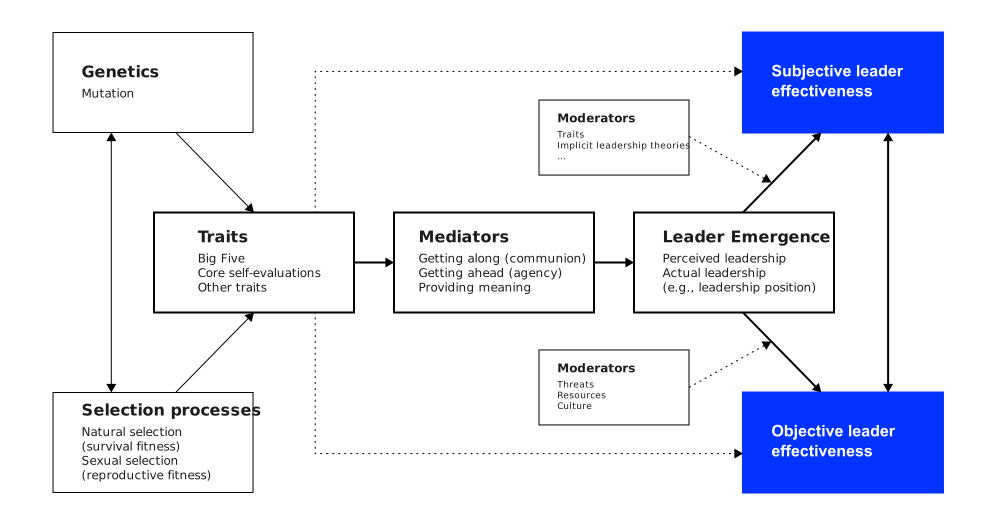
The Leader Trait Emergence Effectiveness (LTEE) model combines the behavioral genetics and evolutionary psychology theories of how personality traits are developed into a model that explains leader emergence and effectiveness (Judge et al., 2009).
- The genetics are the foundational biological basis for leadership potential. Genetic predispositions influence personality traits, cognitive abilities, emotional regulation as well as neurological characteristics that support leadership behaviors.
- Selection processes refer to the mechanisms by which potential leaders are identified and developed. While genes determine the expression of traits, evolutionary processes, in organizations and in collectives more generally, determine which traits are “selected in” and “selected out.”
- Traits are individual characteristics that contribute to leadership potential.
- Mediators are intervening factors that translate traits into leadership behaviors. Based on Socioanalytic Theory Judge et al. (2009) argue that the reason traits result in leader emergence is because of the motives the traits elicit. For example,
- conscientious, extraverted, and emotionally stable (or high core self-evaluations) individuals may be more motivated to get ahead (agency, competing)
- extraverted and agreeable individuals may be more likely to go along (communion, cooperation),
- and intelligent, and charismatic individuals may be more likely to provide meaning for their compatriots
- Leader emergence is the process of transitioning from potential to recognized leadership, which depends on the context and the adaptive processes. As adaptive and coordination problems increase, so does the importance of leadership. There is little need for prudent, courageous and flexible leadership when the collective faces little conflict from within or without. Thus, leader emergence occurs through recognition and opportunity.
- Subjective effectiveness reflects perceived leadership quality (e.g., peer receptions, follower satisfaction, reputation and social standing).
- Objective effectiveness demonstrates tangible leadership impact (e.g., team productivity, goal achievement, financial performance).
Emotional Intelligence
Intelligence is the most “successful” trait in social and applied psychology (Judge et al., 2009).
Goleman (1998) argues that emotional intelligence, not IQ (intelligence, a trait), sets apart great leaders.
Emotional intelligence is a group of five skills that enable the best leaders to maximize their own and their followers’ performance:
- Self-awareness: knowing one’s strengths, weaknesses, drives, values, and impact on others.
- Self-regulation: controlling or redirecting disruptive impulses and moods.
- Motivation: relishing achievements for its own sake.
- Empathy: understanding other people’s emotional makeup and treating them accordingly.
- Social skill: building rapport with others to move them in desired directions.
Self-Awareness
Self-awareness, the first component of emotional intelligence, is arguably the foundation of all leadership development.
Leaders who understand their own strengths, weaknesses, values, and emotional patterns can better manage themselves, relate to others, and adapt to different situations.
Research consistently shows that self-aware leaders are more effective. They make sounder decisions because they understand their own biases. They build stronger relationships because they can accurately read how their behavior affects others. And they develop faster because they know where to focus their growth efforts.
Self-awareness connects directly to what we discussed about mental models in Unit 1: just as the “map is not the territory,” our self-image is not a perfect representation of who we actually are.
Cognitive biases, particularly confirmation bias in self-perception, can distort our self-understanding. Seeking disconfirming evidence about ourselves is just as important as seeking it in our decision-making.
Conclusion
It is fortunate, then, that emotional intelligence can be learned.
Goleman (1998)
Learning might mean here being able to deal efficiently with our personality traits that have a genetic source.
Homework
Read Lavine (2014) and answer following questions:
- What is ambidexterity, what is behavioral complexity?
- Why does a complex world require behavioral complexity?
- Which leadership paradoxes are identified by the CVF?
Can you give specific examples for each? - How do the paradoxes relate to the specifics of the digital era?