Leader
What makes an effective leader?
Neu-Ulm University of Applied Sciences
February 13, 2026
Introduction
Today’s session
- Activation & check-in 15 min
- Evolution of leadership 25 min
- Big Five & paradoxes 35 min
- Break
- LTEE model 20 min
- Emotional intelligence 20 min
- Reflection & closing 10 min
Learning objectives
After completing this unit, you will be able to:
- Trace the evolution of leadership thought from Great Man theory to complexity leadership.
- Analyse how the Big Five personality traits relate to leadership emergence and effectiveness.
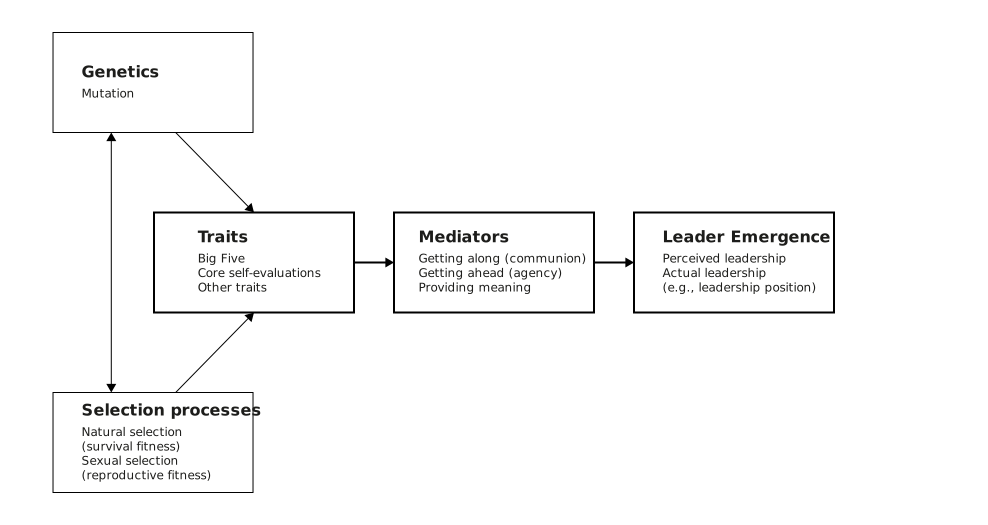
- Explain the LTEE model and the interplay of genetics, traits, and context in leader emergence.
- Assess both the bright and dark sides of personality traits in leadership contexts.
- Reflect on your own trait profile and emotional intelligence as a foundation for leadership development.
Activation
Latticework check-in
What mental models from Unit 1 might help us think about leader traits?
05:00
Individual reflection
Write down your findings.
- One key finding from Judge et al. (2002) that confirmed something you expected.
- One finding that surprised you.
04:00
Pair share
Turn to your neighbor
and compare your findings.
04:00
Where do you agree? Where did your surprises differ?
Evolution of leadership thought
A brief history
Before we examine what specific traits matter, it helps to understand how our thinking about leadership has evolved.
Each era emphasized different aspects
— and each left useful mental models behind.
Great Man Theory (1840s)
Great leaders are born, not made.
Carlyle (1841) argued that history is shaped by exceptional individuals with innate heroic qualities. Leadership was seen as a gift bestowed on a select few — typically male, aristocratic, and military.
Trait approaches (1930s–1940s)
Leadership depends on the
personal qualities of the leader.
Early researchers sought universal traits that distinguish leaders from non-leaders. Initial reviews (e.g., Stogdill, 1948) found inconsistent results, leading many to abandon the trait approach — until meta-analyses revived it decades later.
Behavioral theories (1950s–1960s)
If traits alone don’t explain leadership, perhaps what leaders do matters more than who they are.
- Ohio State Studies identified initiating structure (task-oriented) and consideration (relationship-oriented) as key leadership behaviors (Fleishman, 1953).
- Michigan Studies distinguished production-oriented and employee-oriented leadership (Katz et al., 1950).
Contingency & situational theories (1960s–1970s)
There is no single best way to lead.
Effectiveness depends on the situation.
- Fiedler’s Contingency Model (Fiedler, 1967) — leader effectiveness depends on the match between leadership style and situational favorability.
- Hersey & Blanchard’s Situational Leadership (Hersey & Blanchard, 1977) — leaders should adapt their style based on follower readiness.
Transformational leadership (1980s–1990s)
Leaders transform followers by inspiring them to transcend self-interest for the sake of the organization.
Complexity & adaptive leadership (2000s+)
In complex adaptive systems, leadership is distributed, emergent, and contextual.
Paradigm pitch
Prepare a 60-second pitch for one paradigm.
- Why is your paradigm’s mental model still useful today?
- Give a concrete example from the digital era.
05:00
The map of leadership theory
Each paradigm offers a mental model — and each remains partially useful:
| Era | Core mental model | Still useful for… |
|---|---|---|
| Traits | Individual differences matter | Self-awareness, selection |
| Behavioral | Actions can be learned | Leadership development |
| Contingency | Context determines effectiveness | Situational judgment |
| Transformational | Vision inspires commitment | Organizational change |
| Complexity | Systems produce emergence | Digital transformation |
The Big Five & leadership
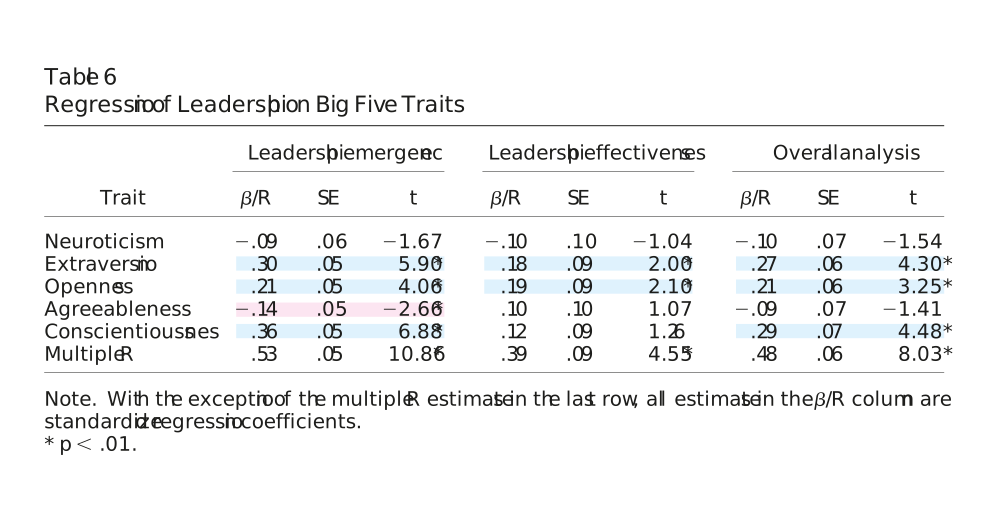
What distinguishes leaders?
What traits distinguish leaders
from other people?
10:00
Big Fixe x leadership
Trait paradoxes
Analyze a Big Five trait
Work through these questions:
- Summarize the bright side and dark side of your trait.
- Create a concrete leadership scenario where the trait helps — and one where it backfires.
- Is this trait more or less important in the digital era? Why?
15:00
Trait paradoxes
Present your two scenarios
and your digital-era verdict.
From traits to process
Born leaders?
We know which traits matter — but where do they come from?
Leaders are born.
Really?
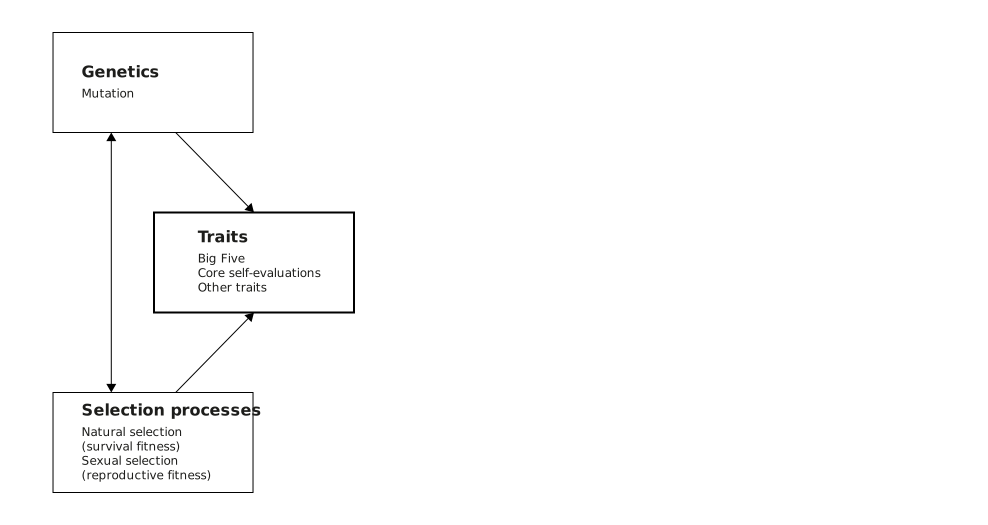
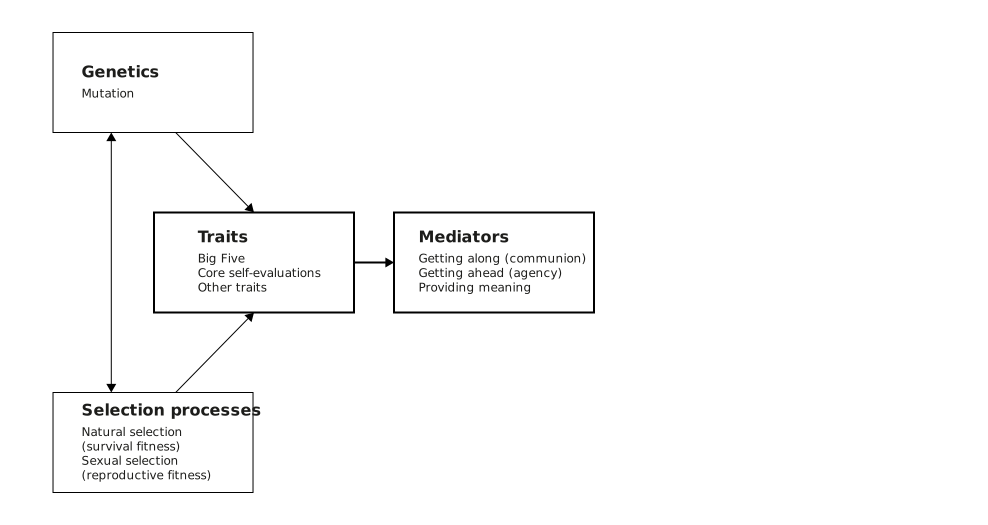
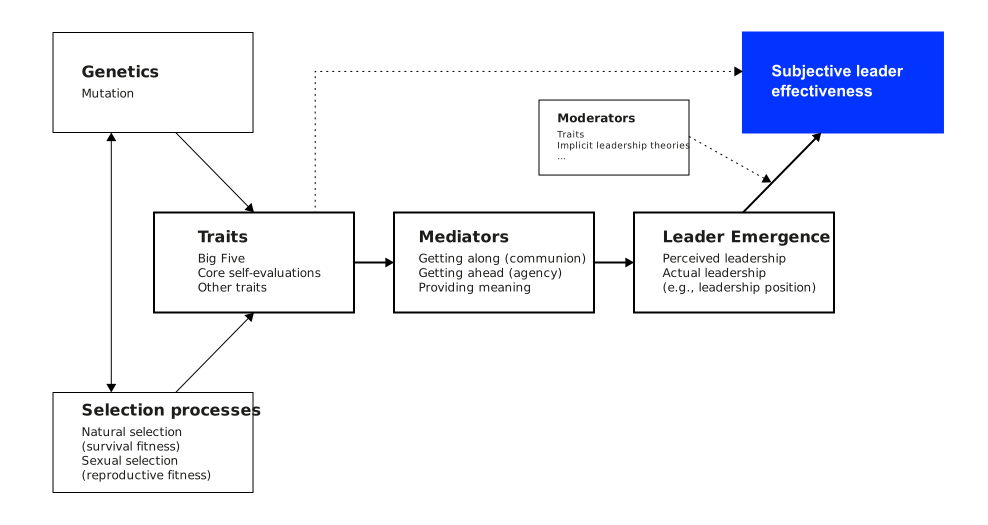
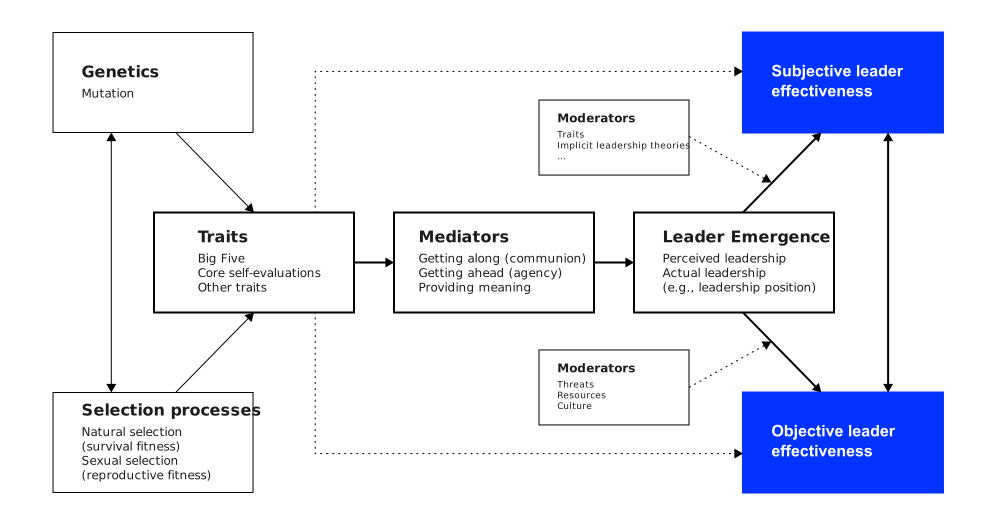
Traits have a genetic source and are the result of adaptive processes (Judge et al., 2009).
The statement oversimplifies a complex phenomenon that involves an interplay between genetic factors, developmental experiences, learning, and situational contexts.
The LTEE model
Think-Pair-Share
If traits have a genetic source,
can leadership really be developed?
Where in the LTEE model do you see room for development?
2 minutes individual thinking
3 minutes pair discussion.
05:00
Emotional intelligence
What sets great leaders apart?
Intelligence is the most “successful” trait
in social and applied psychology (Judge et al., 2009).
Goleman (1998) argues that it is not IQ, but emotional intelligence that makes great leaders.
Emotional intelligence is a group of five skills that enable the best leaders to maximize their own and their followers’ performance.
- Self-awareness — knowing one’s strengths, weaknesses, drives, values, and impact on others.
- Self-regulation — controlling or redirecting disruptive impulses and moods.
- Motivation — relishing achievement for its own sake.
- Empathy — understanding other people’s emotional makeup and treating them accordingly.
- Social skill — building rapport with others to move them in desired directions.
EQ skills — research
In your group (one EI skill per group), do this:
- Research the core characteristics of your skill.
- Find or construct a concrete leadership example.
- Identify one pathway to strengthen this skill.
- Is this skill gaining or losing importance in digital/hybrid work? Why?
05:00
EQ skills — share
Regroup into mixed teams — one expert per skill.
Each expert: teach your skill to the group in 2 minutes.
10:00
EQ skills — development
Which EI skill is the hardest to develop?
Which would have the most impact for digital leaders?
Reflection & closing
Self-awareness as foundation
Self-awareness — the first component of emotional intelligence — is arguably the foundation of all leadership development.
Leaders who understand their own strengths, weaknesses, values, and emotional patterns can better manage themselves, relate to others, and adapt to different situations.
Personal reflection
Based on what you have learned about the Big Five and emotional intelligence:
- Where do you see your strengths?
Which traits and EI skills come naturally to you? - Where are your potential dark sides?
Every strength has a shadow. Where might your strengths become liabilities? - What is your development edge?
Which EI skill, if strengthened, would have the greatest impact on your leadership?
05:00
Latticework update
Which new models have you added to your latticework?
- Cognitive biases in self-perception and other-perception
- Nature–nurture interaction as a thinking framework
- Trait paradoxes — every strength has a shadow
Closing quote
It is fortunate, then, that emotional intelligence can be learned.
Goleman (1998)
Homework
Read Lavine (2014) and answer following questions:
- What is ambidexterity, what is behavioral complexity?
- Why does a complex world require behavioral complexity?
- Which leadership paradoxes are identified by the CVF?
Can you give specific examples for each? - How do the paradoxes relate to the specifics of the digital era?