Storytelling
How to communicate with maximum impact?
Neu-Ulm University of Applied Sciences
May 18, 2026
Learning Objectives
After completing this unit, you will be able to:
- Explain why storytelling is a leadership necessity and identify the four truths of effective stories.
- Apply Aristotle’s persuasion model (ethos, pathos, logos) to structure compelling narratives.
- Adapt stories for different stakeholder audiences using the stakeholder engagement spectrum.
- Create a narrative using story elements and a narrative map structure.
Agenda
- Warm-up 15 min
- Storytelling × leadership 25 min
- Story structure & persuasion 25 min
- Break
- Storytelling practice 25 min
- Adapting to audiences 20 min
- Delivering 15 min
- Wrap-up 5 min
Warm-up
Story Check-In
Share the leadership story you reflected on for homework.
Form groups of 4–5. Each student tells their leadership story to the group in 60 seconds.
Important: Don’t explain the moment where someone’s communication made a real difference, tell the story they told.
Vote for the story you liked best.
05:00
Story Sharing
Perform the story for the plenary.
Listeners: What did you feel?
05:00
Story Elements
What elements did the most compelling stories have in common?
05:00
Storytelling x Leadership
The most powerful person in the world is the storyteller.
The storyteller sets the vision, values and agenda of an entire generation that is to come. Steve Jobs
Recap: Leadership
A leader is one or more people who selects, equips, trains, and influences one or more follower(s) who have diverse gifts, abilities, and skills and focuses the follower(s) to the organization’s mission and objectives, causing the follower(s) to willingly and enthusiastically expend spiritual, emotional, and physical energy in a concerted coordinated effort to achieve the organizational mission and objectives. Winston & Patterson (2006, p. 8)
Storytelling
How will you inspire others to be part of your vision/mission if you can’t communicate it?
Storytelling is a necessity of leadership.
I’ve learned that people will forget what you said, people will forget what you did, but people will never forget how you made them feel. Maya Angelou (American writer, poet, and civil rights activist)
The Power of Good Stories
I’ve learned that the ability to articulate your story or that of your company is crucial in almost every phase of enterprise management. Guber (2007)
Examples:
- A great salesperson knows how to tell a story in which the product is the hero.
- A successful line manager can rally the team to extraordinary efforts through a story that shows how short-term sacrifice leads to long-term success.
- An effective CEO uses an emotional narrative about the company’s mission to attract investors and partners, to set lofty goals, and to inspire employees.
The Leader as Storyteller
For the leader, storytelling is action oriented—a force for turning dreams into goals and then into results. Guber (2007)
Great storytelling does not conflict with truth. In the business world and elsewhere, it is always built on the integrity of the story and its teller.
- Storytelling has always been also about instructing and leading
- Great storytelling does not conflict with truth
Four Truths of Storytelling
Guber (2007) distilled four kinds of truth found in an effective story:
- Truth to the teller: what a storyteller says must be consistent in their heart and mind
- Truth to the audience: the storyteller has to understand and recognize what the audience wants and needs and address those wants and needs
- Truth to the moment: a storyteller adapts a story to the context in which the story is told
- Truth to the mission: a storyteller is “devoted to a cause beyond self.”
Structure
Layers of Conviction
Aristotle argued that a good speech contains three types of persuasion
Ethos, pathos, logos
- Logos appeals to the audience’s reason, building up logical arguments.
- Ethos appeals to the status or authority so that listeners are more likely to trust the speaker.
- Pathos appeals to the emotions, e.g., trying to make the audience feel angry or sympathetic.
Story Structure
Behind really good stories is a well thought-out structure that forms the backbone of the story. This backbone, called the story elements, help writers develop great stories. The essential elements of a story are:
Characters
Setup or conflict
Sequence of events (plot)
Resolution
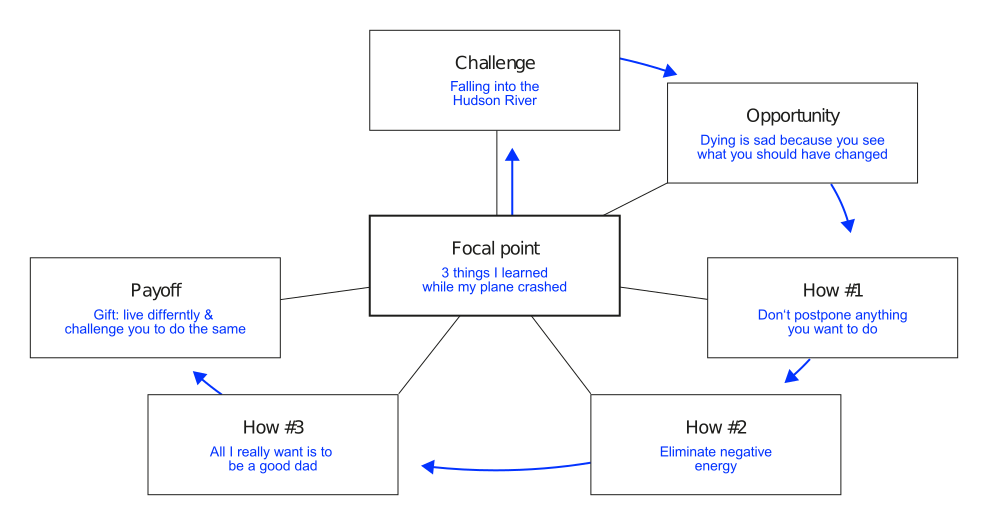
Narrative Map

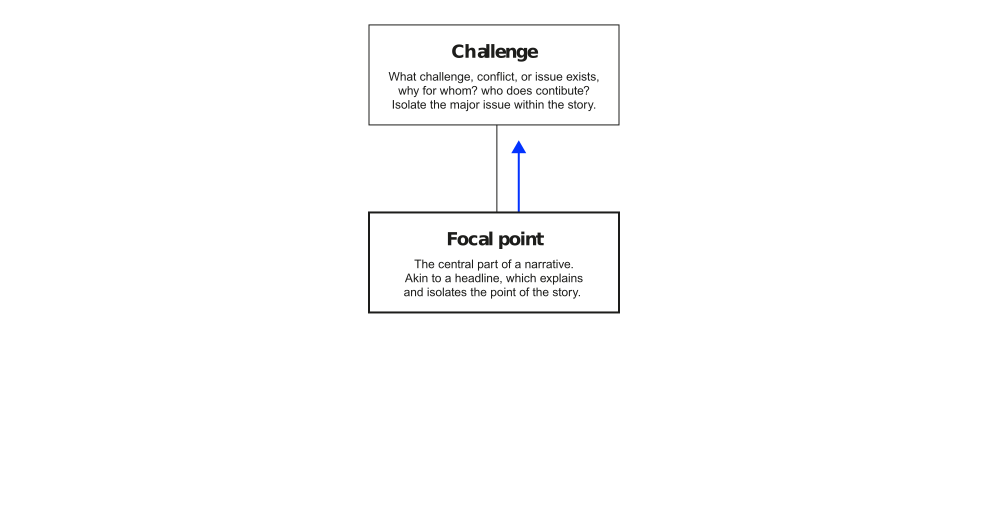
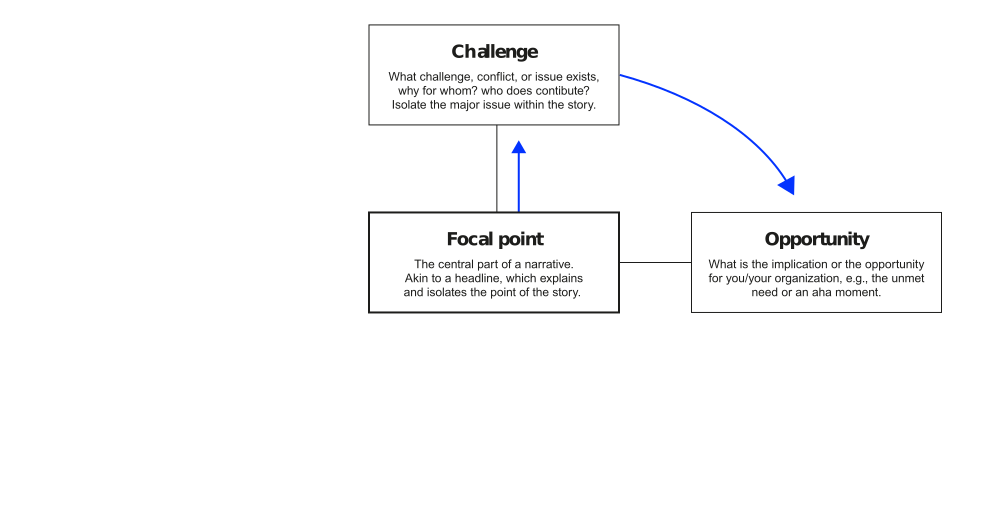
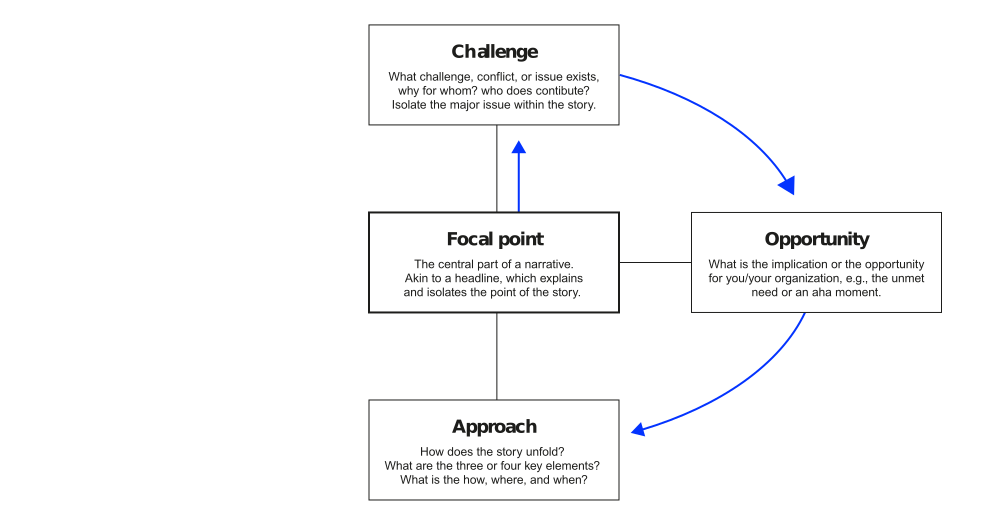
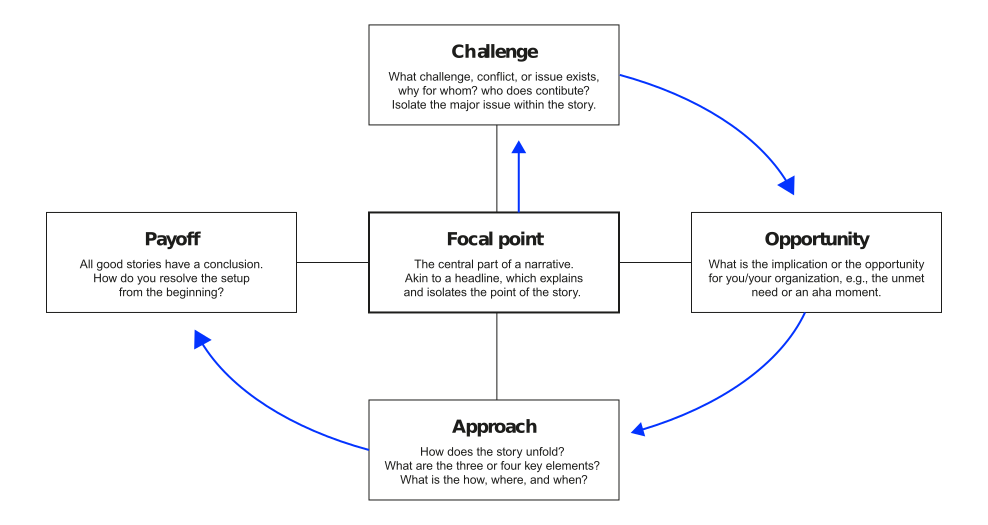
Example
Ric Elias had a front-row seat on Flight 1549, the plane that crash-landed in the Hudson River in New York in January 2009. What went through his mind as the doomed plane went down?
Narrative Map
Storytelling Practice
Exercise
Create and perform a story.
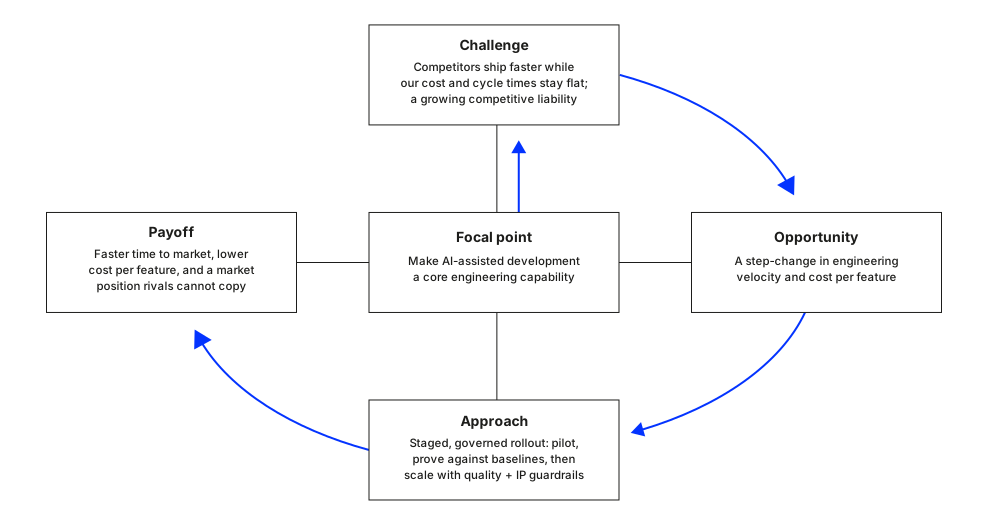
Imagine you are a tech lead at a mid-sized software company. You are convinced the company must invest seriously in AI tools for coding and design: not as a side experiment, but as a strategic commitment that reshapes how the teams work.
You have the opportunity to pitch this to the CEO and the board.
You want to convince them to take a leap of faith.
Form teams of max. 3 students. Write your story using the narrative map structure. Be ready to perform it.
12:00
Narrative Map (Example)
Audiences
Adapting Your Story
The interest/influence matrix (Unit 7) tells you how much engagement each quadrant needs; storytelling theory tells you what kind of narrative fits.
| Matrix quadrant | Engagement | Story emphasis |
|---|---|---|
| Manage closely (high interest, high influence) | Active engagement, involve in decisions | Co-created narrative. Ethos, pathos & logos: “Let’s shape this together.” At the far end, the story is no longer yours to tell: the stakeholder becomes its author. |
| Keep satisfied (low interest, high influence) | Address concerns, don’t overwhelm | Concise strategic narrative. Logos-heavy: the decision, the rationale, the numbers, nothing more. |
| Keep informed (high interest, low influence) | Regular, transparent updates | Narrative of shared purpose. Pathos & ethos: “This is our challenge, here is where we stand.” |
| Monitor (low interest, low influence) | Minimal effort, watch for changes | Clear factual updates only when relevant. Logos, low-touch. |
Exercise
Same story, three audiences.
Return to your AI investment pitch. Imagine you now deliver it to different stakeholders:
- The engineering team, in a town hall.
- A junior developer, one to one, worried about their job.
- A senior developer, one to one, worried about their job.
What changes across versions? What stays the same?
08:00
Delivering
Some advice on public speaking from David JP Phillips, who has spent 7 years studying 5000 speakers, amateurs and professionals.
Wrap-up
Mental Model
Mental models help you think clearly.
Storytelling is how you move others to act.
Storytelling rests on one mental model: humans think, remember, and decide in stories.
A latticework of mental models sharpens your judgement. It helps you read a situation clearly and decide which way to go. But judgement alone moves no one, and leadership is about followers. Storytelling is the other half of the work: it brings people toward the direction your analysis identified and gives them the conviction to act on it.
My suggestions for your latticework are now complete. Building it further, by learning, applying, and reflecting, is a lifelong project. Storytelling is how you turn what you learn into something others can follow.
Closing Quote
People will forget what you said, people will forget what you did, but people will never forget how you made them feel. Maya Angelou (American writer, poet, and civil rights activist)