Learning Objectives
After completing this unit, you will be able to:
- Distinguish paradox from contradiction and explain why paradox is fundamental to contemporary organizations.
- Explain the Competing Values Framework as a diagnostic tool for leadership tensions.
- Differentiate technical problems from adaptive challenges using Heifetz’s framework.
- Apply the concept of behavioral complexity to analyse leadership situations.
Opening Remarks
The hallmark of a first-class leader is the ability to demonstrate contrary or opposing behaviors while maintaining a certain level of integrity, credibility and direction. Denison et al. (1995)
Behavioral theories established a vocabulary of what leaders do, but left open the question of when to do what. Contingency approaches resolved this by matching leadership behaviors to situational demands. Adaptive leadership takes this one step further: some situations don’t just require a different style, they require a fundamentally different role for the leader.
Great leaders can adapt their approach based on what the situation requires. For example, they might need to:
- Be decisive yet open to input
- Maintain stability while driving change
- Show empathy while making tough decisions
- Focus on details without losing sight of the big picture
These behaviors are complementary skills that effective leaders can deploy at the right moments. The challenge is displaying these different behaviors while still being perceived as authentic and consistent in your core values and direction.
This flexibility allows leaders to respond appropriately to complex, changing environments rather than being rigid in their approach. It means drawing on a diverse repertoire of leadership behaviors while maintaining a coherent leadership identity, rather than being inconsistent or unpredictable.
Paradoxes in Leadership
Opening Remarks
Leadership requires the capacity to recognize and react to paradox, contradiction, and complexity. Denison et al. (1995)
Traditional management theories have often presented organizational phenomena in terms of discrete, opposing categories (e.g., Theory X and Theory Y, transactional and transformational leadership). In contrast, more recent theorizing has placed greater emphasis on paradox1, contradiction, and complexity, suggesting that many phenomena may in fact fit multiple opposing categories simultaneously.
While not denying the underlying discrete categories, this more complex perspective recognizes that organizations face competing demands that appear contradictory but must be managed simultaneously. These tensions create the paradoxes that leaders must navigate. Effective leaders are those who have the cognitive and behavioral capacity to recognize and react to paradox, contradiction, and complexity in their environments (Denison et al., 1995). Particularly when considering that paradox is fundamental to contemporary work contexts characterized by globalization, technological change, and increased competition (Lavine, 2014).
Paradox
Contradiction refers to bipolar opposites that are mutually exclusive and interdependent such that the opposites define and potentially negate each other (Putnam et al., 2016, p 6).
Example: A supervisor manages a remote team by strictly enforcing a ‘9-to-5’ login policy. If an employee attends a child’s school play, they are physically and legally ‘not at work.’ Here, work and family are treated as mutually exclusive blocks of time: the presence of one necessitates the absence of the other.
Paradox refers to contradictions that persist over time, impose and reflect back on each other, and develop into seemingly irrational or absurd situations because their continuity creates situations in which options appear mutually exclusive, making choices among them difficult (Putnam et al., 2016, p 8).
Example: An organization implements ‘Unlimited Paid Time Off’ to give employees total autonomy. However, because employees want to prove they are worthy of such trust, they feel pressured to work harder and take less leave than before. The very policy designed to provide freedom (autonomy) ends up tightening the ‘invisible’ leash of self-surveillance (control). This is paradoxical because the increase in freedom directly causes an increase in constraint, creating an absurd cycle that persists regardless of how many ‘days off’ are offered.
Paradoxes differ from contradictions (i.e., logic: if you are doing A, you cannot be doing B) in that they create situations of almost impossible choice (i.e., logic: doing A leads to more of B), hence the seeming irrationality or absurdity of the situation.
Ambidexterity
Ambidexterity refers to “an organization’s capacity to address two organizationally incompatible objectives equally well.” Birkinshaw & Gupta (2013, p. 291)
The ability of senior leadership teams to embrace tension between old states and activities and new ones is a key predictor of firm success (Tushman et al., 2011).
Leaders must “embrace inconsistency by maintaining multiple and often conflicting strategic demands.” O’Reilly III & Tushman (2011, p. 76)
Behavioral Complexity
It takes complexity to defeat complexity. Uhl-Bien et al. (2007, p. 301)
Increasing social and organizational complexity requires cognitive complexity and behavioral complexity: to “conceive and perform” (Denison et al., 1995, p. 524).
Effective leaders are those who have the cognitive as well as the behavioral capacity to recognize and react to paradox, contradiction, and complexity in their environments (Denison et al., 1995; Lawrence et al., 2009; Spreitzer & Quinn, 1996).
Effective leadership is dependent on behavioral complexity, “the ability to perform the multiple roles and behaviors that circumscribe the requisite variety implied by an organizational or environmental context”. (Denison et al., 1995, p. 526)
This capacity to act flexibly across competing demands is exactly what adaptive leadership theory formalizes.
Competing Values Framework
Opening Remarks
The competing values framework highlights the trade-offs, tensions, contradictions, and paradoxes inherent in organizations and their leaders. Lavine (2014, p. 194)
Competing Values (Complexities)
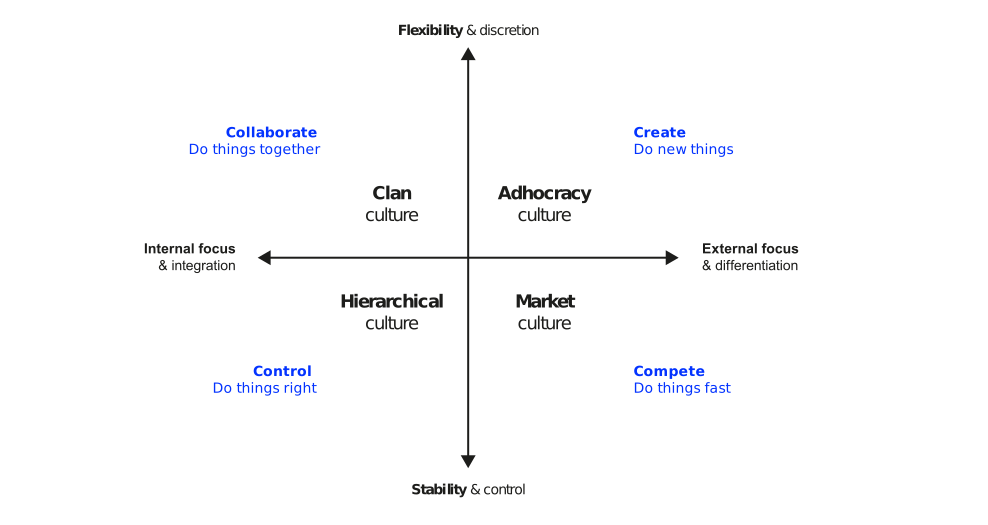
The competing values framework (CVF) (Quinn, 1988) is a theoretical model that identifies four different management models that exist in tension with each other in organizations. The framework is built around two key dimensions. One dimension represents the continuum between flexibility or adaptability and stability or control. The other describes the continuum between efficient internal processes, such as human resource practices or internal control systems, and external positioning vis-à-vis stakeholders such as competitors, customers and clients. These dimensions create four quadrants, each representing a different model of organizational effectiveness:
Human Relations Model (Clan Culture)
- Key assumption: Human development and participation produce effectiveness
- Characteristics: Family-like, collaborative, team-oriented
- Leadership style: Mentoring, facilitating, nurturing
- Value drivers: Commitment, communication, development
Open Systems Model (Adhocracy Culture)
- Key assumption: Innovation, vision, and constant change produce effectiveness
- Characteristics: Dynamic, entrepreneurial, creative
- Leadership style: Innovative, visionary, risk-oriented
- Value drivers: Innovative outputs, transformation, agility
Internal Process Model (Hierarchy Culture)
- Key assumption: Control and efficiency with appropriate processes produce effectiveness
- Characteristics: Structured, controlled, process-oriented
- Leadership style: Coordinating, organizing, efficiency-minded
- Value drivers: Efficiency, timeliness, consistency, uniformity
Rational Goal Model (Market Culture)
- Key assumption: Aggressively competing and customer focus produce effectiveness
- Characteristics: Results-oriented, competitive, achievement-focused
- Leadership style: Hard-driving, directive, goal-oriented
- Value drivers: Market share, goal achievement, profitability
The key insight of the CVF is that the different model of organizational effectiveness contain inherent paradoxes (hence “competing values”). The competing values are paradoxes because they represent demands that are simultaneously necessary yet seemingly contradictory. Each pair of opposing values reflects a genuine organizational need, but pursuing one appears to undermine the other.
Effective management requires, thus, balancing these competing demands rather than focusing exclusively on one approach. The framework suggests that successful managers develop competencies across all four quadrants and can flexibly apply different approaches depending on the situation.
The four orientations are intuitively appealing, perhaps confirming their origin in psychological archetypes; most people can probably find the culture of their current organisation somewhere in this taxonomy. However, as the academic labels for them in each quadrant are often misunderstood, it has proven useful to substitute more accessible and commonly used verbs to describe the dominant activities that relate to each culture: collaborate, create, compete, and control (Lavine, 2014).
Leadership Roles
| Clan (collaborate) | Adhocracy (create) |
| Mentors, facilitators or team builders: they hold everything together when times are tough, and encourage the pursuit of shared objectives. They’ll help members of their team develop the skills needed to work together more effectively. | Visionaries: they embrace change and new thinking, and are often not overly worried about risk. They’re not just imaginative, but eager to turn their ideas into reality. |
| Hierarchy (control) | Market (compete) |
| Managers: they’re focused on organizing, problem solving, and ensuring things are done correctly. They’re scrupulous about paying attention to detail, staying informed, and being rigorous in their analyzes. | Deal makers: they are results-driven, and usually focused on the short-term. They like to take charge, and act fast to close deals with customers. |
Implications
Leadership qualities seem to be best demonstrated by more movement throughout the framework, suggesting complex adaptation to changing circumstances (Denison et al., 1995).
Complex situations require complex responses. Sometimes organizations benefit from stability, and sometimes they benefit from change. Often organizations need both stability and change at the same time. In contrast to earlier approaches, the development of the competing values framework did not assume that stability and change were mutually exclusive, an either/or decision. Quinn et al. (2020, p. 12)
The CVF provides a description of roles and behaviors to encourage self-reflection and to provide a preliminary sense of behaviors and accompanying roles that can be learned. Working to overcome areas of relative weakness so that they can be transformed into average or adequate performance can help leaders see more opportunities for action when core areas of strength are not delivering the desired results.
Situational & Adaptive Leadership
The CVF tells us that effective leaders move flexibly across competing demands. But how should leaders decide which approach to use? Situational and adaptive leadership theories provide concrete answers.
Situational Leadership
The Situational Leadership model (Hersey & Blanchard, 1977) proposes that leaders should adapt their style based on the readiness level of their followers: their ability and willingness to perform a specific task.
| Follower readiness | Leadership style | Leader behavior |
|---|---|---|
| Low ability, low willingness |
Telling | High task, low relationship Provide specific instructions and close supervision |
| Low ability, high willingness |
Selling | High task, high relationship Explain decisions and provide opportunity for clarification |
| High ability, low willingness |
Participating | Low task, high relationship Share ideas and facilitate decision-making |
| High ability, high willingness |
Delegating | Low task, low relationship Turn over responsibility for decisions and implementation |
Task behavior (“directive” dimension)
Focus: The technical execution of the job.
Task behavior is the extent to which a leader spells out the duties and responsibilities of an individual or group. It is goal-oriented and one-way communication.
- Key actions: Telling people what to do, how to do it, when to do it, and who is to do it.
- High task: Necessary when the follower lacks the specific skills or experience to perform the task (Low Ability). The leader provides the “roadmap.”
- Low task: Appropriate when the follower is competent and knows the process; the leader steps back to avoid micromanaging.
Relationship behavior (“supportive” dimension)
Focus: The emotional and interpersonal connection.
Relationship behavior is the extent to which a leader engages in two-way communication. it is about providing emotional support, “psychological” encouragement, and facilitating involvement.
- Key actions: Listening, encouraging, collaborating, praising, and involving the follower in decision-making.
- High relationship: Used when the follower needs a boost in confidence or “buy-in” (Low Willingness/Confidence). The leader acts as a coach or cheerleader.
- Low relationship: Appropriate at both extremes of readiness. In “Telling,” there isn’t time for it; in “Delegating,” the follower is so self-reliant they don’t need constant social reinforcement.
Situational leadership serves as a bridge model between contingency thinking (Unit 2’s evolution of leadership thought) and the more complex adaptive leadership framework. Its core insight is simple but powerful: there is no single best leadership style. The most effective approach depends on the development level of the people you are leading and this can vary across tasks, projects, and time.
The model has practical value for everyday leadership decisions: a new team member learning a technical skill needs more direction (S1/S2), while an experienced professional tackling a familiar challenge benefits from autonomy (S3/S4). The leader’s job is to diagnose readiness accurately and adjust accordingly.
However, situational leadership assumes that the problem itself is well-defined and the solution is known. The leader just needs to guide followers appropriately. What happens when the problem itself is unclear and no known solution exists? This is where adaptive leadership enters.
Adaptive Leadership
Heifetz (1994) distinguishes between two fundamentally different types of challenges leaders face, which require different behaviors:
Technical problems
- Problem definition is clear
- Solution is known
- Expert knowledge can solve it
- Implementation through authority
Example: A hospital needs to upgrade its IT system. The requirements are known, vendors can be evaluated, and the project can be managed.
Adaptive challenges
- Problem definition is unclear
- No known solution exists
- Requires learning and changed behavior
- Implementation through engagement
Example: A hospital needs to fundamentally change its culture to reduce medical errors. This requires changed beliefs, behaviors, and relationships at every level.
The distinction between technical problems and adaptive challenges is one of the most powerful diagnostic tools in leadership theory. The most common leadership failure, Heifetz (1994) argues, is treating adaptive challenges as if they were technical problems: applying expert solutions to situations that actually require people to learn new ways of operating.
Digital transformation is the quintessential adaptive challenge: it is not primarily a technology problem (technical) but a problem of changed behaviors, processes, mental models, and organizational culture (adaptive). Leaders who approach DT as a technology implementation project often fail because they underestimate the adaptive dimension.
Adaptive Leadership Practices
Heifetz & Linsky (2002) identify four key practices for leading through adaptive challenges:
- Getting on the balcony: Step back from the action to observe patterns, political dynamics, and systemic issues. Leaders who are only “on the dance floor” cannot see the larger picture.
- Regulating distress: Adaptive work generates discomfort because it challenges existing beliefs and competencies. Leaders must create enough disequilibrium to motivate change, but not so much that people become overwhelmed.
- Giving the work back: The leader cannot solve adaptive challenges alone. The people with the problem must do the work of adapting. The leader’s role is to create the conditions for this learning.
- Protecting voices of leadership from below: People closest to the problem often have critical insights, but their views may be suppressed. Adaptive leaders protect and amplify dissenting voices.
These practices require a fundamentally different orientation than traditional leadership. Rather than providing answers, the adaptive leader asks questions. Rather than reducing discomfort, they manage it productively. Rather than maintaining control, they distribute responsibility.
Notice how adaptive leadership connects back to the CVF: navigating adaptive challenges requires movement across all four quadrants. Sometimes you need to control (establish a holding environment), sometimes to collaborate (facilitate group learning), sometimes to create (experiment with new approaches), and sometimes to compete (make tough trade-off decisions). Adaptive challenges, by their nature, demand behavioral complexity.
Behavioral Complexity
Adaptive challenges require behavioral complexity: the movement across all four CVF quadrants:
- Collaborate: facilitate group learning and create psychological safety for experimentation
- Create: experiment with novel approaches and tolerate productive failure
- Compete: make difficult trade-off decisions when resources are scarce
- Control: establish structures that provide enough stability for people to take risks
The connection between the CVF and adaptive leadership illustrates why behavioral complexity is so essential. Adaptive challenges are inherently paradoxical as they require simultaneous stability and change, direction and empowerment, urgency and patience. A leader who can only operate in one CVF quadrant will struggle with the contradictory demands of adaptive work.
This also connects to our latticework from Unit 1: the CVF and adaptive leadership are both mental models that help leaders diagnose what type of challenge they face and select appropriate responses. The more models you have, the more nuanced your diagnosis and the more flexible your response repertoire.
Leading Innovation
Opening Remarks
Leading innovation takes a distinctive kind of leadership, one that unleashes and harnesses the “collective genius” of the people in the organization. Linda A. Hill
Innovation
What is an innovation?
An innovation can be defined as an idea, practice, or material artifact perceived to be new by the relevant unit of adoption and offers worthwhile benefits (Dewar & Dutton, 1986).
Innovations can be differentiated according to the degree of deviation from existing technologies and practices: incremental innovation and radical innovation (McDermott & O’connor, 2002).
- Radical innovations are fundamental changes that represent revolutionary changes in technology (Dewar & Dutton, 1986). They represent clear departures from existing practices and require new skills, levels of market understanding, leaps in new processing abilities, and systems throughout the organization (McDermott & O’connor, 2002).
- Incremental innovations are minor improvements or simple adjustments in current technology.
The main difference that characterizes the two dipoles is the degree of new knowledge contained in the innovation (Dewar & Dutton, 1986), which implies technological uncertainty, technical inexperience, business inexperience, and technology cost.
Nature of Innovating
Innovating is not about some genius having an aha moment.
Innovating is a team sport: combining individual’s member’s separate slices of genius into a single work of collective genius. Innovation requires a place where people are willing and able to do the hard work that innovative problem solving requires (Hill et al., 2014a).
Significance
Competitiveness depends to a large extent on the ability to innovate. So the ongoing challenge is to build an organisation that is able to innovate all the time.
The rhetoric of innovation is often about fun and creativity, but the reality is that innovation can be very taxing and uncomfortable, both emotionally and intellectually. Hill et al. (2014a, pp. p. 5)
This requires a different kind of leadership.
Leadership
The role of a leader of innovation is to create a community that is willing and able to generate new ideas. (Hill et al., 2014a, p. 4)
Hill et al. (2014a) has done in-depth research on many exceptional innovation leaders in different organisations and at different levels (e.g. Pixar, VW, Pentagram, Google, Pfizer, IBM). They asked what role the leader plays in creating a more innovative organisation. They concluded that directive leadership can work well when the solution to a problem is known and clear. But when the problem requires a truly original answer, no one can decide in advance what that answer should be. Therefore, leading innovation cannot be about creating a vision, persuading people and then somehow inspiring them to implement it.
So the guiding question becomes “how do I set the stage for it to happen?”
rather than “how do I make innovation happen?”
Paradoxes of Innovation
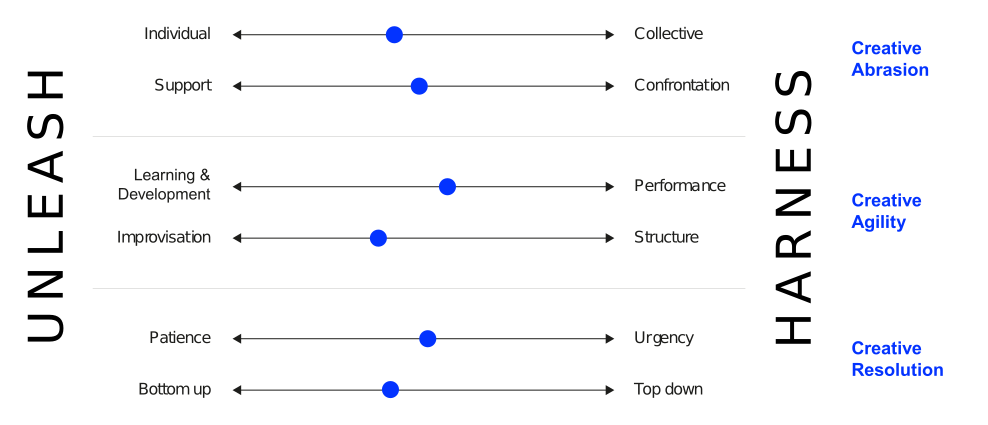
The paradox at the heart of innovation is the need to unleash the talents of individuals and to harness those talents in the form of collective innovation (Hill et al., 2014b).
Hill et al. (2014a) identified six innovation paradoxes. The challenge for leaders is to help the organization continually re-calibrate between:
- affirming the individual … and the group
- supporting … and confronting (i.e., collaborative disagreement)
- fostering experimentation and learning … and performance
- promoting improvisation … and structure
- showing patience … and urgency
- encouraging bottom-up initiative … and intervening top-down
Leaders who stay on the right side of this paradox will never be able to unleash the full genius of their staff; they will have few or no ideas to use. Those who stay on the left side will have many ideas and possibilities to work with, but they will not be able to turn them into new and useful solutions; instead, conflict and chaos will reign. The correct position at any given time will depend on the circumstances. However, the goal will always be to take the position that enables the collaboration, experimentation and integration that are necessary for innovation.
Hard Work of Innovation
The role of an innovation leader is to create a community that is willing and able to innovate over time (Hill et al., 2014a).
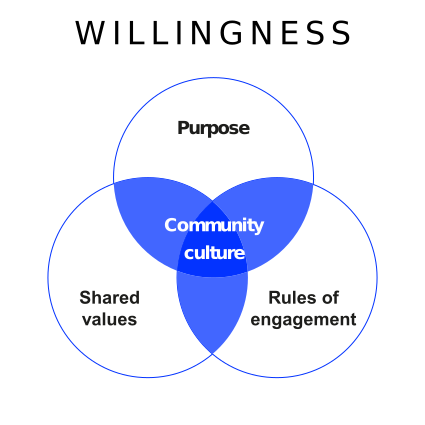
To build willingness, leaders must nurture a sense of community, which rests on three elements: a sense of purpose, values, and rules of engagement (Hill et al., 2014a).
- Purpose
- Purpose is who is in a group or why it exists, not what the group does. It reflects a collective identity.
- Shared values
- To form a community, members have to agree on what is important. By shaping the group’s priorities and choices, values influence individual and collective thought and action (e.g., bold ambition, collaboration, responsibility, learning)
- Rules of engagement
- Those keep members focused on what is imperative, discourage unproductive behaviors, and encourage activities that foster innovation (e.g., respect, trust, influence, see the whole, question everything, be data driven.
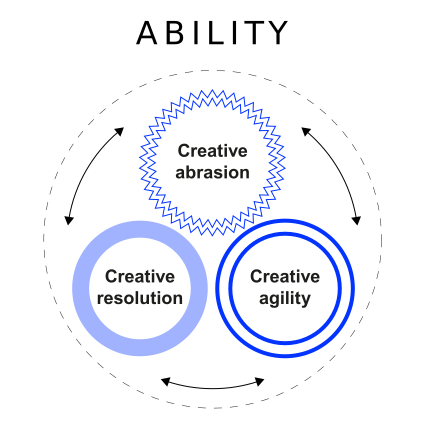
The ability to innovate, is dependent on the leader creating creative abrasion, creative resolution, and creative agility (Hill et al., 2014a).
- Creative abrasion
- The ability to develop a marketplace where rich diverse ideas compete through discourse and debate.
- Creative agility
- The ability to develop and test different options, learn from outcomes and try again and again till the optimal option is evolved.
- Creative resolution
- The ability to make decisions that combine disparate and sometimes even opposing ideas.
Creative Abrasion
Art challenges technology.
Technology challenges art.
Part of the magic of Pixar is that these two disciplines bump up against each other and create something better than either could create by itself. Greg Brandeau, Pixar Animation Studios
Paradoxes
- Individual vs. group identity
- Support vs. confrontation
Ingredients
- Diversity (i.e., people who think differently)
- Cognitive conflict over ideas and approaches (i.e., aimed at learning and improving not winning/losing/dominating); doing experiments
Leader’s role
- Espouse, encourage, expect and practice communal norms that value and even amplified diversity.
- Push people together and create situation in which diverse thinkers where put in close proximity
- Create organizational bridges
Creative Agility
Pursue. Reject. Adjust.
We used to launch products in an “all or nothing” mode to all of our users. Now we had the capability to test multiple different live versions of new products on 1 percent samples of our users. This yielded huge data sets and brought with it a change in mind-set for approaching innovation. We began to avoid projects that only allowed for “zero or one” decisions, instead choosing projects that could be rolled out and evaluated in small slices. Philipp Justus, eBay Germany
Creative agility is about discovery based learning. It involves quickly pursuing multiple experiments, learning from the outcomes, and then adjusting plans. Hill et al. (2014a, pp. p. 9)
Paradoxes
- Learning and development vs. performance
- Improvisation vs. structure
Ingredients
- Nimble mind
Leader’s role
- Pursue new ideas vigorously, proactively again and again
- Reflect to harvest knowledge (consciously, collaboratively and openly)
- Adjust and identify next steps in seeking a solution
Creative agility requires a community. Common purpose and shared values provide a framework for creating and assessing experiments.
Creative Resolution
From either or
to both-and thinking
We hired innovators and if I were to forbid a passionate team to do something, it really would have misused their talents. I wanted people with a vision, and the ambition to build the next great thing. We needed to let teams go far enough so they could in fact discover this great new thing. Or, in another scenario, they had to recognize it was not quite right, then decide to work on something else, in the best-case scenario integrating their knowledge to another solution. Bill Coughran, Google
Paradoxes
- Patience vs. urgency
- Bottom-up vs. top-down initiatives
Ingredients
- “Either-or” to “Both-and” thinking
Leader’s role
- Guide their organizations to keep multiple options open
- Create the space for integration by keeping things simple, flexible and open
- Lead differently by aggregating view points not directing decisions
Innovation Leaders
The leaders Hill et al. (2014b) studied had some things in common. They call it the right stuff
They are found to be:
Are you an innovation leader? Start by asking yourself these questions about your organization (Hill et al., 2014a, p. 10):
- Do members of my organization feel part of a community?
- Does my organization have a shared purpose, one that binds us together and compels us all to do the hard work of innovation?
- Does it live by rules of engagement supportive of a set of core values: bold ambition, responsibility to the community, collaboration, and learning?
- Do we have the ability to generate ideas through candid discourse and debate?
- Do we have the ability to test ideas through quick pursuit, reflection, and adaptation?
- Do we have the ability to make integrative decisions, rather than compromising or letting some groups dominate?
Ask yourself some questions about your own leadership mind-set and practices: - Do I think my primary job as a leader is to create a context in which my team can innovate? - Am I comfortable serving as the “stage setter” as opposed to the visionary leading from the front? - Do I have the courage and patience required to amplify differences, even when discussion becomes heated and when ambiguity and complexity loom?
If your answer to any of these questions is “no” or even “I don’t know,” it’s probably time to look again at your own leadership role and at the leadership potential that may be hiding in your organization.
Wrap-up
New models added to your latticework:
- Competing values as a diagnostic framework
- Technical vs. adaptive problem distinction
- Inversion and both/and thinking for navigating paradox
Closing Remark
Leadership requires the capacity to recognize and react to paradox, contradiction, and complexity. (Denison et al., 1995)
Homework
Read House (1996) and answer following questions:
- What is the essence of the theory?
- How does leader behavior impact subordinates’ motivation, satisfaction, and performance?
- What leader behaviors have you experienced?
- Do you have empirical evidence on the propositions made?
Look for connections between the CVF quadrants and the leader behaviors described by House.
Literature
Footnotes
A paradox can be defined as a set of mutually inconsistent propositions, each of which seems true (Rescher, 2004).↩︎
Generosity here means the willingness, based on their own sense of personal security, to share power, control and credit↩︎
This includes the willingness to admit imperfections and asking for help↩︎