Learning Objectives
After completing this unit, you will be able to:
- Explain social capital theory and distinguish structural, relational, and cognitive dimensions.
- Apply stakeholder salience analysis (power, legitimacy, urgency) to identify and prioritise stakeholders.
- Select appropriate engagement levels using the IAP2 spectrum based on stakeholder attributes.
- Design coalition-building strategies using network analysis and second-order thinking.
Stakeholder Identification
Defining Stakeholders
A stakeholder is any group or individual who can affect or is affected by the achievement of the organization’s objectives. Freeman (1984, p. 46)
This definition is deliberately broad. It forces leaders to look beyond the obvious (shareholders, employees, customers) to include all groups that have a stake in the organization’s actions and outcomes.
The stakeholder concept challenges the shareholder primacy view that the organization’s only obligation is to maximize returns for owners. Instead, stakeholder theory argues that long-term organizational success depends on managing relationships with multiple groups whose interests may diverge. This makes stakeholder management a leadership skill, not just a communication exercise.
For digital leaders, the stakeholder landscape is particularly complex: digital transformation affects employees, customers, suppliers, regulators, communities, and entire industries, often in ways that are difficult to predict.
Stakeholder Salience
Not all stakeholders are equally important at any given time. Mitchell et al. (1997) proposed the stakeholder salience model based on three attributes: power, legitimacy, urgency.
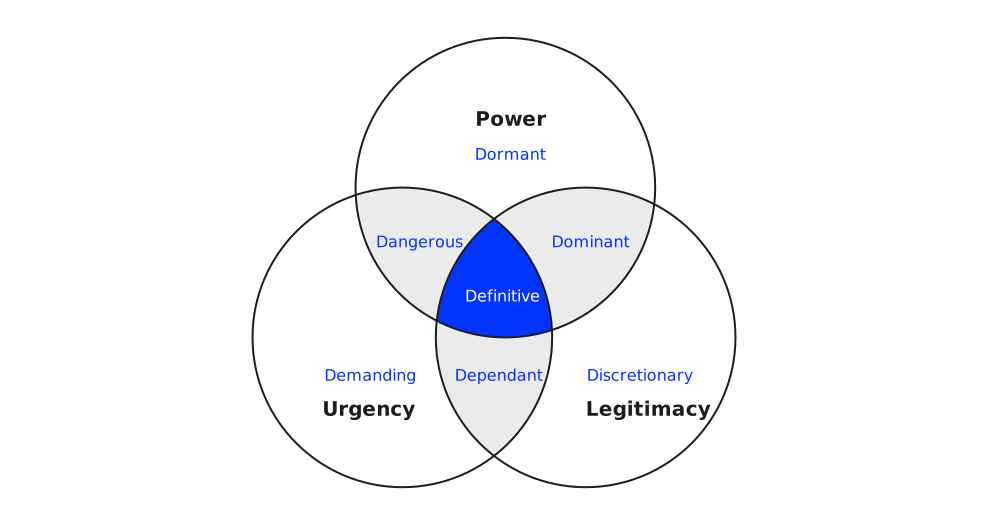
- Power
- the stakeholder’s ability to influence the organization (coercive, utilitarian, or normative)
- Legitimacy
- The perceived appropriateness of the stakeholder’s claim or relationship
- Urgency
- The degree to which the stakeholder’s claim demands immediate attention (time-sensitivity and criticality)
The three attributes combine to create seven stakeholder types:
- Dormant (power only): have power but no legitimate claim or urgent need; potential threat if activated
- Discretionary (legitimacy only): have legitimate claims but no power or urgency; often recipients of philanthropy
- Demanding (urgency only): make urgent claims but lack power and legitimacy; can be disruptive but are easily dismissed
- Dominant (power + legitimacy): have both power and legitimate claims; the stakeholders that formal governance structures typically address
- Dangerous (power + urgency): have power and urgency but may lack legitimacy; can resort to coercive tactics
- Dependent (legitimacy + urgency): have legitimate and urgent claims but depend on others to act on their behalf
- Definitive (all three): have power, legitimacy, and urgency; demand and deserve immediate managerial attention
The model is dynamic: stakeholder salience changes over time as attributes are gained or lost. A dormant stakeholder can become definitive if they gain legitimacy and urgency (e.g., a regulator that begins investigating the company).
The 2×2 Matrix
A complementary tool to the salience model: map stakeholders on interest (how much they care) × influence (how much they can affect outcomes):
| Low influence | High influence | |
|---|---|---|
| High interest1 | Keep informed: regular updates, transparent communication | Manage closely: active engagement, involve in decisions |
| Low interest | Monitor: minimal effort, watch for changes | Keep satisfied: address concerns proactively, don’t overwhelm |
The interest-influence matrix is widely used in practice because of its simplicity. It translates stakeholder analysis into concrete engagement strategies. However, it has limitations:
- It is a static snapshot: stakeholder positions change over time, especially during crises or organizational transitions
- It does not capture network dynamics: a low-influence stakeholder who is closely connected to a high-influence stakeholder may be more important than they appear
- It can oversimplify: the binary high/low categorization misses nuances
This is where social capital theory enriches the picture: network analysis reveals how stakeholders are connected, showing indirect influence paths that the 2×2 matrix misses. A stakeholder with low direct influence but high centrality in the network (a “bridge” in Burt’s terms) may be critical for building coalitions.
Matching Engagement to Salience
The engagement level should match the stakeholder’s salience:
Higher engagement needed
- Definitive stakeholders (all three attributes)
- Stakeholders with veto power
- Groups whose buy-in is critical for implementation
- Internal champions and change agents
Lower engagement sufficient
- Dormant stakeholders (power only)
- Discretionary stakeholders (legitimacy only)
- Groups with low interest and low influence
- Stakeholders who are adequately represented by others
Beyond the 2×2 Map
Static stakeholder maps are useful starting points, but they miss the network dynamics that often determine outcomes. Questions to be asked:
Who connects whom?
Where are the bridges and bottlenecks?
Using social capital concepts to analyze stakeholder networks:
- Centrality: which stakeholders are most connected? They are likely the most influential, even if they lack formal authority
- Structural holes: where are the gaps between stakeholder groups? Bridging these gaps creates opportunities for influence
- Clusters: which stakeholders form tight-knit groups? These clusters may act as blocks in coalition dynamics
Stakeholder network analysis connects social capital theory directly to practical leadership action:
- A leader who identifies a structural hole between two important stakeholder groups can position themselves as a bridge, gaining influence by connecting otherwise disconnected parties
- A leader who identifies a central connector (a person with ties to many different stakeholder groups) can leverage that person’s network position to amplify their message
- A leader who identifies dense clusters of opposition can develop targeted strategies for each cluster rather than treating all opponents as a monolithic group
This is the practical payoff of the social capital theory we studied earlier: it provides not just a theoretical framework but a diagnostic tool for real stakeholder challenges.
Coalitions
Coalitions are a mechanism for achieving change without unilateral authority.
A coalition is a temporary alliance of stakeholders who share a common interest or goal and pool their resources to achieve it (Murnighan, 1978).
Key principles of coalition building:
- Identify potential allies and blockers using the stakeholder map (i.e, who shares your objectives? Who opposes them? Who is undecided?)
- Start with easy wins: build momentum by first engaging stakeholders who are predisposed to support you
- Sequence carefully: each new ally makes the next one easier to recruit (Lax & Sebenius, 2006). Build a critical mass of support before approaching skeptics.
- Use reciprocity as currency: coalitions run on mutual benefit. Understand what each ally needs and find ways to create value for them (connecting to social capital’s relational dimension).
Coalition building is where stakeholder management, social capital theory, and political navigation converge. The stakeholder map tells you who to engage. Social capital theory tells you through whom to reach them (leveraging structural holes and bridging ties). Political navigation (Unit 6) tells you how to exercise influence.
Effective coalition builders think several moves ahead; this is second-order thinking applied to political strategy. “If I engage stakeholder A first, how will that affect my ability to engage stakeholder B? What signal does it send to stakeholder C?”
Wrap-up
Closing Quote
The core intuition guiding social capital research is that the goodwill that others have toward us is a valuable resource (Adler & Kwon, 2002).
Homework
Reflect on your own cultural background and how it shapes your leadership assumptions:
- What cultural values (e.g., from Hofstede’s dimensions) are most prominent in your context?
- Have you experienced a situation where cultural differences affected leadership or teamwork?
- What ethical principles guide your approach to leadership?
Literature
Footnotes
People are “interested” because they have a valid claim (legitimacy) or a time-sensitive need (urgency).↩︎
Social Capital Theory
In Brief
Your network of relationships often determines the opportunities available to you.
History
The concept of social capital has been relatively independently introduced by scholars from various disciplines at different times.
Seminal works particularly originate from
Since the 1990s the concept of social capital found its way into organizational and management sciences to explain e.g.
Definitions
Similarities and Distinctions
The definitions of social capital share some similarities and distinctions:
Strong vs. Weak Ties
Coleman (1988) argues that cohesion, that is to say the strength of the relationship between actors, is the source of social capital (strong ties). Cohesion …
Burt (2018) posits that social capital rather emerges from opportunities to bridge disconnections or non-equivalencies separating non-redundant sources of information (i.e., structural holes)
This strong/weak tie distinction maps directly onto stakeholder engagement: bonding ties for core allies, bridging ties for new stakeholder access.
Structure, Cognition, and Relation
Value
The ultimate value of a given form of social capital is context-dependent (Adler & Kwon, 2002).
Strong ties
Effective search for novel information
(competitive rivalry, certain tasks, individual contribution)
Weak ties
Effective transfer of information and tacit knowledge
(collective goals, uncertain tasks, group contribution)
The value is further dependent on the availability of complementary resources (e.g., combination capability)
Opportunity, Motivation, and Ability
According to Adler & Kwon (2002)’s conceptual model, the value of social capital is contingent on specific contextual factors rather than universal or fixed, which explains why similar network structures or relationships yield different outcomes in different settings.
Recommendations
Leadership in modern organizations extends far beyond formal authority. The following practices support effective leadership:
Effective leadership requires constant attention to dependencies and relationships: continuously reevaluate your sources of power, nurture your network, and adapt your political strategies to changing contexts. Your effectiveness depends on your ability to exercise influence across organizational boundaries.