Conflict & Power
How do leaders exercise influence and manage conflict?
Neu-Ulm University of Applied Sciences
February 16, 2026
Learning objectives
After completing this unit, you will be able to:
- Explain why power and politics are inherent to organizational life and distinguish functional from dysfunctional politics.
- Identify personal and positional sources of power and assess their relevance in different leadership situations.
- Apply the Thomas-Kilmann conflict styles to diagnose and respond to organizational conflicts.
- Describe lateral leadership strategies for influencing without formal authority.
Introduction
Today’s session
- Warm-up 15 min
- Power & politics 30 min
- Sources of power 25 min
- Break
- Conflict dynamics 40 min
- Lateral leadership 10 min
- Reflection & closing 10 min
A conflict scenario
A product manager wants to redirect engineering resources to a new customer-facing initiative. The engineering lead disagrees as her team is already stretched thin maintaining critical infrastructure. Both escalate to the VP, who needs both of them to succeed.
- How should this be resolved?
- What role does power play?
03:00
Warm-up
Conflict reflection
Discuss your conflict reflection
from the homework.
Share your example with your neighbor and …
- analyze the causes for the conflict;
- discuss if the conflict was helpful or not.
08:00
Plenum
Share your conflict reflection with us.
04:00
On power and politics
Does leadership require being political?
Does leadership require
being political?
If so, what do you associate with it?
03:00
Power in organizations
Organizations can be seen as both, cooperative systems of employees working together to achieve goals and political arenas of individuals and groups with differing interests (Brass, 2017).
Power can be defined as the ability to get other people to do what you want them to do, politics as power in action, using a range of techniques and tactics (Buchanan & Badham, 2020).
Power and politics is at the heart of how organizations function (Hill, 2003).
Managers have to understand and develop new sources of power and influence if they are going to be able to defend their groups’ interests. Thus, they must become “political”— i.e., understand the political dynamics of organizations and build the power and influence necessary to navigate them. Hill (2003), p. 272
Though, often associated with negative connotations, Buchanan & Badham (2020) shows that the view of the damaging, negative consequences of politics is too narrow. Politics can be both ‘functional’ and ‘dysfunctional’.
Power and leadership
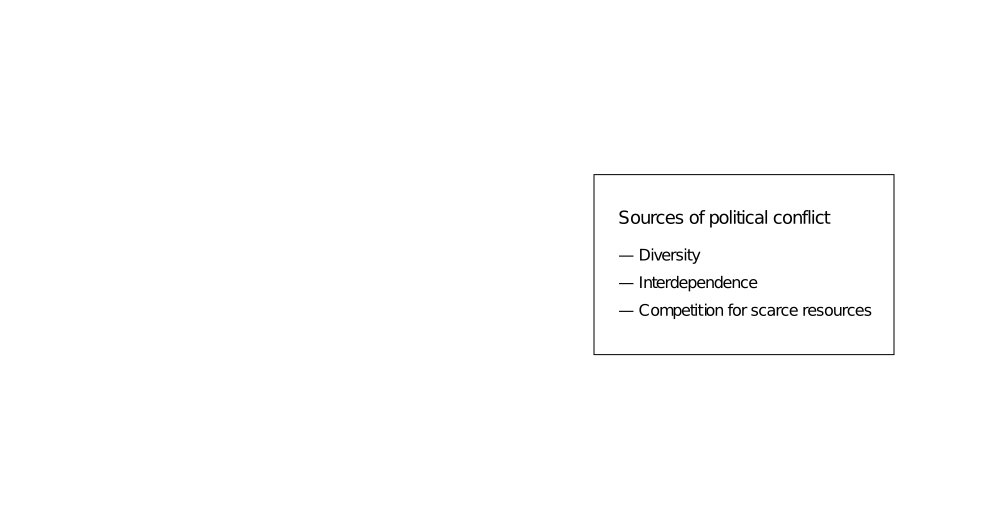
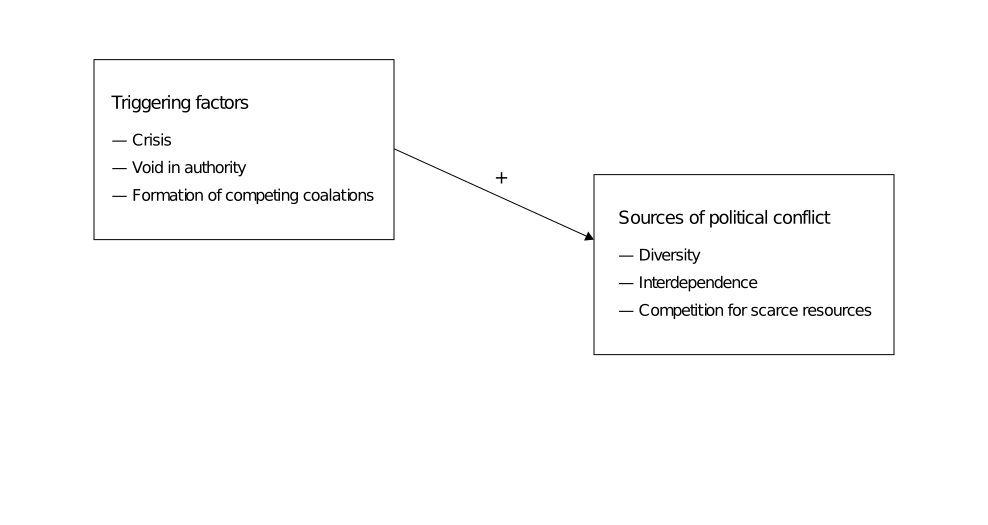
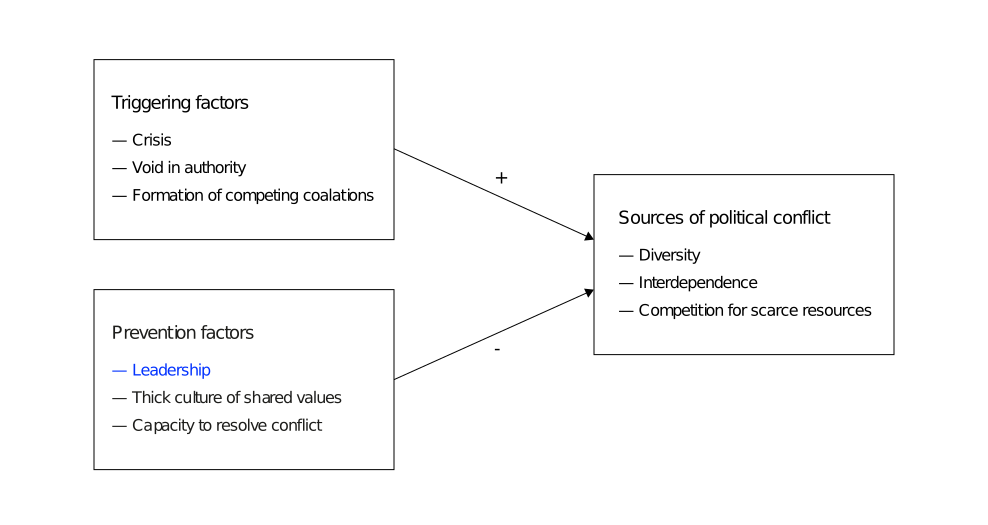
Other things being equal, political conflict increases with growing interdependence, diversity, and resource scarcity (Pfeffer, 1992).
Managers who ignore or fail to understand how power and influence work in organizations will find that they and their teams experience difficulty in being effective and ethical in their work. Hill (2003, p. 273)
Development of competing coalitions and periods of organizational crisis1 exacerbate political conflict, while leadership and shared value help to reduce the amount of conflict (Hill, 2003).
Leaders need to define a vision that aligns and motivates people, creates shared values, and a shared culture—these are critical mechanisms for managing the increased diversity and interdependence in organizations today.
Political conflict summary
Sources of power
Discovering that formal authority is a very limited source of power, new managers must find other ways to get things done […] they soon learn that power and influence are the mechanisms by which the inevitable political conflicts in organizations get resolved. Hill (2003, p. 274)
Personal and positional characteristics
Sources of personal power (Hill, 2003, p. 276)
- Expertise: relevant knowledge and skills
- Track record: relevant experience
- Attractiveness: attributes that others find appealing and identify with
- Effort: expenditure of time and energy
Sources of positional power (Hill, 2003, p. 276)
- Formal authority: position in hierarchy and prescribed responsibilities
- Relevance: relationship between task and organizational objectives
- Centrality: position in key networks
- Autonomy: amount of discretion in a position
- Visibility: degree to which performance can be seen by others
Power mapping exercise
Map the power sources in a scenario.
Return to the opening scenario (product manager vs. engineering lead). In groups of 3–4:
- Identify what sources of power the product manager has
- Identify what sources of power the engineering lead has
- Assess whose power position is stronger — and why
- Advise the VP: how should she navigate this conflict?
08:00
Building key relationships
Companies are increasingly required to engage in cross-organizational work (across levels, functions, geographies) in an effort to improve their capacities to execute and innovate.
Leaders need to build and maintain key relationships to identify changes in the priorities and needs of these groups and prepare their field for new opportunities and threats—a strong, well-developed network can provide the kind of big picture information needed in today’s world (Brass & Krackhardt, 2012).
According to Hill (2003), effective leadership requires to
It is always better to overestimate rather than underestimate dependencies. Hill (2003)
Understanding how to build these relationships brings us to social capital theory — which we will explore in depth in Unit 7, where we connect network theory to stakeholder management.
Conflict dynamics
Conflict as inevitable
Conflict is a natural consequence of interdependence, diversity, and scarce resources — the same conditions that make organizations productive.
The question is not whether conflict will occur, but whether it will be functional or dysfunctional.
- Functional conflict stimulates creative problem-solving, surfaces hidden assumptions, prevents groupthink, and improves decision quality
- Dysfunctional conflict damages relationships, wastes energy, creates anxiety, and undermines collaboration
Sources of conflict
Organizational conflict typically arises from:
- Goal incompatibility: different units pursue objectives that are in tension (e.g., sales wants customization, operations wants standardization)
- Resource scarcity: competing claims on limited budgets, personnel, or attention
- Role ambiguity: unclear boundaries of responsibility create overlap and friction
- Communication breakdowns: misunderstandings, information asymmetry, and different interpretive frameworks
- Interdependence: the more units depend on each other, the more potential friction points exist
Thomas-Kilmann conflict styles
The Thomas-Kilmann model (Thomas & Kilmann, 1974) maps five conflict-handling styles along two dimensions: assertiveness (concern for own goals) and cooperativeness (concern for others’ goals):
| Low cooperativeness | High cooperativeness | |
|---|---|---|
| High assertiveness | Competing — “I win, you lose” | Collaborating — “Let’s find a win-win” |
| Medium | Compromising — “Let’s split the difference” | |
| Low assertiveness | Avoiding — “Let’s not deal with this” | Accommodating — “You win, I’ll go along” |
Conflict style exercise
Which conflict style fits which situation?
For each scenario, diagnose: What conflict style would be most effective? Why? What would happen if you used the wrong style?
- Two team members disagree about the project architecture. Both have valid points. You need both committed to the solution.
- A client demands a feature change 24 hours before launch. The change would break existing functionality.
- A colleague repeatedly takes credit for your team’s work in leadership meetings.
08:00
Conflict escalation
The conflict escalation model (Glasl, 1982) describes how conflict can spiral through increasingly destructive stages if unmanaged:
Win-Win (stages 1–3)
- Hardening of positions
- Debates and polemics
- Actions instead of words
Win-Lose (4–6)
- Coalition building
- Loss of face
- Threats and ultimatums
Lose-Lose (7–9)
- Limited destructive blows
- Fragmentation
- Together into the abyss
The leader’s role in conflict
- Diagnose the conflict type: is this a task conflict (potentially productive) or a relationship conflict (almost always destructive)? Is it structural or interpersonal? (Jehn, 1995)
- Choose the right intervention: match your approach to the conflict stage and type. Not every conflict needs the same treatment (Pruitt & Rubin, 1986).
- Create conditions for constructive disagreement: build psychological safety (Unit 5) and explicit norms for how the team handles disagreement before conflicts escalate.
- Model productive conflict behavior: how the leader handles disagreement sets the tone for the entire team. Engage in conflict openly, respectfully, and with genuine curiosity. Be aware of conflict contagion indicating that team members mimic their leader’s conflict style (Yang & Guy, 2015).
Lateral leadership
Leading without formal authority
Most leadership in complex organizations happens without formal authority — in cross-functional projects, matrix structures, and influence-based roles.
When you cannot rely on hierarchical power, what works?
- Building credibility: expertise and track record are the primary currencies of lateral influence. People follow those they respect, not just those who outrank them.
- Creating mutual benefit: identify what the other party needs and find ways to create value for both sides. Influence is a two-way street.
- Leveraging reciprocity: the norm of reciprocity is one of the strongest social forces. Build a track record of helping others, and they will be more willing to help you.
- Coalition tactics: identify allies, build momentum through early wins, and create a critical mass of support before approaching skeptics.
Reflection & closing
Latticework update
New models added to your latticework:
- Conflict styles as situational tools (Thomas-Kilmann)
- Power as relational, not just positional
- Game theory: cooperation vs. competition in iterated interactions
Closing quote
It is always better to overestimate rather than underestimate dependencies (Hill, 2003).
Q&A
Homework
Read Nahapiet & Ghoshal (1998) and answer following questions:
- What is social capital?
- What advantages does social capital bring?
- How does social capital relate to leadership?
Literature
Footnotes
Competing coalitions represent what happens when ‘organizational seams’ (i.e., interfaces or boundaries between distinct units) become battlegrounds — different departments or teams develop their own agendas, priorities, and cultures - creating friction at the seams. Organizational crises can intensify these seam problems as departments protect their interests during uncertainty or resource constraints.
Dependencies can be analyzed by asking questions such as On whom am I dependent, and who depends on me?
Political dynamics can be understood by asking, e.g., What differences exist between me and the people on whom I am dependent? What sources of power do I have to influence this relationship?
Questions like What can be done to cultivate or repair the relationship? help to cultivate relationships