Stakeholder
How do leaders identify, analyze, and engage stakeholders?
Neu-Ulm University of Applied Sciences
February 14, 2026
Learning objectives
After completing this unit, you will be able to:
- Explain social capital theory and distinguish structural, relational, and cognitive dimensions.
- Apply stakeholder salience analysis (power, legitimacy, urgency) to identify and prioritise stakeholders.
- Select appropriate engagement levels using the IAP2 spectrum based on stakeholder attributes.
- Design coalition-building strategies using network analysis and second-order thinking.
Introduction
Today’s session
- Warm-up 15 min
- Social capital theory 30 min
- Stakeholder analysis 25 min
- Break
- Coalition building 30 min
- Integrated case exercise 25 min
- Reflection & closing 10 min
Warm-up
The Invisible 3
The HNU is launching a “Digital Leadership” Master’s.
Group in pairs and identify 3 “shadow” stakeholders who are not the Students or the Dean.
03:00
Power vs. legitimacy
Pick one shadow stakeholder.
Debate in your group:
Do they have the power to veto the program, or just the right to complain about it?
04:00
Plenary debrief
Who is the dormant giant
in this case?
Who identified someone with no interest now, but who will be furious if we get it wrong?
05:00
What is social capital?
Based on your reading of Nahapiet & Ghoshal (1998), how would you define social capital?
03:00
Definitions
Social capital is defined by its function. It is not a single entity, but a variety of different entities having two characteristics in common: They all consist of some aspect of social structure, and they facilitate certain actions of individuals who are within the structure. Like other forms of capital, social capital is productive, making possible the achievement of certain ends that would not be attainable in its absence Coleman (1988, p. 98)
… features of social organizations such as networks, norms, and social trust that facilitate coordination and cooperation for mutual benefits Putnam (1993, p. 67)
… the aggregate of the actual or potential resources which are linked to possession of a durable network of more or less institutionalized relationships of mutual acquaintance or recognition Bourdieu (1986, p. 21)
… the sum of the actual and potential resources embedded within, available through, and derived from the network of relationships possessed by an individual or a social unit. Social capital thus comprises both the network and the assets that may be mobilized through that network. Nahapiet & Ghoshal (1998, p. 243)
Similarities and distinctions
The definitions of social capital share some similarities and distinctions:
- There is an emphasis on the structure of social relations (networks)
- Social capital is seen as a resource for action (individual goal achievement)
- The level of analysis stems from macro-level (e.g., societies) to meso/micro-level (e.g., organizations and groups)
- The causal structure of social capital is conceived differently
- Networks as source of social capital; social capital is a result of network embeddedness (e.g., Bourdieu, 1986; Coleman, 1988).
- The network of relations is equivalent to social capital (Nahapiet & Ghoshal, 1998; e.g., Putnam, 1993).
Strong vs. weak ties
Coleman (1988) argues that cohesion, that is to say the strength of the relationship between actors, is the source of social capital (strong ties)
- Cohesion facilitates the creation of social norms, trust and sanctions within networks, which safeguard against opportunistic behavior
- Cohesion enables coordination and increases willingness of actors to engage in knowledge exchange (bonding)
Burt (2018) posits that social capital rather emerges from opportunities to bridge disconnections or non-equivalencies separating non-redundant sources of information (structural holes)
- Structural holes (i.e. ‘weak ties’) provide the opportunity to get access to diverse sets of perspectives, skills, or resources.
- Social capital emerges from structurally favorable positions between different group of actors (bridging)
This strong/weak tie distinction maps directly onto stakeholder engagement: bonding ties for core allies, bridging ties for new stakeholder access.
Structure, cognition, and relation
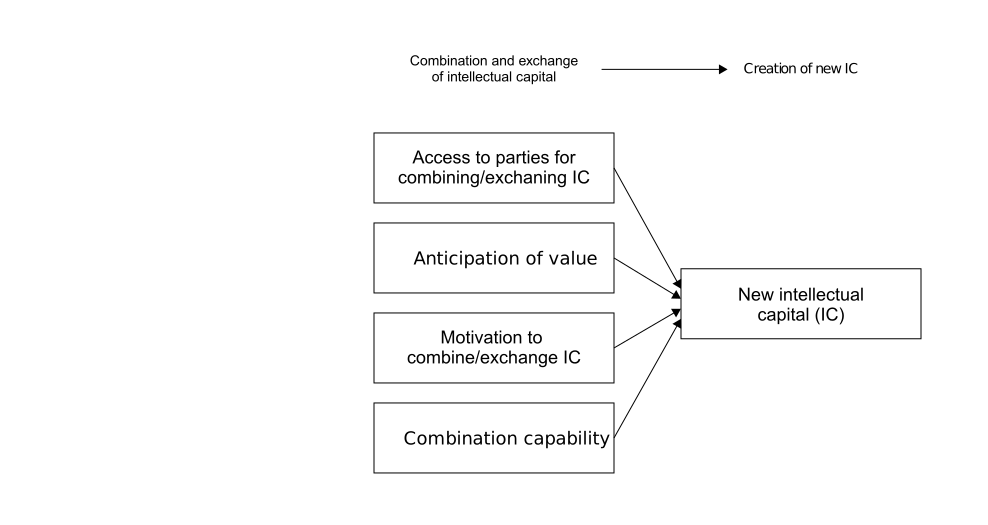
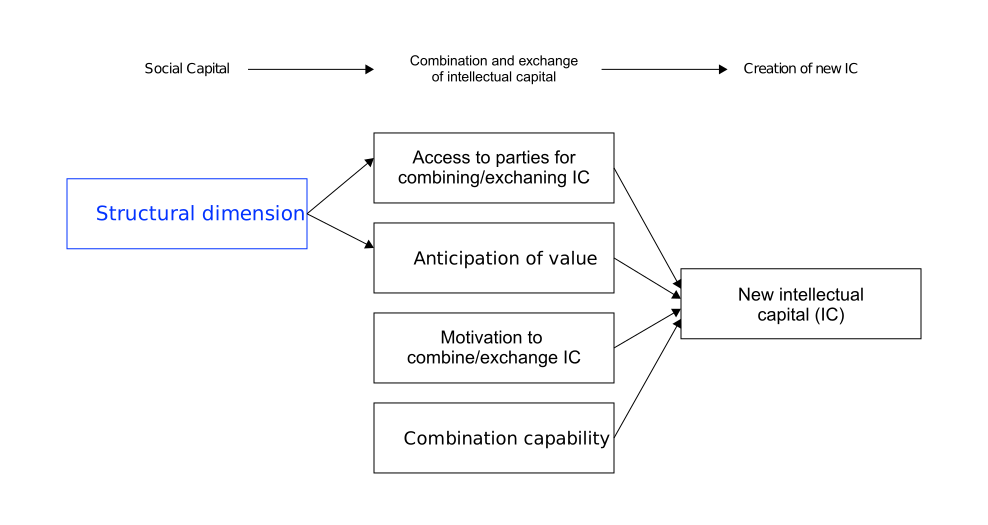
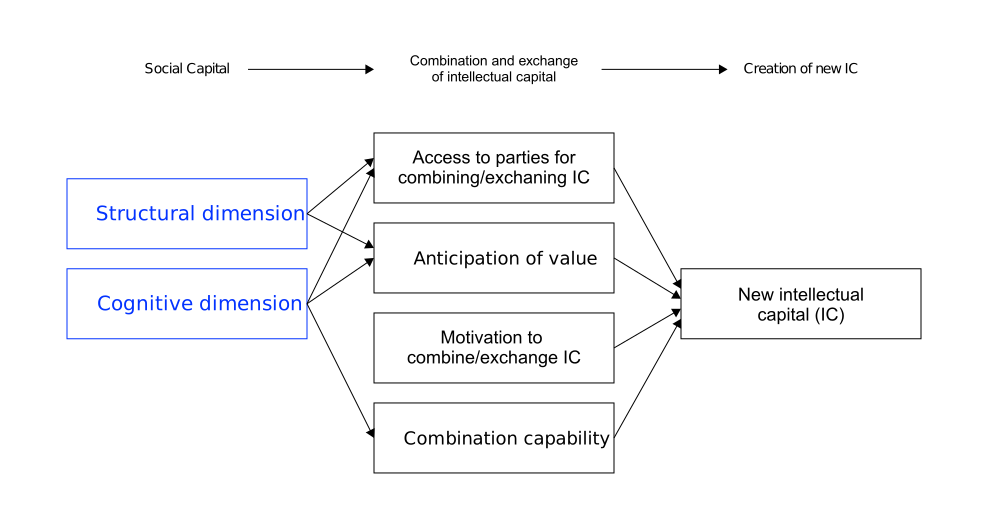
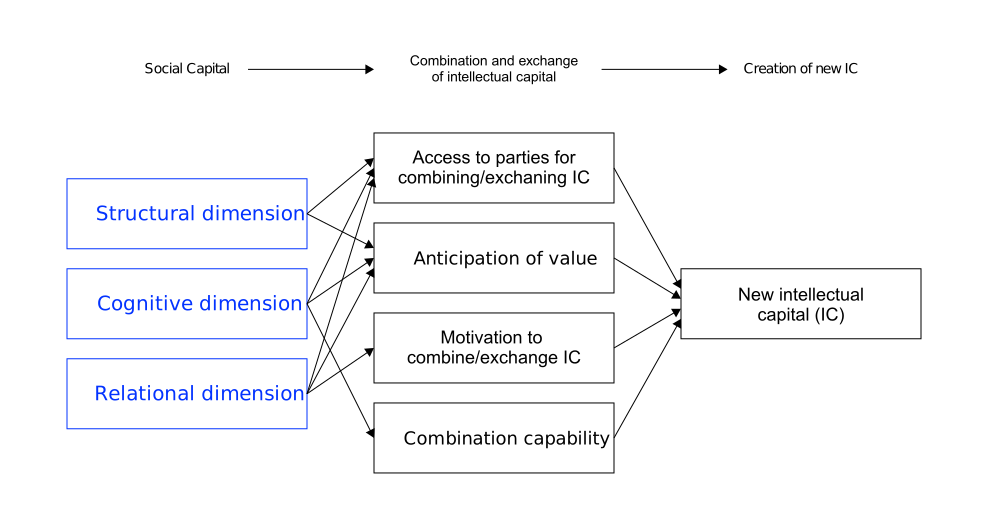
Exercise
Diagnose the social capital gap for a key player in the new study program launch.
Group in teams of 2 and distribute following roles:
- The proposer: plays the “Lead Professor” trying to get the Digital Leadership Master’s approved.
- The consultant: Helps them analyze their relationship with a “blocker”.
The proposer explains their “blocker” problem.
The consultant uses the three social capital dimensions to find the weakest link.
06:00
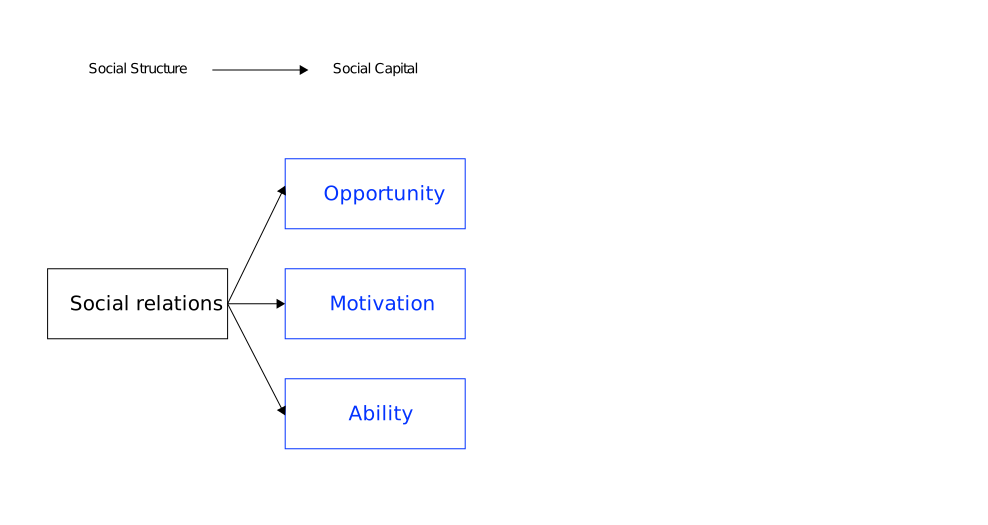
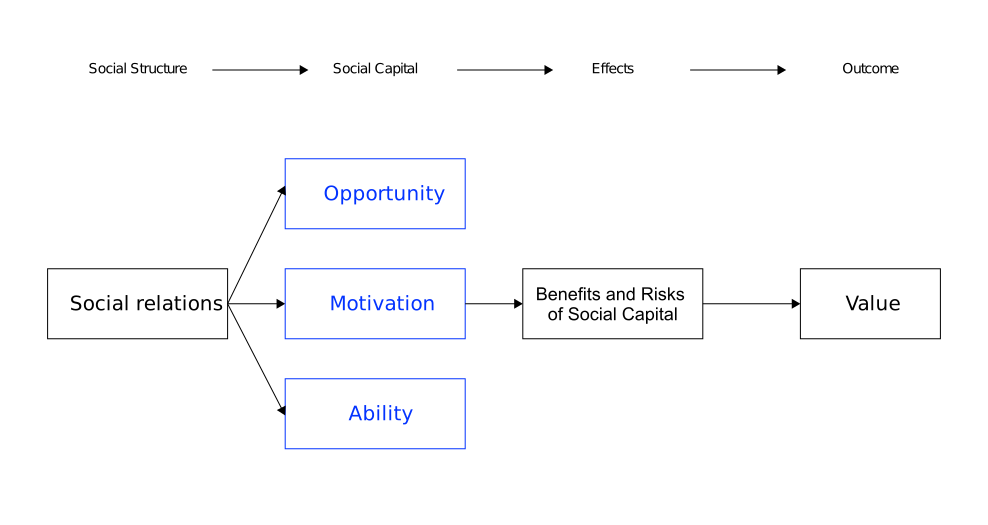
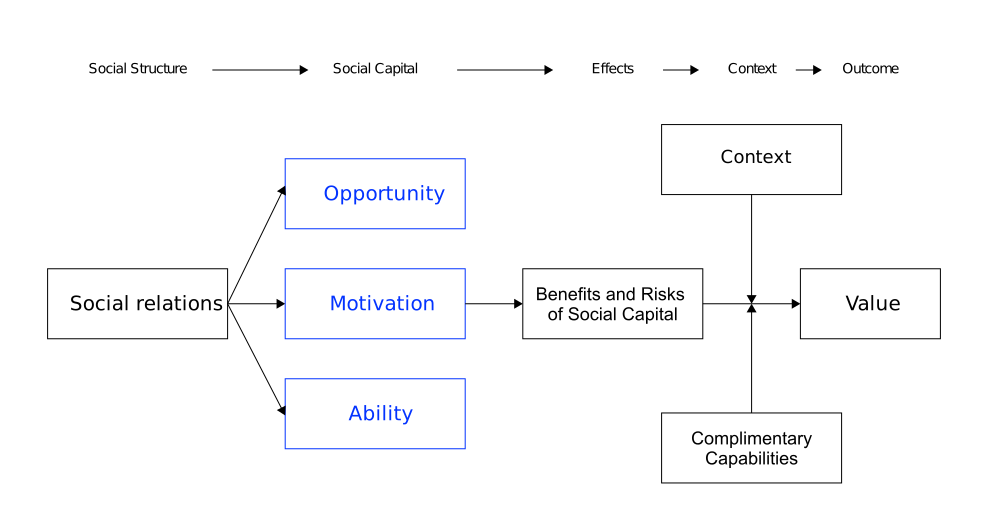
Opportunity, motivation, and ability
Stakeholder identification
Who is a stakeholder?
A stakeholder is any group or individual who can affect or is affected by the achievement of the organization’s objectives. Freeman (1984, p. 46)
This definition is deliberately broad. It forces leaders to look beyond the obvious (shareholders, employees, customers) to include all groups that have a stake in the organization’s actions and outcomes.
Stakeholder salience
Not all stakeholders are equally important at any given time. Mitchell et al. (1997) proposed the stakeholder salience model based on three attributes:
- Power: the stakeholder’s ability to influence the organization (coercive, utilitarian, or normative)
- Legitimacy: the perceived appropriateness of the stakeholder’s claim or relationship
- Urgency: the degree to which the stakeholder’s claim demands immediate attention (time-sensitivity and criticality)
The 2×2 matrix
A complementary tool to the salience model: map stakeholders on interest (how much they care) × influence (how much they can affect outcomes):
| Low influence | High influence | |
|---|---|---|
| High interest1 | Keep informed — regular updates, transparent communication | Manage closely — active engagement, involve in decisions |
| Low interest | Monitor — minimal effort, watch for changes | Keep satisfied — address concerns proactively, don’t overwhelm |
Exercise
Apply salience analysis to a digital transformation scenario.
Scenario: Your company is implementing AI-driven customer service in a bank.
- Identify at least 6 stakeholders
- Assess each stakeholder’s power and interest (legitimacy and urgency)
- Classify each using the salience model (dormant, discretionary, demanding, dominant, dangerous, dependent, or definitive)
- Map them on the interest-influence matrix
10:00
Matching engagement to salience
The engagement level should match the stakeholder’s salience:
Higher engagement needed
- Definitive stakeholders (all three attributes)
- Stakeholders with veto power
- Groups whose buy-in is critical for implementation
- Internal champions and change agents
Lower engagement sufficient
- Dormant stakeholders (power only)
- Discretionary stakeholders (legitimacy only)
- Groups with low interest and low influence
- Stakeholders who are adequately represented by others
Beyond the 2×2 map
Static stakeholder maps are useful starting points, but they miss the network dynamics that often determine outcomes.
Key question: “Who connects whom? Where are the bridges and bottlenecks?”
Using social capital concepts to analyze stakeholder networks:
- Centrality: which stakeholders are most connected? They are likely the most influential, even if they lack formal authority
- Structural holes: where are the gaps between stakeholder groups? Bridging these gaps creates opportunities for influence
- Clusters: which stakeholders form tight-knit groups? These clusters may act as blocks in coalition dynamics
Coalitions
Coalitions are a mechanism for achieving change without unilateral authority.
A coalition is a temporary alliance of stakeholders who share a common interest or goal and pool their resources to achieve it (Murnighan, 1978).
Key principles of coalition building:
- Identify potential allies and blockers using the stakeholder map — who shares your objectives? Who opposes them? Who is undecided?
- Start with easy wins: build momentum by first engaging stakeholders who are predisposed to support you
- Sequence carefully: each new ally makes the next one easier to recruit (Lax & Sebenius, 2006). Build a critical mass of support before approaching skeptics.
- Use reciprocity as currency: coalitions run on mutual benefit. Understand what each ally needs and find ways to create value for them (connecting to social capital’s relational dimension).
Exercise
Design a complete stakeholder engagement strategy.
Get back to our scenario: Your company is implementing AI-driven customer service in a bank.
- Propose engagement strategies per stakeholder group.
- Design a coalition-building sequence — who do you engage first? Through whom?
08:00
Latticework update
New models added to your latticework:
- Stakeholder salience (power × legitimacy × urgency)
- Engagement spectrum as situational tool
- Coalition logic and second-order stakeholder effects
Homework
Reflect on your own cultural background and how it shapes your leadership assumptions:
- What cultural values (e.g., from Hofstede’s dimensions) are most prominent in your context?
- Have you experienced a situation where cultural differences affected leadership or teamwork?
- What ethical principles guide your approach to leadership?
Reflection & closing
Closing quote
The core intuition guiding social capital research is that the goodwill that others have toward us is a valuable resource (Adler & Kwon, 2002).
Q&A
Literature
Footnotes
People are “interested” because they have a valid claim (legitimacy) or a time-sensitive need (urgency).
Social capital theory